
Published: October 2026
Author: Amergin Consulting Ltd.
Target Audience: Business Owners, Small Business Seeking Financial Stability, Entrepreneurs, Start-Ups, Irish SMEs
Book a meeting: https://calendly.com/amergin-group_free/30min-finance-consultation
The end of the financial year is an opportunity to look beyond the numbers and ask an important question:
Is your business in a stronger position today than it was twelve months ago?
For many Irish SMEs, an annual business review begins with revenue, profitability and year-end accounts. These figures are essential, but they do not always explain the full story.
A business may have achieved its sales targets while experiencing weaker cash flow. Another may have improved profitability but become increasingly dependent on a small number of customers. A growing company may have recruited successfully but discovered that its internal processes are struggling to keep pace.
These developments matter because financial performance is only one part of business health.
An effective annual business review connects financial results with operational performance, customer relationships, people, risks and strategic priorities.
More importantly, it turns those findings into decisions. At Amergin Consulting, we help Irish SMEs use financial reporting, budgeting, cash-flow forecasting and strategic business advisory to understand performance and plan their next steps.
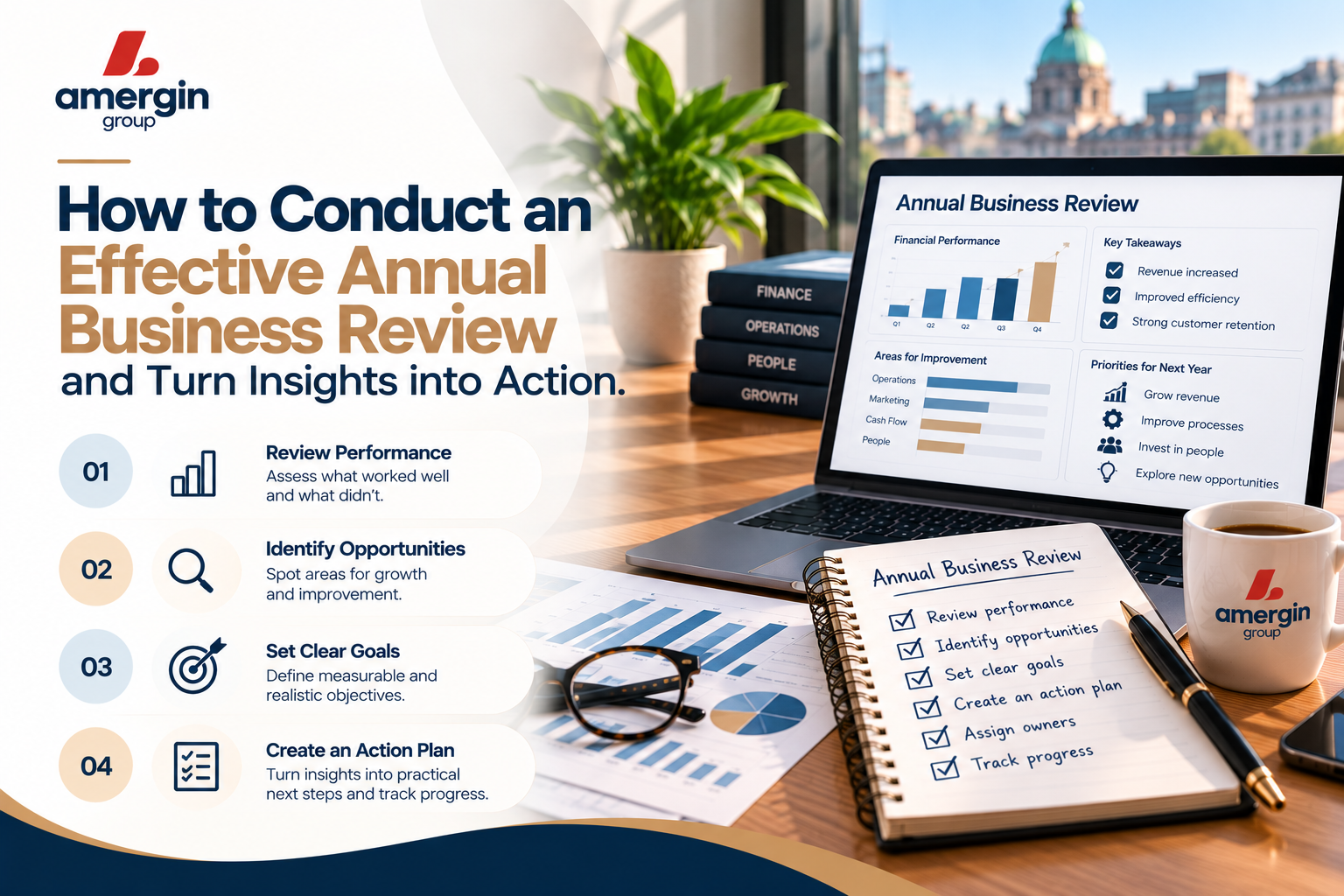
This guide explains how to conduct a structured annual business review, identify what matters most and create an actionable plan for the year ahead.
Why Every Irish SME Should Conduct an Annual Business Review
Running a business involves constant decisions.
Customers need attention, employees require support, suppliers must be paid and unexpected challenges can quickly change priorities.
As a result, business owners often spend most of their time managing immediate demands. An annual business review creates an opportunity to examine the bigger picture.
It helps management understand what worked, what underperformed, which assumptions proved incorrect and whether the business is progressing towards its longer-term objectives.
Consider an Irish professional services company that increases revenue by 18% during the year.
Management may initially view this as a strong result. However, further analysis reveals that payroll costs increased by 25%, debtor days deteriorated and operating profit remained relatively unchanged.
Revenue growth is positive, but the overall financial picture is more complicated.
Without a structured review, management might respond by pursuing further sales growth.
With better information, the company can focus on pricing, workforce productivity and customer payment performance. This illustrates why an annual review should go beyond celebrating achievements or identifying problems.
Its purpose is to help management understand the business more clearly and make better decisions about what happens next.
1. Start by Reviewing Your Original Business Objectives
Before examining the year's results, return to the objectives established at the beginning of the period.
What was the business trying to achieve?
Perhaps the company planned to increase revenue, improve profitability, recruit additional employees, reduce customer concentration or invest in new technology.
These objectives provide the context needed to assess performance. Without them, management may judge success based on whichever figures appear most positive.
Compare planned and actual outcomes
For each major objective, review the original target, the actual result and the reasons for any difference.
Example: Annual Business Objectives Review
| Business objective | Original target | Actual result | Management assessment |
|---|---|---|---|
| Revenue growth | 15% | 12% | Below target |
| Gross profit margin | 38% | 35% | Requires attention |
| Debtor days | 40 days | 55 days | Collections deteriorated |
| Employee retention | 90% | 93% | Above target |
| New customer acquisition | 20 customers | 24 customers | Above target |
Illustrative figures only.
This comparison helps management distinguish between areas where the business performed well and those requiring further investigation.
It also provides an opportunity to assess whether the original targets were realistic. A target may have been missed because of poor execution, but it may also have been based on assumptions that changed during the year.
What should Irish SMEs do?
Review each major objective and record whether it was achieved, partially achieved or missed. Focus on the reasons behind the result rather than the result alone.
2. Review Financial Performance Beyond Revenue
Financial performance should form a central part of the annual business review.
However, revenue growth alone is not enough. Management should assess profitability, operating expenses, cash generation and financial stability to understand whether the company has become stronger.
Revenue and sales performance
Begin by comparing annual revenue with the previous year and the approved budget. Investigate changes by customer, service line, product or business division.
For example, a construction company may discover that most of its revenue growth came from a small number of large projects. That information may raise questions about project profitability, customer concentration and future pipeline stability.
Gross profit margin
Gross profit margin shows how much revenue remains after direct costs.
A declining margin may indicate higher supplier costs, inefficient project delivery, pricing pressure or changes in the mix of products and services sold.
Operating profit
Operating profit helps management understand whether the company's core operations are becoming more efficient.
A business may increase revenue while generating little additional operating profit because overhead expenditure is rising too quickly.
Net profit
Net profit provides a broader picture after financing costs and tax. It helps management assess whether the business is generating sufficient returns to support its objectives.
Budget variance
Comparing actual financial performance with budgeted figures reveals where expectations differed from reality.
These differences should be investigated and used to improve future forecasts.
Amergin's article on the financial KPIs every Irish SME should track provides a practical framework for monitoring profitability, liquidity and operational efficiency.
What should Irish SMEs do?
Prepare a concise annual financial performance summary showing the previous year's results, current-year budget, actual results and significant variances.
The objective is to understand which financial changes require management action.
3. Assess Cash Flow and Working Capital
A business can be profitable and still experience cash-flow pressure. This is why an annual review should include a detailed assessment of how effectively the company converted trading activity into cash.
Review cash generation
Compare operating cash flow with accounting profit.
If the business generated strong profits but weak cash flow, investigate where the difference arose.
Possible explanations include increasing customer receivables, higher inventory levels, substantial tax payments or other working-capital movements.
Analyse debtor days
Debtor days measure how long customers take to pay outstanding invoices.
If debtor days increased during the year, the business may have more cash tied up in customer balances.
For example, a professional services company may have increased sales while experiencing slower customer collections. The business could therefore require additional working capital despite improved revenue.
Review supplier payments and inventory
Supplier payment patterns and inventory levels can also affect liquidity.
Excessive inventory may tie up cash, while consistently delayed supplier payments may indicate financial pressure or create commercial difficulties.
Assess cash-flow forecasting accuracy
Compare forecast cash balances with actual results.
Were cash shortages anticipated? Did customer payments arrive when expected? Were tax liabilities, payroll costs and other commitments accurately reflected?
The answers can help improve forecasting for the following year.
For further guidance, Amergin's article on strengthening liquidity and working capital explores practical approaches to improving cash visibility and managing financial commitments.
What should Irish SMEs do?
Review operating cash flow, debtor days, creditor days, inventory and forecast accuracy. Identify where cash became tied up and agree actions to improve liquidity.
4. Evaluate Customer and Commercial Performance
Financial results show what the business earned.
Customer and commercial analysis helps explain how those results were generated and whether they are sustainable.
Review customer profitability
Not every customer contributes equally to profitability.
A business may have customers generating substantial revenue but requiring significant service time, discounts or additional support.
Where possible, assess profitability by customer, project or service line.
This can help management identify which relationships are commercially valuable and which may require changes to pricing or delivery.
Assess customer concentration
A business generating a large proportion of revenue from one or two customers may face significant exposure if those relationships change.
For example, an Irish engineering company may depend on one customer for 40% of annual revenue.
Even if the relationship is strong, management should understand the financial consequences of losing that customer.
Review customer retention
Consider how many customers continued working with the business, how many were lost and why.
Customer feedback, service quality and recurring complaints may reveal issues that are not immediately visible in financial reports.
Evaluate the sales pipeline
A strong previous year does not guarantee future revenue.
Management should review the quality of the current sales pipeline, the likelihood of converting opportunities and the extent to which future revenue depends on a small number of contracts.
What should Irish SMEs do?
Identify the most profitable customers and services, investigate customer losses and assess whether the sales pipeline supports the next year's financial targets.
5. Review Operational Efficiency and Internal Processes
Operational performance has a direct effect on profitability, customer satisfaction and business capacity.
An annual review should examine whether the company's processes are supporting growth or creating unnecessary costs and delays.
Identify recurring operational problems
Consider where the business experienced delays, errors, duplicated work or unexpected costs.
For example, a construction company may discover that project margins were affected by inaccurate quotations or poor coordination between procurement and site teams.
A professional services company may find that manual approval processes delayed invoicing and customer collections.
These issues may appear operational, but their consequences are financial.
Review technology and automation
Assess whether existing systems remain appropriate for the size and complexity of the business.
A process that worked when the company employed five people may become inefficient when the workforce grows to twenty-five. Accounting software, payroll systems, project management tools and reporting processes should support accurate information and timely decisions.
Assess internal controls
Growth can increase the risk of errors, fraud and inconsistent processes.
Management should review approval procedures, payment controls, reconciliations, access permissions and financial reporting responsibilities.
Amergin's article on scaling financial controls with growth explores why internal processes need to evolve as businesses become larger and more complex.
What should Irish SMEs do? Identify the three operational problems that created the greatest cost, delay or disruption during the year. Assign responsibility for improving them.
6. Review People, Payroll and Workforce Capacity
Employees play a central role in business performance.
For many Irish SMEs, payroll also represents one of the largest operating expenses.
An effective annual review should therefore consider workforce capacity, employment costs, productivity and organisational resilience.
Review payroll costs
Compare total payroll expenditure with the previous year and the approved budget.
Investigate changes caused by recruitment, salary increases, overtime, employer contributions and other employment-related costs.
Where appropriate, monitor payroll costs as a percentage of revenue.
Assess workforce productivity
Consider whether staffing levels are aligned with business activity.
For professional services companies, this may involve reviewing utilisation, billable work and revenue per employee.
For manufacturing or construction businesses, the relevant measures may include output, project productivity and labour efficiency.
Identify skills gaps
Does the business have the capabilities required to achieve its next-stage objectives?
For example, a company planning to expand may need stronger financial management, project management or operational leadership.
Review key-person dependencies
Smaller businesses often depend heavily on individual employees.
If one person manages payroll, customer relationships or a critical operational process, their unexpected absence could create disruption.
Documenting procedures and developing backup arrangements can improve resilience.
What should Irish SMEs do?
Review employment costs, productivity, employee retention, skills requirements and key-person dependencies before approving the next year's recruitment plan.
7. Assess Business Risks and Financial Resilience
An annual business review should include a structured assessment of the risks that could affect future performance. These may include financial, operational, commercial, regulatory and technology-related risks.
Review the business risk register
A risk register provides a record of significant exposures, their potential consequences, existing controls and management responsibilities.
For example, an SME may identify risks involving customer concentration, supplier dependency, cybersecurity, cash-flow shortages or compliance obligations.
The annual review should assess whether those risks remain relevant and whether existing controls are working effectively.
Identify new risks
Changes in business activity may create new exposures.
A company expanding into a new market may face different commercial and operational risks.
A business investing in new technology may become more dependent on external software providers.
A growing workforce may require more structured payroll and employment compliance processes.
Connect risks with financial forecasts
Where risks could materially affect profitability or liquidity, management should assess the potential financial consequences.
Amergin's guide to building and maintaining a business risk register explains how SMEs can identify, assess and manage their most significant exposures.
What should Irish SMEs do?
Review the highest-priority risks, update ownership and controls, and identify which exposures should be reflected in the next year's financial forecasts.
8. Evaluate Strategic Progress
An annual business review should also assess whether the company is moving towards its longer-term objectives.
This requires management to look beyond day-to-day financial performance.
Consider the strategic decisions made during the year.
Did the business enter new markets?
Introduce new services?
Invest in technology?
Recruit senior employees?
Improve its competitive position?
The review should assess whether those decisions produced the expected results.
Example: Reviewing an investment decision
An Irish SME invested €100,000 in new equipment to improve production efficiency.
The original business case anticipated lower operating costs and increased capacity.
At year-end, management should compare actual benefits with those assumptions.
Did production output improve?
Were labour or maintenance costs reduced?
Did the investment generate the expected financial return?
If not, what prevented the anticipated benefits from materialising?
The purpose is not to judge decisions solely with hindsight.
It is to understand what the business learned and how future decisions can improve.
What should Irish SMEs do?
Review major strategic initiatives and investments against their original objectives, financial assumptions and actual outcomes.
Identify which initiatives should continue, change or stop.
9. Use Scenario Planning to Prepare for the Year Ahead
Historical performance provides a starting point for planning.
However, the next year may develop differently. Customer demand may change, costs may increase, projects may be delayed or new opportunities may emerge.
Scenario planning helps management understand how different outcomes could affect the business.
Build three practical scenarios
A useful approach is to prepare:
Expected scenario: Performance based on the most realistic current assumptions.
Upside scenario: Stronger demand, improved margins or faster customer collections.
Downside scenario: Lower sales, higher costs, slower payments or operational disruption.
Each scenario should consider the impact on revenue, profitability, cash flow and financing requirements.
A practical example
An Irish SME expects revenue of €2 million next year.
Its downside scenario assumes revenue falls 10% below that expectation.
Management can then assess whether the business could continue meeting payroll, supplier and financing commitments.
The review may reveal that certain costs could be delayed or that additional cash reserves would be beneficial.
Amergin's article on scenario planning for Irish SMEs explains how businesses can prepare for uncertainty through financial modelling and practical contingency planning.
What should Irish SMEs do?
Develop realistic scenarios and identify the management actions that would be required if trading conditions differ from expectations.
10. Turn Findings Into a Practical Action Plan
This is the most important stage of the annual business review.
A review that identifies problems but produces no actions has limited value.
The findings should be translated into a manageable number of priorities with clear ownership, deadlines and measurable outcomes.
Example: Annual Business Review Action Plan
| Review finding | Agreed action | Responsible person | Target timing | Success measure |
|---|---|---|---|---|
| Debtor days increased | Strengthen collections and weekly debtor review | Finance Manager | First 30 days | Debtor days reduced towards target |
| Gross margin declined | Review pricing and project costs | Operations Manager | First 60 days | Improved project margins |
| Payroll costs exceeded budget | Review workforce capacity and productivity | Managing Director | First 60 days | Payroll aligned with forecast |
| Customer concentration increased | Develop new customer acquisition plan | Commercial Lead | First 90 days | Reduced reliance on largest customer |
| Cash forecasts were inaccurate | Introduce rolling 13-week forecast | Finance Manager | First 30 days | Improved forecast accuracy |
| Internal processes caused delays | Review approval and invoicing procedures | Operations Manager | First 90 days | Faster processing and fewer errors |
Illustrative management plan. Actions and deadlines should reflect the company's priorities and available resources.
Keep the action plan focused
Not every finding needs to become a major project.
For many SMEs, selecting three to five strategic priorities is more effective than creating a lengthy list that cannot realistically be delivered.
Each priority should have a clear owner, a specific action, a realistic deadline and a measurable outcome.
This creates accountability and makes progress easier to review.
11. Connect the Annual Review With Your 2027 Business Budget
For Irish SMEs completing their 2026 annual review, the findings should feed directly into the 2027 business budget and financial forecast.
The annual review explains what happened and why.
The budget translates those lessons into financial expectations for the next period.
For example, if the review identifies declining gross margins, the new budget should reflect realistic pricing and cost assumptions.
If customer payment periods increased, the cash-flow forecast should account for actual collection behaviour.
If recruitment costs exceeded expectations, workforce plans should be reassessed before new employment commitments are made.
This helps ensure that the next budget is grounded in evidence rather than optimistic assumptions.
Amergin's guide to preparing your 2027 business budget explains how businesses can connect financial targets, cash requirements and strategic priorities within a structured planning process.
What should Irish SMEs do?
Use the annual review findings to update revenue assumptions, cost budgets, payroll plans, capital expenditure and cash-flow forecasts.
The next year's financial plan should reflect the lessons learned from the previous year.
12. Establish a Quarterly Follow-Up Process
An annual review should not be the only time management evaluates business performance.
Once priorities have been agreed, progress should be monitored throughout the year.
A quarterly review provides an opportunity to assess whether actions are being completed and whether the business is moving towards its objectives.
Questions for each quarterly review
Management should consider whether revenue and profitability are tracking against budget, whether cash-flow forecasts remain realistic and whether strategic initiatives are progressing.
It should also review overdue actions, emerging risks and changes in market conditions.
Where assumptions are no longer valid, management should update the plan.
For example, if the company expected a major customer contract to begin in March but the project is delayed until June, the financial forecast should reflect the revised timing.
The objective is not to change strategy every time performance fluctuates.
It is to maintain enough flexibility to respond when circumstances materially change.
What should Irish SMEs do?
Schedule quarterly management reviews at the beginning of the year and connect them with monthly financial reporting and KPI dashboards.
A Practical Example: Turning an Annual Review Into Better Decisions
Consider a hypothetical Irish SME providing engineering and technical services.
The company generates €2.5 million in annual revenue and employs 22 people.
Revenue increased by 14% during the year, and management initially considers the performance successful.
However, the annual review reveals several concerns.
Gross profit margin declined from 36% to 31%.
Debtor days increased from 42 to 63 days.
Payroll expenditure rose faster than revenue.
The business also became more dependent on two large customers.
What the review reveals
The company is growing, but its financial resilience is weakening.
Several new contracts were priced aggressively, reducing margins.
Additional employees were recruited before the expected workload fully materialised.
Meanwhile, slower customer payments increased working-capital requirements.
What management decides
Rather than focusing exclusively on winning more work, the leadership team agrees on four priorities.
First, project pricing and cost estimation will be reviewed.
Second, the finance team will introduce weekly debtor reporting and a rolling cash-flow forecast.
Third, workforce capacity will be assessed before further recruitment.
Fourth, the commercial team will focus on diversifying the customer base.
Each priority receives an owner, a deadline and a measurable outcome.
What changes
The company now has a clearer understanding of the relationship between revenue growth, profitability, cash flow and operational capacity.
Its 2027 budget can be built around more realistic assumptions.
Management also has a practical framework for monitoring whether corrective actions are producing results.
The annual review has moved beyond financial reporting.
It has become a tool for better business management.
Common Annual Business Review Mistakes to Avoid
One common mistake is focusing entirely on financial results without examining the operational and commercial factors behind them.
Another is treating the review as an exercise in explaining past performance rather than preparing for future decisions.
Businesses may also spend too much time collecting information and too little time identifying priorities.
A detailed report is not necessarily a useful report. If management finishes the process with twenty recommendations but no clear ownership, the review is unlikely to produce meaningful change.
Another mistake is relying on incomplete or inconsistent financial information.
Management accounts, payroll reports, customer balances and budget comparisons should be sufficiently reliable to support decisions.
Finally, an annual review loses value when the findings are not revisited.
The strongest process connects the annual review with monthly financial reporting, quarterly management discussions and ongoing strategic planning.
How Amergin Helps Irish SMEs Conduct Effective Annual Business Reviews
At Amergin Consulting, we help Irish SMEs move beyond historical financial reporting and use business information to support better decisions.
Our approach combines Accounting, Payroll, Taxation, management reporting, budgeting, cash-flow forecasting, financial planning and Fractional CFO services.
We can support businesses in reviewing financial performance, analysing profitability and working capital, identifying cost pressures and assessing the financial implications of operational and strategic decisions.
We also help management teams develop practical financial dashboards, strengthen forecasts and connect annual review findings with business budgets and action plans.
For owner-managed businesses, this process can provide greater clarity around recruitment, investment, financing, tax planning and long-term growth objectives.
The goal is not simply to produce another year-end report.
It is to help business owners understand where the company stands, what needs to improve and which actions should come next.
The Deeper Truth: An Annual Review Is Only Valuable If Something Changes
An annual business review can reveal a great deal about a company.
It may show that certain customers are less profitable than expected. It may identify processes that create unnecessary costs. It may reveal that the business is growing faster than its cash flow can support.
Or it may confirm that previous investments and strategic decisions are delivering strong results.
But insight alone does not improve performance.
Improvement comes when management uses that information to make decisions, allocate resources and change how the business operates.
That is why an effective annual review should always end with a practical action plan. The most valuable outcome is not a comprehensive presentation of the previous year's performance.
It is a shared understanding of what the business should do differently.
The Takeaway: Review the Past, Improve the Future
For Irish SMEs, an annual business review is an opportunity to assess financial performance, operational efficiency, customer relationships, workforce capacity, business risks and strategic progress.
The process should be structured but practical.
Begin with the original objectives. Review the financial results. Understand what drove performance. Identify the most significant risks and opportunities.
Then agree on a manageable number of priorities for the year ahead. Each priority should have a responsible owner, a deadline and a measurable outcome.
The findings should also inform the company's budget, cash-flow forecast and strategic plan.
Because the real value of an annual business review is not knowing what happened last year. It is using that knowledge to make better decisions next year.
About Amergin Consulting Ltd.
Amergin Consulting Ltd. is a Dublin-based chartered accountancy and business advisory firm supporting Irish SMEs and growth companies across construction, technology, professional services and renewable energy.
We specialise in Accounting, Payroll, Taxation and CFO Services, helping businesses improve financial visibility, strengthen profitability, manage cash flow and plan for sustainable growth.
Is your business ready to turn this year's performance into a stronger plan for 2027?
Amergin can help you review your financial performance, identify the priorities that matter and connect those insights with practical budgeting, forecasting and strategic planning.
Book your FREE 30-minute finance consultation:
https://calendly.com/amergin-group_free/30min-finance-consultation
Disclaimer
This article is provided for general informational purposes and does not constitute financial, tax, legal or investment advice.
Financial figures, business scenarios and management frameworks are illustrative. Appropriate performance measures, financial assumptions and business priorities will depend on each company's circumstances, sector and objectives.
Businesses should seek professional advice tailored to their circumstances before making significant financial or strategic decisions.
Sources and Resources
- Chartered Accountants Ireland — Financial reporting and business advisory resources.
- Enterprise Ireland — Business growth and strategic planning resources.
- Local Enterprise Office — Business planning and management guidance.
- Revenue Commissioners — Irish taxation and employer compliance information.
- Amergin Consulting Blog — Financial planning, budgeting, cash flow and business advisory insights.