
Published: October 2026
Author: Amergin Consulting Ltd.
Target Audience: Business Owners, Small Business Seeking Financial Stability, Entrepreneurs, Start-Ups, Irish SMEs
Book a meeting: https://calendly.com/amergin-group_free/30min-finance-consultation
Every business faces risk. A major customer may delay payment. A key employee might leave unexpectedly. A supplier could fail to deliver essential materials. A cyberattack may interrupt operations, or a compliance deadline could be missed during a particularly busy period.
For Irish SMEs, these events can have a significant impact. Smaller businesses often operate with limited financial reserves, lean management teams and fewer resources to absorb unexpected disruption.
Yet risk management is frequently treated as something reserved for larger organisations.
In reality, effective risk management does not require a complicated corporate framework. It requires a practical way to identify what could go wrong, understand the potential consequences and decide what to do about it.
One of the most useful tools for achieving this is a business risk register.
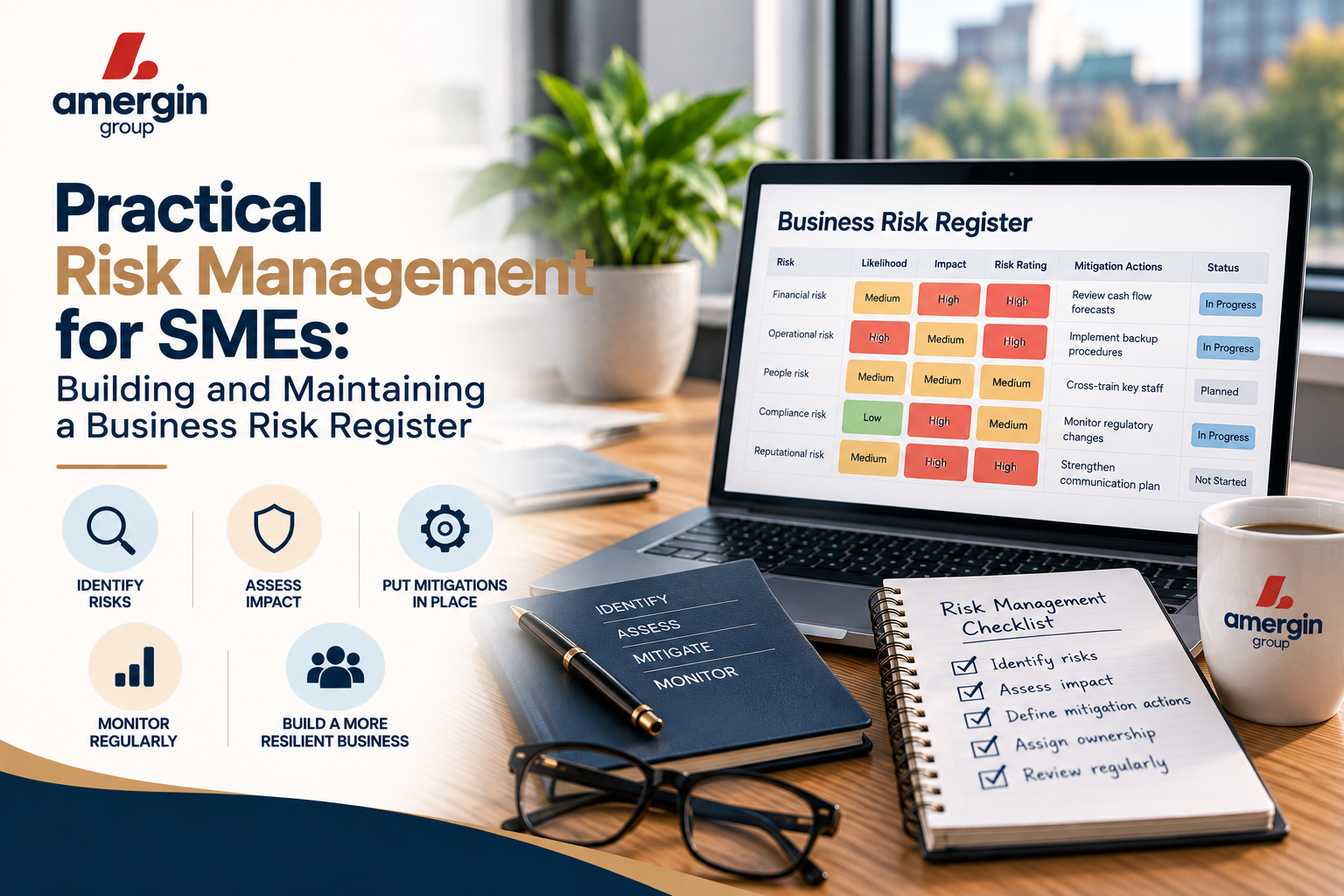
A risk register provides a structured record of the risks facing a company, their potential impact, the controls already in place and the actions required to reduce exposure.
More importantly, it creates accountability. Instead of relying on informal conversations or reacting when problems arise, management can review risks systematically and make informed decisions.
At Amergin Consulting, we help Irish SMEs strengthen financial visibility, improve business planning and connect risk management with cash-flow forecasting, budgeting, management reporting and strategic decision-making.
This guide explains how to build a practical business risk register, how to assess and prioritise risks, and how to maintain the register as part of everyday business management.
Why Risk Management Matters for Irish SMEs
Risk is a normal part of running a business.
Recruiting employees, accepting new customers, entering contracts, investing in equipment and expanding operations all involve uncertainty.
The objective of risk management is not to eliminate every possible problem. That would be unrealistic and could prevent businesses from pursuing worthwhile opportunities.
Instead, the objective is to understand which risks could materially affect the business and prepare proportionate responses.
Consider an Irish construction company that depends on one major supplier for essential materials.
The arrangement may work well for several years. However, if that supplier experiences financial difficulties or delivery delays, the company could face project disruption, additional costs and dissatisfied customers.
Without a structured risk review, management may not recognise the level of dependency until a problem occurs.
A risk register makes that exposure visible and encourages the company to consider alternatives before disruption takes place.
The same principle applies to customer concentration, cash-flow pressure, cybersecurity, payroll compliance and key employee dependencies.
Risk management becomes particularly valuable when connected with financial planning.
As explored in Amergin's article on scenario planning for Irish SMEs, businesses can strengthen resilience by considering how different outcomes may affect profitability, cash flow and operational capacity.
A risk register complements this process by identifying the events that deserve attention and assigning responsibility for managing them.
What Is a Business Risk Register?
A business risk register is a central record of the significant risks that could affect an organisation's operations, finances, compliance, reputation or strategic objectives.
It helps management answer five important questions:
- What could go wrong?
- How likely is it to happen?
- What would the consequences be?
- What are we already doing to manage it?
- Who is responsible for taking further action?
A practical risk register typically includes a description of each risk, its likelihood and impact, existing controls, an assigned owner, planned actions and a review date.
Some businesses also include a risk score, warning indicators and the level of risk remaining after controls are considered.
The register does not need to be complicated.
For many SMEs, a well-maintained spreadsheet is sufficient.
The value comes from the quality of the discussion and the actions taken, not from the sophistication of the software.
1. Start by Identifying the Risks That Matter Most
The first step is to identify the risks that could materially affect the company's ability to operate, remain compliant, generate cash and achieve its objectives.
A useful starting point is to review the business across several categories.
Financial risks
Financial risks include events that could affect profitability, liquidity or the company's ability to meet its obligations.
Examples include:
- A major customer failing to pay.
- Increasing debtor days.
- Unexpected supplier cost increases.
- Insufficient cash reserves.
- Higher borrowing costs.
- Revenue falling below forecast.
- Significant tax liabilities not reflected in cash-flow planning.
For example, an Irish SME may report strong revenue growth while experiencing pressure because customers take longer to pay.
The underlying risk is not simply lower cash balances. It is the possibility that delayed collections will prevent the business from meeting payroll, supplier or tax commitments.
Operational risks
Operational risks arise from the processes, systems, people and resources required to deliver products or services.
Examples include equipment failure, supplier disruption, project delays, inadequate quality control and dependence on individual employees.
A professional services company may rely heavily on one senior employee who manages several important customer relationships.
If that employee leaves unexpectedly, the business could experience disruption to service delivery and customer retention.
Identifying the risk creates an opportunity to improve documentation, cross-training and succession planning.
Compliance and regulatory risks
Irish businesses must manage obligations relating to taxation, employment, payroll, company reporting, data protection and industry-specific requirements.
Relevant areas may include Revenue filings, Companies Registration Office obligations, employment legislation, pension requirements and data protection.
For example, a company that relies on one individual to manage payroll and statutory deadlines may face a higher risk of errors or missed submissions if that person is unavailable.
A risk register can identify the dependency and record the need for documented procedures and appropriate backup arrangements.
Cybersecurity and technology risks
Technology supports many essential business activities, including accounting, payroll, banking, customer communication and document management.
Risks may include phishing attacks, ransomware, unauthorised access, data loss, system outages and inadequate backups.
For an SME, a successful cyberattack could interrupt operations and create financial, legal and reputational consequences.
Risk management should therefore consider access controls, employee awareness, backup arrangements, incident response procedures and dependence on external technology providers.
Strategic and commercial risks
Strategic risks concern developments that could affect the company's longer-term position.
These may include dependence on a small number of customers, changing market demand, increased competition, unsuccessful expansion or investment decisions based on unrealistic assumptions.
A business generating 45% of its revenue from one customer, for example, may be financially exposed if that relationship ends.
The customer relationship may be strong, but the concentration itself deserves management attention.
What should Irish SMEs do?
Begin with a structured discussion involving the business owner, finance lead and relevant operational managers.
Identify the risks most likely to affect cash flow, profitability, compliance, service delivery and business continuity.
The first register does not need to capture every imaginable risk. It should focus on those that could materially affect the business.
2. Write Clear Risk Descriptions
A useful risk register should describe risks clearly enough that management understands both the event and its potential consequences.
A vague description such as "cash-flow problems" provides limited information.
A stronger description would be:
"A major customer delays payment beyond agreed terms, creating insufficient cash to meet payroll and supplier commitments."
This explains the potential event and why it matters.
Another example might be:
"Failure of the primary payroll system delays employee payments and statutory payroll reporting."
Clear descriptions make it easier to identify appropriate controls and assign responsibility.
A practical approach
For each risk, describe the cause or event, followed by the potential consequence.
For example:
Risk event: A key supplier fails to deliver materials on time.
Potential consequence: Project delays, additional costs and customer dissatisfaction.
This level of detail is usually sufficient for an SME risk register.
Avoid descriptions that are so broad they cannot be managed or so detailed that the register becomes difficult to maintain.
3. Assess the Likelihood and Impact of Each Risk
Once the risks have been identified, management needs to determine which ones deserve the most attention.
A simple approach is to assess each risk using two factors:
Likelihood: How likely is the event to occur?
Impact: How serious would the consequences be if it happened?
For many SMEs, a five-point scoring system provides a practical starting point.
Example likelihood scale
| Score | Likelihood | Description |
|---|---|---|
| 1 | Rare | Unlikely under current circumstances |
| 2 | Unlikely | Possible, but not expected |
| 3 | Possible | Could reasonably occur |
| 4 | Likely | Expected to occur in some circumstances |
| 5 | Almost certain | Very likely without further intervention |
Example impact scale
| Score | Impact | Description |
|---|---|---|
| 1 | Insignificant | Minimal disruption or financial effect |
| 2 | Minor | Limited operational or financial impact |
| 3 | Moderate | Noticeable cost or disruption requiring management action |
| 4 | Major | Significant financial loss or interruption |
| 5 | Severe | Threat to business continuity or major legal, safety or financial consequences |
These definitions are illustrative. Each business should establish criteria appropriate to its size, activities and risk exposure.
For example, a €20,000 unexpected cost may be manageable for one company but create substantial financial pressure for another.
Calculating a risk score
A common method is:
Risk Score = Likelihood × Impact
If a risk has a likelihood score of 4 and an impact score of 5, its score is 20 out of 25.
This helps management compare risks consistently.
However, the score is a prioritisation tool rather than a precise prediction. Two risks with the same score may require different responses.
A low-likelihood event with severe consequences may still need urgent attention, particularly where employee safety, legal obligations or business continuity are involved.
4. Build a Practical Risk Register
After identifying and assessing the main risks, record them in a central register.
The format should be simple enough to review regularly.
Example: SME Business Risk Register
| Risk | Likelihood | Impact | Score | Risk owner | Proposed action |
|---|---|---|---|---|---|
| Major customer delays payment | 4 | 4 | 16 | Finance Manager | Weekly debtor review and cash forecast |
| Key employee leaves unexpectedly | 3 | 4 | 12 | Managing Director | Document processes and develop backup cover |
| Supplier disruption | 3 | 4 | 12 | Operations Manager | Identify alternative suppliers |
| Cybersecurity incident | 3 | 5 | 15 | IT Lead | Review access controls, backups and response plan |
| Payroll compliance error | 2 | 4 | 8 | Payroll Manager | Monthly reconciliations and secondary review |
| Revenue falls below forecast | 4 | 4 | 16 | Managing Director | Downside forecast and cost review |
| Equipment failure | 3 | 3 | 9 | Operations Manager | Preventive maintenance and contingency arrangements |
Illustrative example only. Scores should be based on the company's actual circumstances and agreed assessment criteria.
A working register should also record existing controls, outstanding actions, target completion dates, action status and the next review date.
These additional fields turn the register into a management tool rather than a static list.
5. Identify the Controls Already in Place
Before deciding what additional action is required, management should understand how each risk is currently being managed.
A control is a procedure, system or activity intended to prevent an event, reduce its likelihood or limit its consequences.
For example, an SME concerned about customer payment delays may already have credit checks, payment terms, monthly debtor reporting and a collection process.
These controls may reduce the risk, but they may not eliminate it.
Similarly, a business concerned about cybersecurity may already use multifactor authentication, data backups and restricted access to sensitive systems.
The next question is whether those controls are working effectively.
Assess control effectiveness
A control should not be considered effective simply because a policy exists.
Management should establish whether the process is being followed, whether responsibility is clear and whether the control is tested or reviewed.
For example, a company may have a documented backup procedure but never test whether its data can actually be restored.
The existence of the procedure provides some reassurance, but a successful restoration test provides stronger evidence that the control works.
What should Irish SMEs do?
Record the main existing controls for each significant risk and identify where gaps remain.
This helps avoid unnecessary duplication and ensures that additional actions address genuine weaknesses.
6. Understand Inherent Risk and Residual Risk
A useful risk register can distinguish between inherent risk and residual risk.
Inherent risk is the level of risk before considering existing controls.
Residual risk is the level of risk remaining after taking those controls into account.
Consider a company that depends heavily on digital systems to process customer orders.
A major technology outage could have a severe operational impact.
However, reliable backups, alternative communication methods and a tested business continuity plan may reduce the likely disruption.
The underlying exposure remains, but the controls can reduce the residual risk.
This distinction helps management understand whether existing arrangements provide sufficient protection.
It also prevents the business from assuming that a risk has disappeared simply because a control has been introduced.
For smaller businesses, a simple before-and-after assessment is often sufficient.
7. Prioritise Risks That Require Action
Not every risk requires the same level of management attention.
Some risks can be managed through existing procedures. Others require additional controls, investment or changes to business operations.
A practical register should identify which risks need immediate attention, which require planned improvements and which can be monitored through normal management processes.
The company should establish its own thresholds for prioritisation.
For example, management may decide that risks with scores above a defined level require a formal action plan and more frequent review.
However, numerical thresholds should not override judgement. A potential legal breach or serious health and safety issue may require action regardless of its numerical score.
Four common risk responses
Businesses generally have four options when deciding how to respond to a risk.
Avoid: Stop or change the activity creating the exposure.
Reduce: Introduce controls that lower the likelihood or impact.
Transfer or share: Use arrangements such as appropriate insurance or contractual allocation to transfer or share certain financial consequences, while recognising that responsibility may remain.
Accept: Acknowledge and monitor the remaining risk where further action is not proportionate or practical.
The appropriate response depends on the nature of the risk, the potential consequences and the company's capacity to manage it.
For example, a business may accept a minor operational inconvenience but should not knowingly accept an unmanaged serious safety hazard or disregard a statutory obligation.
8. Assign a Risk Owner
One of the most common weaknesses in risk management is identifying a problem without deciding who is responsible for addressing it.
A risk register should assign an owner to every significant risk.
The owner is responsible for monitoring the exposure, reviewing controls, reporting changes and ensuring agreed actions are progressed.
For an SME, risk ownership may sit with the managing director, finance manager, operations manager, payroll lead or another appropriate person.
The owner does not necessarily have to perform every action personally.
For example, the finance manager may own the risk of poor cash collection while the accounts receivable team carries out daily credit-control activities. The important point is that responsibility is clear.
Set action deadlines
Each action should have a target completion date and a status. A statement such as "improve cybersecurity" is difficult to manage.
A more useful action would be:
"Introduce multifactor authentication for all relevant business accounts by the agreed implementation date." Specific actions make progress easier to monitor.
What should Irish SMEs do?
Ensure that every material risk has one accountable owner and that actions are reviewed at regular management meetings.
9. Connect the Risk Register to Cash-Flow Forecasting
Financial risk management becomes more useful when risks are translated into possible cash-flow consequences.
Consider an Irish SME with a major customer responsible for €40,000 in monthly receipts.
If that customer delays payment by two months, the company could experience a temporary €80,000 cash shortfall compared with its expected collection schedule.
The precise effect depends on existing receivables, payment patterns and other cash movements, but the example illustrates why customer concentration and collection risk deserve attention.
A risk register can identify the exposure. A cash-flow forecast can show when the financial pressure may occur.
Management can then consider actions such as improving collection procedures, adjusting expenditure timing or arranging appropriate working-capital facilities.
Amergin's guide to cash-flow strategies for strengthening liquidity and working capital explores how businesses can improve cash visibility and manage financial commitments.
What should Irish SMEs do?
For material financial risks, estimate the potential effect on cash and include relevant downside assumptions in the rolling cash-flow forecast.
This connects risk identification with practical financial decisions.
10. Use Scenario Planning to Test Major Risks
A risk register identifies potential events and assigns responsibility.
Scenario planning helps management understand how those events could affect financial performance.
The two tools work particularly well together.
For example, a business may identify the loss of a major customer as a significant commercial risk.
A downside scenario can then model the effect on revenue, gross margin, payroll capacity, working capital and cash reserves.
Management can use the results to identify the actions required if the customer relationship changes.
These might include delaying recruitment, reducing discretionary expenditure, diversifying the sales pipeline or arranging additional financing.
As explained in Amergin's guide to preparing for best-case, expected and downside outcomes, financial scenarios become more valuable when each outcome includes a clear management response.
What should Irish SMEs do?
Select the three to five risks with the greatest potential financial impact and assess how they would affect the company's forecast.
The objective is not to predict every event, but to understand the consequences and prepare appropriate responses.
11. Include Irish Compliance and Regulatory Risks
A business risk register should include the statutory obligations relevant to the company's activities.
For Irish SMEs, these may involve Revenue, the Companies Registration Office, employment and payroll obligations, data protection, workplace safety and sector-specific regulation.
The register should identify what could cause non-compliance, the possible consequences and the controls required to prevent it.
For example, a business may identify a risk that a key employee's absence could result in a missed statutory filing. Appropriate controls might include a compliance calendar, documented procedures and backup responsibility.
Health and safety obligations
Under Ireland's Safety, Health and Welfare at Work Act 2005, employers are required to assess workplace hazards and prepare a written Safety Statement.
A general business risk register can support management oversight, but it does not automatically replace the specific workplace risk assessments and Safety Statement required by law.
Data protection and cybersecurity
Businesses handling personal data should also consider the consequences of data breaches.
Under GDPR, certain personal data breaches must be reported to the Data Protection Commission within 72 hours of becoming aware of them, unless the breach is unlikely to result in a risk to individuals' rights and freedoms.
What should Irish SMEs do?
Include relevant compliance risks in the register, assign responsibility and establish clear escalation procedures.
Where specialist legal, safety, cybersecurity or regulatory expertise is required, obtain appropriate professional advice.
12. Establish Early Warning Indicators
A risk register becomes more valuable when management can identify signs that a risk is increasing.
These are often called Key Risk Indicators (KRIs).
While financial KPIs measure business performance, KRIs help identify potential threats to that performance.
For example:
| Business risk | Early warning indicator | Possible response |
|---|---|---|
| Cash-flow shortage | Forecast cash below minimum reserve | Review expenditure and collections |
| Customer payment delays | Debtor days increasing | Escalate overdue accounts |
| Customer concentration | One customer represents a growing share of revenue | Review diversification strategy |
| Supplier disruption | Delivery delays increasing | Activate alternative suppliers |
| Employee dependency | Critical processes handled by one person | Introduce backup cover |
| Project profitability | Actual margins below quoted margins | Review pricing and cost controls |
| Cybersecurity incident | Unusual access or security alerts | Investigate under incident response procedures |
These indicators should be linked to agreed management actions.
For example, a company might decide that if debtor days exceed 50, the finance manager will review overdue accounts and report corrective actions.
The specific threshold should reflect the company's actual payment terms and historical performance.
What should Irish SMEs do?
Select a small number of measurable indicators for the most significant risks.
Review them alongside management accounts and financial dashboards so that emerging problems are identified before they become more serious.
13. Review and Update the Risk Register Regularly
One of the most common mistakes businesses make is creating a risk register and then leaving it unchanged.
Risks evolve as the business grows.
New customers, suppliers, employees, technologies and operating arrangements can introduce exposures that did not previously exist.
Equally, risks that were once significant may become less important because controls have improved or circumstances have changed.
A risk register should therefore be treated as a living management document.
A practical review schedule
For many SMEs, the following approach provides a useful starting point:
- Monthly: Review high-priority risks, overdue actions and significant changes.
- Quarterly: Reassess the main risks, controls, scores and ownership.
- Annually: Complete a broader review of the risk framework and its connection to business strategy.
Additional reviews should take place after significant events, including major operational incidents, new contracts, acquisitions, changes in legislation or material changes to financial performance.
These are suggested management review intervals, not universal statutory deadlines. Specific regulatory risk assessments may have their own review requirements.
What should happen during a risk review?
Management should ask whether the risk remains relevant, whether its likelihood or impact has changed, whether controls are working and whether outstanding actions have been completed.
The review should also consider whether new risks have emerged.
A short, focused discussion at a monthly management meeting is often more effective than a lengthy annual exercise.
14. Avoid the Most Common Risk Register Mistakes
A risk register can lose its value when it becomes an administrative task rather than a management tool.
One common mistake is including too many low-priority risks. A register containing dozens of minor issues can make it difficult to identify the exposures that genuinely threaten the business.
Another is using vague descriptions that do not explain the potential event or consequence.
Businesses may also assign risk scores without considering the effectiveness of existing controls.
A risk may appear severe before controls are considered, but the remaining exposure could be substantially lower.
Conversely, management may underestimate a risk because a procedure exists without checking whether it is actually followed.
A further mistake is failing to assign ownership. If nobody is accountable for reviewing a risk or completing an action, the register is unlikely to produce meaningful improvements.
Finally, businesses should avoid treating the register as a substitute for specialist compliance processes.
A general risk register can help monitor statutory obligations, but it does not replace required health and safety assessments, data protection procedures or industry-specific controls.
The most effective registers are concise, regularly reviewed and directly connected to management decisions.
A Practical Example: Building a Risk Register for an Irish SME
Consider a hypothetical Irish engineering company generating €3 million in annual revenue.
The business employs 25 people and provides services to a combination of commercial and industrial customers.
Over the previous two years, the company has experienced steady growth and is considering investing in additional equipment.
However, a management review identifies several potential exposures.
One customer accounts for approximately 35% of annual revenue.
A key supplier provides essential components that are difficult to source quickly elsewhere.
The company also relies heavily on one experienced employee to coordinate production schedules.
Meanwhile, customer payment periods have increased, creating additional pressure on working capital.
Step 1: Identify the risks
Management records customer concentration, supplier dependency, key-person dependency and cash-flow pressure in the register.
Step 2: Assess likelihood and impact
Each risk is assessed using the company's agreed scoring system.
The customer concentration and cash-flow risks receive particular attention because of their potential financial consequences.
Step 3: Review existing controls
The company already maintains customer relationships, monitors outstanding invoices and has informal arrangements with alternative suppliers.
However, some controls are not documented, and there is limited backup cover for critical operational responsibilities.
Step 4: Agree actions
Management decides to strengthen customer diversification, identify alternative suppliers, document production processes and introduce a rolling 13-week cash-flow forecast.
Step 5: Assign ownership
The managing director takes responsibility for customer concentration, the operations manager for supplier and employee dependencies, and the finance manager for cash-flow risk.
Step 6: Monitor progress
The register is reviewed monthly alongside management accounts.
After several months, the company has improved process documentation, strengthened credit control and developed a clearer understanding of its financial exposure.
The business has not eliminated uncertainty.
However, it is better prepared to manage disruption and make informed investment decisions.
This is the practical value of maintaining a business risk register.
How Risk Management Supports Better Business Decisions
Risk management should not be separated from commercial decision-making.
Every major investment, recruitment plan, financing arrangement or expansion strategy introduces some degree of uncertainty.
A risk register helps management understand those exposures before committing resources.
For example, a business considering expansion into a new market may identify risks involving customer demand, payment terms, additional payroll costs and operational capacity.
The register can document these concerns and assign responsibility.
Financial forecasting can then estimate the potential consequences.
Management can use the combined information to decide whether to proceed, delay the investment, introduce additional controls or adjust the scale of the project.
This approach supports balanced decision-making.
The objective is not to avoid every risk, but to understand whether the potential return justifies the exposure and whether the business has sufficient financial and operational capacity to manage it.
How Amergin Helps Irish SMEs Strengthen Risk Management
At Amergin Consulting, we help Irish SMEs improve financial visibility and develop practical management processes that support business resilience.
Our approach combines Accounting, Payroll, Taxation, management reporting, cash-flow forecasting, budgeting, financial planning and Fractional CFO services.
We can help business owners identify financial and operational exposures, assess the potential consequences for profitability and liquidity, and connect risk management with financial forecasts and management reporting.
This may include reviewing customer concentration, working-capital pressure, payroll costs, financial controls, budget assumptions and investment decisions.
We also support businesses in developing management dashboards and financial reporting processes that help leadership teams identify emerging problems earlier.
Where risks require specialist legal, cybersecurity, health and safety or regulatory expertise, businesses should involve appropriately qualified professionals.
The objective is to make risk management part of everyday financial and operational decision-making rather than a separate administrative exercise.
The Deeper Truth: Risk Management Is About Preparedness, Not Fear
Risk management is sometimes viewed as a defensive activity.
It can appear to focus entirely on what might go wrong.
However, a well-maintained risk register can also give business owners greater confidence when pursuing opportunities.
A company that understands its cash-flow exposure can make more informed investment decisions.
A business that has identified supplier dependencies can develop more resilient purchasing arrangements.
An organisation with documented processes and clear responsibilities is better positioned to manage unexpected employee absences or operational disruption.
In each case, risk management creates greater visibility and supports better decisions.
It does not eliminate uncertainty.
It reduces the likelihood that uncertainty will catch the business unprepared.
The Takeaway: Make Risk Management Part of Normal Business Management
A business risk register is one of the most practical tools Irish SMEs can use to identify, assess and manage uncertainty.
It does not need to be complicated.
Start by identifying the risks that could materially affect cash flow, profitability, compliance, operations and business continuity.
Assess their likelihood and impact. Record existing controls. Assign responsibility. Agree practical actions and deadlines.
Then review the register regularly as the business changes.
For many SMEs, the greatest benefit comes from connecting the risk register with management accounts, financial KPIs, cash-flow forecasts and strategic planning.
The purpose is not to predict every problem. It is to make sure the business understands its most important risks and has a plan to respond.
Because stronger businesses are not necessarily those that face fewer risks.
They are the ones that manage their risks more effectively.
About Amergin Consulting Ltd.
Amergin Consulting Ltd. is a Dublin-based chartered accountancy and business advisory firm supporting Irish SMEs and growth companies across construction, technology, professional services and renewable energy.
We specialise in Accounting, Payroll, Taxation and CFO Services, helping businesses strengthen financial visibility, manage cash flow, improve profitability and plan for sustainable growth.
Do you know which risks could have the greatest financial impact on your business?
Amergin can help you review your financial exposures, strengthen management reporting and connect risk management with cash-flow forecasting, budgeting and strategic business planning.
Book your FREE 30-minute finance consultation:
https://calendly.com/amergin-group_free/30min-finance-consultation
Disclaimer
This article is provided for general informational purposes and does not constitute financial, legal, cybersecurity, health and safety or regulatory advice.
Risk scoring methods, register examples and management review schedules are illustrative. Businesses should adapt their risk management processes to their activities, circumstances and applicable legal obligations.
A general business risk register does not replace statutory risk assessments or other compliance requirements. Businesses should seek appropriate professional advice where specialist expertise is required.
Sources and Resources
- Health and Safety Authority – Safety Statements and Risk Assessments
- Health and Safety Authority – BeSMART Risk Assessment Tool
- National Cyber Security Centre – Guidance for SMEs
- Data Protection Commission – Personal Data Breach Notification
- Amergin Consulting Blog