
Published: July 2026
Author: Amergin Consulting Ltd.
Target Audience: Business Owners, Small Business Seeking Financial Stability, Entrepreneurs, Start-Ups, Irish SMEs
Book a meeting: https://calendly.com/amergin-group_free/30min-finance-consultation
Every successful business reaches a point where financial management becomes more complex than bookkeeping, compliance, and annual accounts.
In the early stages of growth, business owners are often deeply involved in every financial decision. They approve purchases, negotiate supplier agreements, monitor bank balances, speak directly with customers, and understand exactly how money flows through the business. Financial decisions are made quickly because the business is relatively simple and the owner has complete visibility.
As the business grows, however, that visibility begins to change.
Revenue increases, payroll expands, departments become more specialised, investment decisions become larger, and financial risks become more significant. Management is no longer focused solely on keeping accurate accounts or submitting tax returns. The business now requires financial leadership that helps guide strategic decisions, improve profitability, manage cashflow, and support sustainable growth.
This is the stage where many SMEs begin asking an important question:
Do we need a Chief Financial Officer (CFO)?
For many Irish SMEs, the answer is yes—but not necessarily on a full-time basis.
A Fractional CFO provides senior financial expertise on a flexible, part-time basis, giving businesses access to strategic financial leadership without the cost of employing a full-time executive. This model has become increasingly popular among growing SMEs because it delivers high-level financial planning, forecasting, business analysis, and strategic support while remaining commercially practical.
Amergin works with Irish SMEs and growing businesses that are transitioning from operational management to strategic financial leadership. Amergin positions itself as an integrated partner across accounting, payroll, finance, marketing, operations, and advisory. Through its Fractional CFO services, Amergin helps businesses move beyond compliance and reporting by providing the financial insight needed to improve profitability, strengthen cashflow, manage growth, and make better commercial decisions.
This article explores what a Fractional CFO does, the signs that your business may be ready for one, and how strategic financial leadership can help Irish SMEs scale with confidence.
Understanding the difference between accounting and financial leadership
Many business owners believe that if their accounts are accurate and taxes are filed on time, their financial management is complete.
Accurate bookkeeping, payroll processing, VAT returns, corporation tax compliance, and annual financial statements are all essential, but they answer a different question.
They explain what has already happened.
A CFO focuses on what happens next.
Financial leadership involves analysing performance, identifying opportunities, forecasting future results, assessing financial risk, improving profitability, managing working capital, supporting investment decisions, and helping leadership teams understand the financial implications of strategic choices.
In other words, accounting records the past.
A CFO helps shape the future. For many SMEs, this distinction becomes increasingly important as the business grows.
Growth often creates financial complexity before it creates financial structure
Business growth is exciting, but it also introduces challenges that many SMEs underestimate.
Additional employees mean larger payrolls and higher employer PRSI costs. More customers create higher transaction volumes, increased working capital requirements, and more complex cashflow management. Expansion into new markets often requires investment in technology, recruitment, marketing, and operational infrastructure.
At the same time, leadership decisions become more financially significant.
Should the business recruit additional staff?
Can it afford to invest in new premises?
How much working capital will growth require?
Is current pricing protecting profit margins?
Would external funding accelerate growth or create unnecessary risk?
These questions require strategic financial analysis rather than historical reporting.
A Fractional CFO provides the expertise needed to answer them.
One of the first signs is that the owner becomes the finance department
Many SME owners continue making every financial decision long after the business has outgrown that approach.
They approve every supplier payment, monitor cashflow personally, prepare budgets, negotiate with banks, analyse profitability, and attempt to interpret financial reports while simultaneously managing sales, operations, customer relationships, and business development.
This creates two problems. Firstly, the owner becomes a bottleneck. Secondly, important financial decisions often become reactive because there is limited time available for strategic analysis.
A Fractional CFO provides dedicated financial leadership, allowing business owners to focus on running and growing the business while ensuring that financial decisions remain informed by robust analysis.
Rather than replacing the owner, the CFO becomes a strategic partner.
Cashflow becomes harder to manage as businesses grow
Cashflow management is one of the most common reasons SMEs seek Fractional CFO support.
Revenue growth does not automatically improve liquidity.
In fact, rapid growth often increases pressure on working capital. More customers may mean larger debtor balances. Increased production requires additional inventory. Recruitment expands payroll commitments before customer payments are received.
Without structured financial forecasting, these pressures can quickly affect liquidity.
A Fractional CFO develops rolling cashflow forecasts, analyses working capital requirements, monitors debtor performance, reviews supplier payment strategies, and helps businesses ensure they have sufficient liquidity to support continued growth.
Strong cashflow management reduces financial stress and improves confidence in future planning.
Better forecasting supports better decisions
Growing businesses constantly face decisions involving uncertainty.
Should prices increase?
Is expansion financially sustainable?
Can additional employees be recruited?
What happens if sales slow unexpectedly?
Scenario planning and financial forecasting allow leadership teams to evaluate different outcomes before making significant commitments.
A Fractional CFO develops forecasts that incorporate revenue assumptions, payroll planning, tax liabilities, operating costs, capital expenditure, and cashflow projections.
These forecasts provide decision-makers with a clearer understanding of financial risk and opportunity.
Rather than relying on instinct alone, leadership makes decisions supported by evidence.
Profitability deserves deeper analysis
Many businesses monitor turnover closely but pay less attention to the quality of profit being generated.
A Fractional CFO helps businesses understand profitability at a much deeper level.
This includes analysing gross margins, customer profitability, product profitability, departmental performance, pricing strategies, labour costs, overhead allocation, and operational efficiency.
Businesses are often surprised to discover that some of their busiest customers generate relatively low margins, while smaller customer segments produce significantly stronger financial returns.
Understanding where profit is created allows businesses to focus investment where it delivers the greatest value.
Improving profitability is rarely about selling more.
It is often about understanding existing performance more clearly.
Financial reporting should support strategy
Monthly management accounts are valuable.
However, as businesses grow, leadership requires reporting that supports strategic decision-making rather than simply summarising historical transactions.
A Fractional CFO develops reporting frameworks that provide meaningful insight.
These often include:
- Cashflow forecasting.
- Budget versus actual analysis.
- Working capital reporting.
- Financial dashboards.
- Key performance indicators (KPIs).
- Payroll cost analysis.
- Margin reporting.
- Customer and project profitability.
- Scenario planning.
- Board reporting.
Good reporting answers important business questions before they are asked.
It helps leadership identify trends early, measure performance consistently, and respond proactively.
Funding and investment decisions require financial expertise
As businesses expand, many consider external finance to support growth.
Whether applying for bank finance, attracting investors, purchasing new equipment, or acquiring another business, financial preparation becomes critical.
Lenders and investors expect more than historical accounts.
They want robust financial forecasts, realistic cashflow projections, business plans, sensitivity analysis, and evidence that management understands the financial implications of future decisions.
A Fractional CFO helps prepare these materials while also evaluating whether proposed investments align with the long-term financial strategy of the business.
Access to experienced financial leadership can significantly improve the quality of funding discussions.
Risk management becomes increasingly important
Growth introduces opportunity, but it also increases exposure to financial risk.
Customer concentration, rising payroll costs, compliance obligations, tax liabilities, cyber security investment, inflation, interest rates, and supplier dependency all require ongoing attention.
A Fractional CFO helps businesses identify financial risks before they become operational problems.
Regular reviews of working capital, cashflow, pricing, financial controls, tax planning, payroll forecasting, and business performance create stronger resilience and support better long-term planning.
Managing risk proactively protects both profitability and business continuity.
Real-life example: financial leadership without full-time overhead
An Irish technology services company had grown steadily over several years.
Revenue exceeded €3 million, employee numbers increased rapidly, and management began exploring new market opportunities. The business had an excellent external accountant and an efficient payroll function, but leadership found it increasingly difficult to answer strategic financial questions.
Cashflow forecasting was inconsistent, pricing decisions were largely intuitive, profitability reporting was limited, and management meetings focused primarily on historical performance.
Rather than recruiting a full-time CFO, the business engaged Amergin's Fractional CFO service.
Amergin introduced rolling financial forecasts, integrated management dashboards, improved cashflow reporting, reviewed pricing strategy, strengthened budgeting processes, and developed board-level financial reporting.
Within months, management had significantly greater visibility into financial performance.
Investment decisions became more structured, working capital improved, and leadership gained confidence in planning future growth.
The business did not need a full-time executive.
It needed the right expertise at the right time.
When is the right time?
There is no single revenue figure that determines when a business should engage a Fractional CFO.
Instead, the decision depends on complexity.
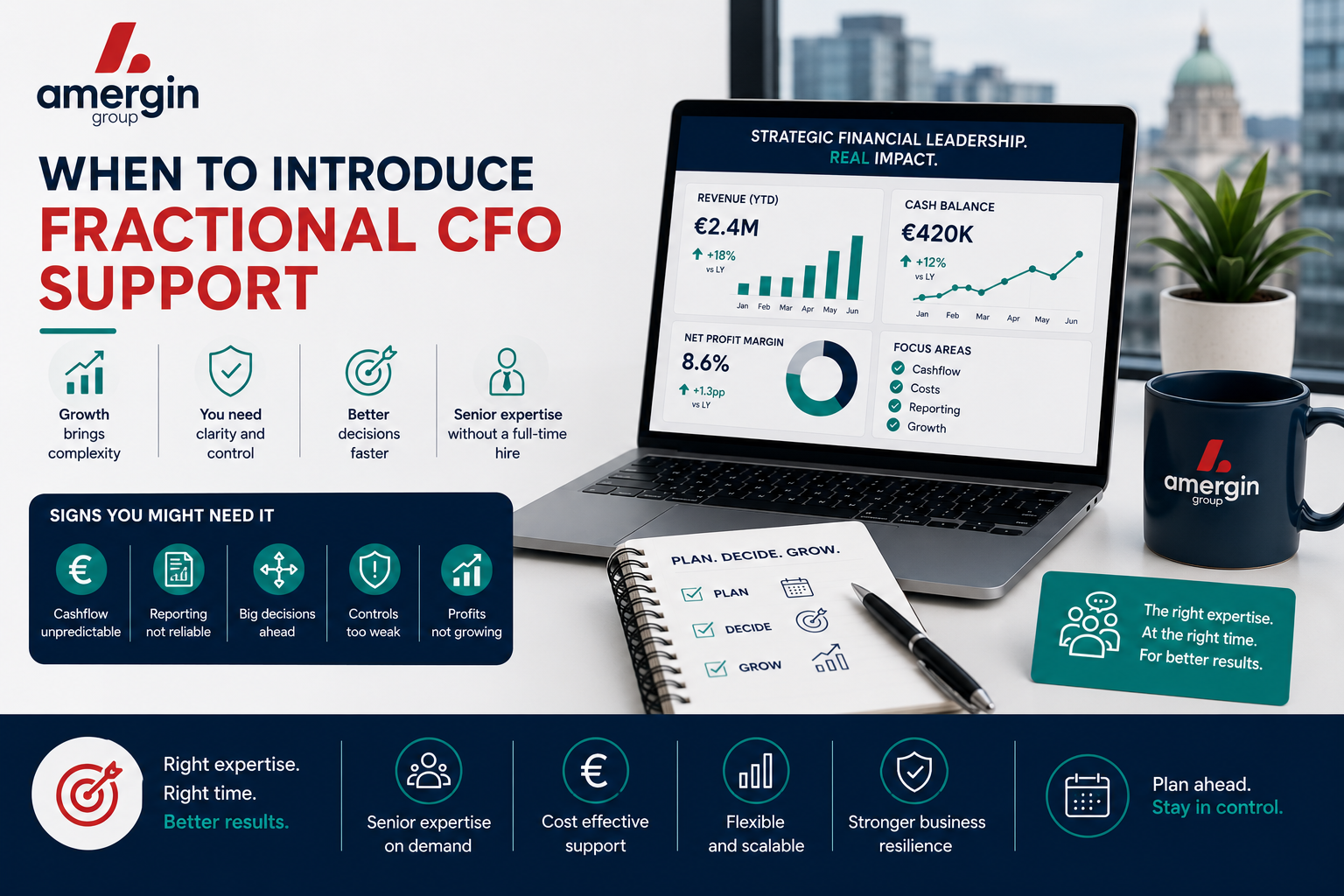
Your business may benefit from Fractional CFO support if:
- Growth is accelerating and financial decisions have become more complex.
- Cashflow forecasting is becoming increasingly difficult.
- You need stronger budgeting and financial planning.
- Payroll has grown significantly.
- Profitability is unclear despite increasing turnover.
- You are seeking funding or investment.
- Management reporting no longer supports strategic decisions.
- The owner remains responsible for most financial analysis.
- Expansion into new markets is being considered.
- Financial decisions increasingly affect long-term strategy.
When these situations begin to appear, strategic financial leadership often provides significantly greater value than simply producing more reports.
How Amergin helps businesses through Fractional CFO services
Amergin provides Fractional CFO services tailored to the needs of Irish SMEs.
This includes strategic financial planning, budgeting, rolling forecasts, cashflow forecasting, working capital management, pricing analysis, profitability reporting, board reporting, financial dashboards, payroll planning, tax planning, funding support, and business performance analysis.
By integrating accounting, payroll, finance, marketing, operations, and advisory services, Amergin delivers practical financial leadership that supports better commercial decisions across the entire organisation.
The focus is not simply on improving financial reporting. It is on improving business performance.
The deeper truth: businesses outgrow financial management before they realise it
Most SMEs do not suddenly require a CFO.
They gradually outgrow the financial systems that supported them in earlier stages of growth. Initially, these limitations appear manageable. Over time, however, forecasting becomes more difficult, decisions become more expensive, and financial complexity increases. The earlier businesses strengthen financial leadership, the easier sustainable growth becomes.
A Fractional CFO bridges the gap between operational management and executive financial strategy.
The takeaway
Fractional CFO support allows Irish SMEs to access experienced financial leadership without the cost of employing a full-time Chief Financial Officer.
As businesses grow, strategic financial planning becomes increasingly important. Cashflow forecasting, budgeting, profitability analysis, working capital management, pricing strategy, payroll planning, financial reporting, and business forecasting all contribute to stronger decision-making and sustainable growth.
By introducing Fractional CFO support at the right stage of growth, businesses gain greater financial visibility, improve resilience, strengthen profitability, and build the confidence to scale successfully.
The best time to bring in strategic financial leadership is not when problems arise.
It is when the business is growing quickly enough that better financial decisions will have the greatest long-term impact.
About Amergin Consulting Ltd.
Amergin Consulting Ltd. is a Dublin-based chartered accountancy and business advisory firm serving Ireland’s SMEs and growth companies across construction, technology, professional services, and renewable energy.
We specialise in Accounting, Payroll, Taxation, and CFO Services that help businesses build stronger foundations for profit and compliance.
Need help running a year-end tax review or planning your 2026 changes?
Amergin Consulting’s finance and tax team can help you identify deductions, forecast cash flow, and ensure full compliance before the year closes.
Book your 30-minute FREE consultation: https://calendly.com/amergin-group_free/30min-finance-consultation
Disclaimer
This article is for general informational purposes only and does not constitute financial or tax advice. While every effort has been made to ensure accuracy, legislation may change upon enactment of the Finance Act 2025.
Public should seek professional advice tailored to their specific circumstances before acting on any points discussed.
Sources and Resources
Amergin Consulting – Fractional CFO, Accounting and Financial Advisory Services for Irish SMEs
https://amergin.ie
Enterprise Ireland – Business Growth and Financial Planning Resources
https://www.enterprise-ireland.com
Local Enterprise Office (LEO) – Financial Management and SME Growth Supports
https://www.localenterprise.ie
Revenue Commissioners – Business Tax, Payroll and Financial Compliance
https://www.revenue.ie
Chartered Accountants Ireland – Financial Leadership and Business Advisory
https://www.charteredaccountants.ie
Institute of Directors Ireland – Corporate Governance and Financial Oversight
https://www.iodireland.ie
Harvard Business Review – CFO Strategy, Business Growth and Financial Leadership
https://hbr.org
MIT Sloan Management Review – Strategic Finance, Business Scaling and Executive Decision-Making
https://sloanreview.mit.edu