
Published: March 2026
Author: Amergin Consulting Ltd.
Target Audience: Business Owners, Small Business Seeking Financial Stability, Entrepreneurs, Start-Ups, Irish SMEs
Book a meeting: https://calendly.com/amergin-group_free/30min-finance-consultation
Payroll is often treated as an administrative function.
It runs in the background. It is expected to work. It is rarely discussed strategically unless something goes wrong. In many SMEs, payroll systems evolve informally. A process is set up early, adjustments are made over time, and the structure grows around immediate needs rather than long-term design.
When the business is small and stable, this may be sufficient.
However, as the business grows, complexity increases. More employees, varied contracts, bonuses, commissions, remote work arrangements, benefits, statutory obligations, and changing Revenue requirements all add layers of risk. What once felt manageable begins to strain.
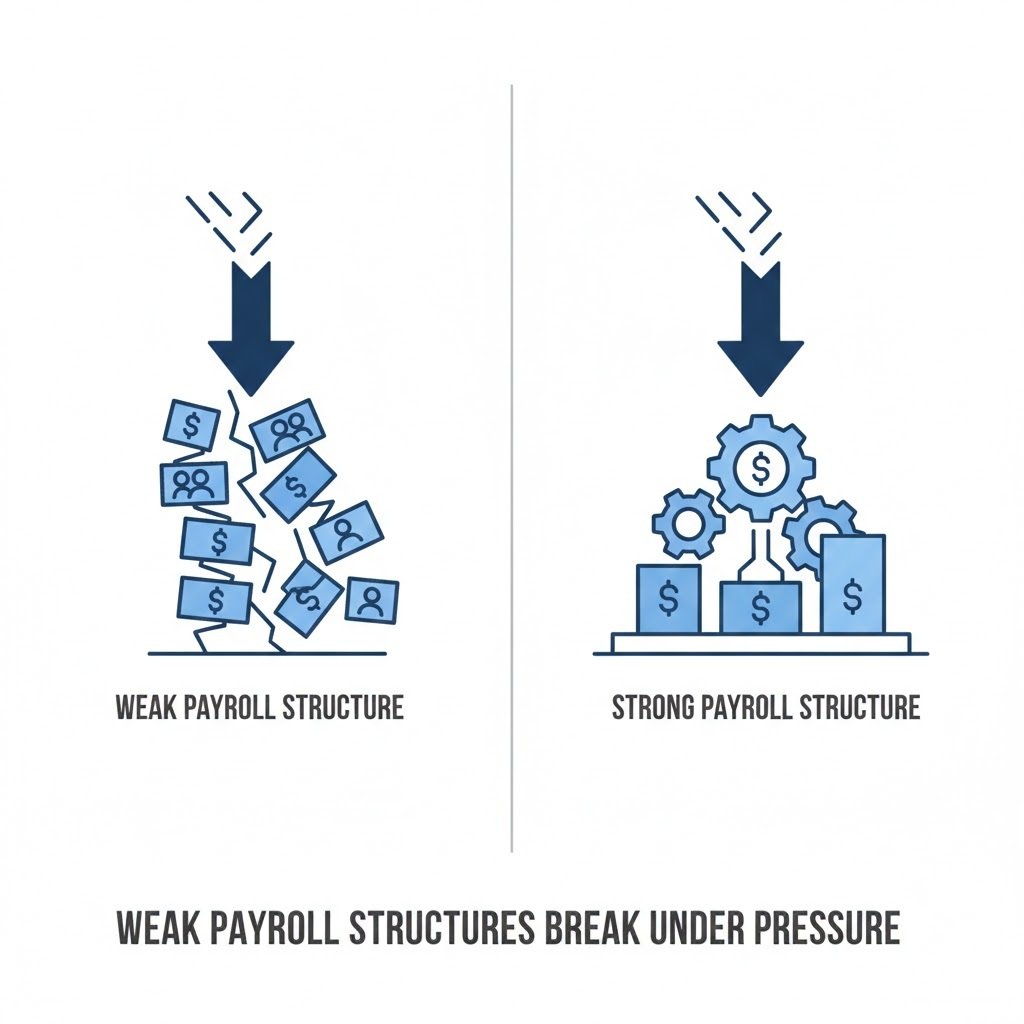
Weak payroll structures rarely fail during calm periods. They fail under pressure.
Amergin works with Irish SMEs and growing businesses that have experienced this tension first-hand. Amergin positions itself as an integrated partner across accounting, payroll, finance, marketing, operations, and advisory. That integration matters because payroll is not isolated from the wider financial system. It interacts directly with cashflow, compliance, hiring decisions, and employee trust.
This article explores why weak payroll structures create hidden risk, how they break under pressure, and how disciplined payroll design protects both people and performance.
Payroll is not just a transaction. It is a trust mechanism.
Payroll represents one of the most sensitive commitments a business makes.
Employees rely on timely, accurate payment. They expect correct deductions, compliance with PAYE requirements, and clear communication regarding benefits and entitlements. Payroll errors do not simply create accounting issues. They affect morale, trust, and credibility.
When payroll structures are weak, errors increase under strain. Late submissions, incorrect deductions, inconsistent bonus calculations, or confusion around leave and entitlements can damage internal confidence quickly.
Trust, once shaken, is difficult to restore.
A strong payroll structure does more than process payments. It reinforces organisational reliability.
Growth exposes structural weaknesses
Many SMEs begin with simple payroll processes managed manually or through basic software. When the team is small, oversight is straightforward. However, growth introduces complexity.
New hires may have different tax credits or pension arrangements. Variable compensation structures create additional calculation requirements. Remote work arrangements affect benefits and compliance. Overtime and commission tracking require accurate documentation.
If payroll systems were not designed intentionally, they become reactive. Adjustments are layered onto existing processes without re-evaluating structure. Over time, complexity increases faster than clarity.
Under pressure—such as rapid hiring, staff turnover, regulatory updates, or financial strain—these weaknesses surface.
Payroll errors multiply not because people are careless, but because the structure is fragile.
Cashflow pressure magnifies payroll risk
Payroll is one of the largest fixed financial commitments in most SMEs.
When cashflow visibility is weak, payroll becomes a point of anxiety. Founders may rely on incoming invoices arriving in time. They may assume VAT obligations will not conflict with payroll cycles. They may hesitate before hiring because they cannot clearly see affordability.
Amergin frequently highlights that many businesses fail due to poor cashflow rather than lack of profitability. Payroll sits directly at this intersection.
A weak payroll structure combined with weak cashflow forecasting creates disproportionate stress. If payroll runs are not integrated into rolling cashflow planning, small timing shifts can feel catastrophic.
Strong payroll systems align with structured cashflow models. They ensure commitments are visible in advance rather than managed reactively.
Compliance pressure exposes informal processes
In Ireland, payroll compliance is tightly regulated. Employers must operate PAYE correctly, submit payroll information through Revenue’s real-time reporting system, and maintain accurate records.
Weak payroll structures often rely heavily on individual knowledge rather than documented processes. If a key team member leaves, expertise leaves with them. If regulatory changes occur, updates may be applied inconsistently.
Revenue is clear that businesses are responsible for maintaining proper books and records and for accurate payroll submissions. Informal systems increase compliance risk, particularly under audit or during rapid growth.
Under pressure, gaps become visible.
A disciplined payroll structure includes documented procedures, role clarity, and integrated reporting that supports statutory obligations reliably.
Hiring without payroll discipline creates cultural strain
When hiring accelerates without strengthening payroll systems, small errors compound.
Incorrect tax treatment, inconsistent payslips, miscalculated holiday entitlements, or delayed updates can create frustration among staff. Even minor inaccuracies can lead to repeated queries and administrative overhead.
Beyond compliance, these issues affect perception. Employees interpret payroll reliability as a reflection of organisational maturity.
A business that struggles to manage payroll accurately may appear unstable, regardless of revenue performance.
Designed payroll discipline supports confident growth.
Real-life example: when pressure revealed fragility
An Irish SME experienced rapid growth over eighteen months. Revenue increased significantly, and headcount expanded quickly. Payroll had previously been managed internally using basic processes that worked well for a small team.
As hiring accelerated, payroll complexity increased. Variable commissions, pension contributions, and remote working arrangements added layers to the system. VAT exposure also grew due to higher turnover, creating additional cashflow pressure.
Under this combined strain, payroll errors began appearing. Payslips required corrections. PAYE submissions were occasionally delayed. Internal stress increased as leadership questioned the reliability of the system.
Amergin conducted a structured payroll review. Processes were formalised. Responsibilities were clarified. Payroll was integrated into rolling cashflow forecasting to align commitments with visibility. Documentation was standardised to ensure compliance consistency.
The result was not merely administrative improvement. Leadership stress reduced, employee confidence improved, growth felt stable again.
The issue had not been growth itself. It had been structural fragility under pressure.
Payroll discipline protects founders as well
Payroll stress often falls heavily on founders.
If systems are informal, founders remain involved in oversight. They double-check figures, approve corrections, and worry about compliance exposure. They carry the emotional weight of ensuring salaries are paid correctly and on time.
When payroll systems are robust, this vigilance is no longer necessary. Structured processes reduce the need for personal intervention. Visibility into payroll commitments integrates seamlessly into broader financial planning.
Financial discipline, in this context, protects leadership bandwidth.
Integration is stronger than isolation
Payroll cannot function in isolation from financial strategy.
A robust payroll structure connects to: Cashflow forecasting, Contribution and margin modelling, Hiring planning, Compliance documentation, Management reporting
When payroll operates separately from financial visibility, risk increases. When it is integrated into structured financial discipline, resilience improves.
Amergin’s integrated approach ensures payroll clarity is aligned with wider financial architecture, reducing pressure points before they emerge.
Simplicity creates reliability
Strong payroll systems do not require excessive complexity. They require clarity, consistency, and integration.
Clear documentation of processes
Defined responsibility for payroll oversight
Accurate, timely reporting aligned with Revenue requirements
Integration with cashflow planning
Regular review to ensure compliance updates are applied
Simplicity supports sustainability.
A payroll system that is understandable and well-documented will endure growth better than one built on ad hoc adjustments.
The deeper truth: payroll stability is cultural stability
Payroll is one of the most direct expressions of a business’s reliability.
Employees experience it monthly. Errors are felt immediately. Timeliness signals discipline. Accuracy signals professionalism.
Weak payroll structures under pressure damage more than numbers. They affect morale, trust, and confidence.
Strong payroll discipline reinforces stability. It protects relationships internally and externally.
The takeaway
Weak payroll structures do not fail quietly. They fail under pressure.
Growth, compliance changes, hiring acceleration, and cashflow strain all expose informal systems. When payroll is reactive rather than designed, stress multiplies quickly.
Financial discipline in payroll is not restrictive. It is protective.
It protects employees.
It protects founders.
It protects compliance.
It protects reputation.
The strongest businesses design payroll structures that absorb pressure rather than amplify it.
Because when payroll breaks, people feel it first.
About Amergin Consulting Ltd.
Amergin Consulting Ltd. is a Dublin-based chartered accountancy and business advisory firm serving Ireland’s SMEs and growth companies across construction, technology, professional services, and renewable energy.
We specialise in Accounting, Payroll, Taxation, and CFO Services that help businesses build stronger foundations for profit and compliance.
Need help running a year-end tax review or planning your 2026 changes?
Amergin Consulting’s finance and tax team can help you identify deductions, forecast cash flow, and ensure full compliance before the year closes.
Book your 30-minute consultation: https://calendly.com/amergin-group_free/30min-finance-consultation
Disclaimer
This article is for general informational purposes only and does not constitute financial or tax advice. While every effort has been made to ensure accuracy, legislation may change upon enactment of the Finance Act 2025.
Public should seek professional advice tailored to their specific circumstances before acting on any points discussed.
Sources and Resources
Amergin Consulting – Integrated Financial & Marketing Consulting for Irish SMEs and Growing Businesses
https://amergin.ie
Amergin Payroll Services – Payroll Processing and Compliance Support
https://amergin.ie
Revenue Commissioners – PAYE Modernisation and Employer Obligations
https://www.revenue.ie
Revenue Tax and Duty Manual Part 42-04-35 – Employer Obligations Under PAYE
https://www.revenue.ie
Companies Act 2014 (Ireland), Section 282 – Accounting Records
https://www.irishstatutebook.ie
Harvard Business Review – Operational Discipline and Organisational Stability
https://hbr.org
MIT Sloan Management Review – Organisational Resilience Under Growth Pressure
https://sloanreview.mit.edu