
Published: August 2026
Author: Amergin Consulting Ltd.
Target Audience: Business Owners, Small Business Seeking Financial Stability, Entrepreneurs, Start-Ups, Irish SMEs
Book a meeting: https://calendly.com/amergin-group_free/30min-finance-consultation
An annual budget gives a business direction, but it should never be treated as a fixed financial document that remains unchanged regardless of what happens during the year. Every budget is built on assumptions about revenue, costs, staffing, customer demand, pricing, investment, and market conditions. As the year progresses, some of those assumptions will prove accurate, while others may no longer reflect the actual trading performance of the business.
For Irish SMEs, relying on an outdated budget can create a false sense of security. Sales may be performing above expectations, but payroll, supplier costs, or working capital requirements may also be increasing faster than planned. Alternatively, revenue may be falling behind target while spending continues at the level approved at the beginning of the year. In both situations, the original budget becomes less useful because it no longer represents the financial reality of the organisation.
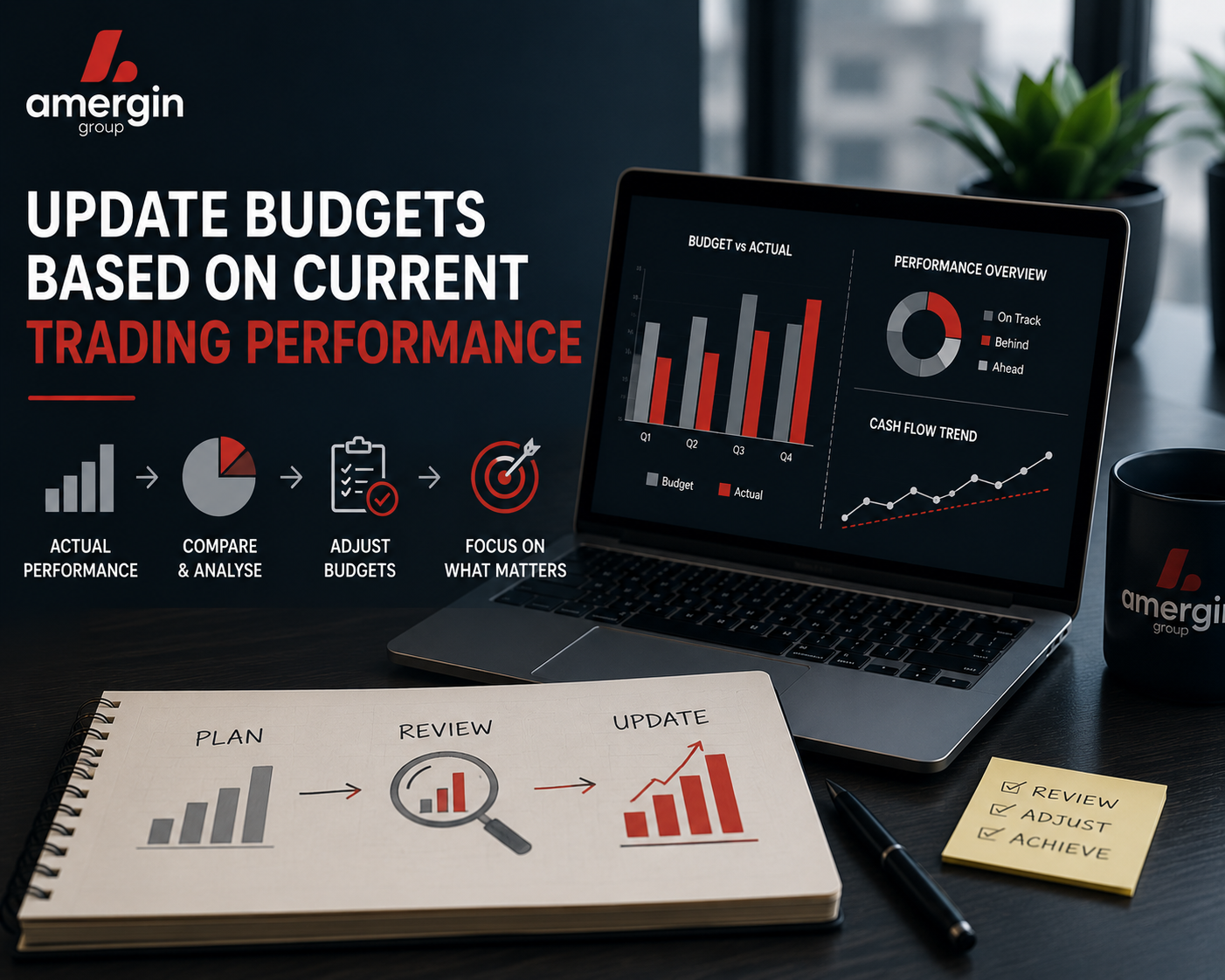
Updating budgets based on current trading performance allows business owners to make decisions using relevant information rather than historical assumptions. It helps leadership teams understand where the business stands today, what the remainder of the year is likely to look like, and which actions are required to protect profitability, cash flow, and long-term growth.
A revised budget does not mean the original plan has failed. It means the business is responding intelligently to new information. Strong financial management requires flexibility, and businesses that regularly review and update their budgets are generally better equipped to adapt to market changes, control costs, manage cash flow, and pursue new opportunities with confidence.
At Amergin, we help Irish SMEs improve budgeting, financial forecasting, cash flow management, management reporting, profitability analysis, working capital planning, payroll forecasting, and strategic decision-making. Through integrated accounting, payroll, finance, Fractional CFO services, operations, marketing, and business advisory, we support leadership teams in turning current financial data into practical plans for the months ahead.
This guide explains why businesses should update their budgets during the year, how to compare actual trading performance against financial targets, and how revised forecasts can strengthen profitability, liquidity, and sustainable business growth.
Why annual budgets become outdated
Every annual budget is based on assumptions. Management estimates future sales, supplier costs, payroll expenses, overheads, tax obligations, investment, and cash flow requirements based on the information available at the time. These assumptions create a useful starting point, but they cannot account perfectly for every development that may occur during the year.
Customer demand may be stronger or weaker than expected. Supplier prices may increase. Recruitment may happen earlier than planned. Projects may be delayed. New contracts may create additional revenue, while customer losses may reduce income. Inflation, regulation, competition, and wider economic conditions can all influence business performance in ways that were not fully anticipated when the budget was prepared.
When actual trading conditions change but the budget remains unchanged, financial reporting becomes less meaningful. Management may continue comparing performance against targets that are no longer realistic, creating confusion about whether the business is truly performing well or poorly.
Updating the budget ensures that financial planning remains connected to current business conditions. It replaces outdated assumptions with more realistic expectations and gives leadership a clearer basis for decision-making.
Compare actual trading performance against the original budget
The first step in updating a budget is to compare actual performance against the original financial plan. This review should go beyond total turnover and net profit. It should examine the specific areas of the business that are driving positive or negative variances.
Revenue should be reviewed by customer, product, service, project, or business unit to identify where trading performance differs from expectations. A business may be close to its total sales target while relying heavily on one customer or one low-margin service line. Without deeper analysis, management may overlook risks or assume that overall performance is stronger than it actually is.
Costs should also be reviewed in detail. Payroll, supplier expenditure, marketing, insurance, utilities, rent, technology, professional fees, travel, and operational expenses may all differ from the original budget. Some variances may be temporary, while others may represent permanent changes that should be reflected in the revised financial plan.
The objective is not simply to identify whether figures are above or below budget. Management should understand why the variance occurred, whether it is likely to continue, and what it means for the remainder of the year.
Reforecast revenue using current information
Revenue forecasts should be updated using current trading performance rather than relying on the targets established at the beginning of the year. This involves reviewing sales achieved to date, confirmed orders, recurring revenue, customer pipelines, contract renewals, seasonal trends, and known risks.
Businesses should be realistic when assessing future revenue. A strong first half of the year does not automatically guarantee that the same growth rate will continue. Equally, a slower start may not mean that annual targets are unachievable if confirmed projects or seasonal demand are expected later in the year.
Revenue forecasting should distinguish between confirmed income, highly probable opportunities, and more uncertain pipeline activity. Treating every potential sale as guaranteed can create an overly optimistic budget and lead to spending commitments that the business may later struggle to support.
A revised revenue forecast gives leadership a more accurate picture of future trading performance and helps ensure that cost, recruitment, investment, and cash flow decisions remain commercially sustainable.
Update cost assumptions before margins deteriorate
Operating costs rarely remain exactly as budgeted. Supplier pricing, payroll, employer PRSI, insurance, utilities, software subscriptions, transport, rent, and professional fees can all increase during the year.
If revenue forecasts are updated but cost assumptions remain unchanged, the revised budget will still provide an incomplete picture. Businesses should review every significant expenditure category and determine whether the original assumptions remain realistic.
A small increase in several cost areas can have a significant effect on profitability. Supplier prices may rise gradually, overtime may increase, software costs may expand as more employees are added, and operational inefficiencies may increase the cost of delivering products or services. Individually, these changes may appear manageable, but together they can reduce margins considerably.
Updating cost assumptions allows management to identify where expenditure needs to be controlled, renegotiated, or reflected in pricing. It also prevents the business from overestimating future profitability.
Review gross margin and net profitability
Revenue growth should always be assessed alongside profitability. A business can exceed its sales budget while generating less profit if costs have risen or if growth is concentrated in lower-margin work.
A revised budget should include updated gross margin and net profit expectations. Businesses should analyse whether current pricing covers the full cost of delivery, whether supplier increases have been passed on appropriately, and whether certain customers or service lines are weakening overall profitability.
Customer profitability, project profitability, and product margin analysis can provide valuable insight into where the business is creating or losing value. This is particularly important where management is considering increasing sales or investing further in areas that may not produce an acceptable financial return.
Updating profitability assumptions helps ensure that business growth remains financially worthwhile. The objective should not simply be to increase turnover, but to improve the quality and sustainability of earnings.
Align payroll budgets with current workforce plans
Payroll is one of the largest recurring costs for most Irish SMEs, making it essential to update workforce assumptions when revising a budget. Recruitment, salary increases, employer PRSI, pensions, overtime, bonuses, training, and employee benefits can all cause payroll expenditure to differ materially from the original plan.
Businesses should review whether planned recruitment is still required, whether existing staffing levels are sufficient, and whether changes in trading performance justify further workforce investment. Where sales are below budget, recruitment may need to be phased or delayed. Where growth is stronger than expected, additional staffing may be necessary to maintain service quality and operational capacity.
Payroll forecasting should include the full cost of employment rather than gross salaries alone. Equipment, software, onboarding, training, insurance, and employer taxes should all be reflected in the revised budget.
Aligning payroll planning with current trading performance helps businesses avoid committing to fixed costs that future revenue may not support.
Incorporate cash flow into the revised budget
A budget may show that the business will remain profitable while still failing to highlight periods of cash flow pressure. For this reason, updated budgeting should always be linked to cash flow forecasting.
Businesses should assess when revenue is expected to be collected, when supplier invoices will fall due, and how payroll, tax, loan repayments, rent, and capital expenditure will affect liquidity. Customer payment delays, seasonal trading patterns, inventory purchases, and tax obligations can all create gaps between reported profit and available cash.
A rolling cash flow forecast allows management to understand whether the revised budget is financially achievable. It shows whether the business has sufficient working capital to support planned activity and identifies months where additional liquidity may be required.
Linking budgeting and cash flow forecasting creates a more complete financial plan. It ensures that the business is not only profitable on paper but also able to meet its financial commitments as they arise.
Review working capital assumptions
Working capital requirements often change when actual trading performance differs from budget. Faster growth may require more inventory, additional employees, larger supplier commitments, or extended customer credit. Slower trading may leave cash tied up in excess stock or unpaid invoices.
A revised budget should therefore include updated assumptions for debtor days, creditor terms, inventory levels, and the cash conversion cycle. These factors can have a major influence on liquidity, particularly for businesses experiencing growth.
Management should assess whether customers are paying within agreed terms, whether stock levels remain appropriate, and whether supplier payment arrangements support healthy cash flow. Even small changes in debtor days or inventory turnover can release or consume significant amounts of working capital.
Improving working capital management can strengthen the financial position of the business without requiring additional sales or external finance.
Update tax provisions and reserves
Tax obligations should be revised whenever revenue, payroll, or profitability forecasts change. Higher sales may increase VAT liabilities, additional employees may increase PAYE and employer PRSI commitments, and stronger profits may result in a larger corporation tax obligation.
Businesses should ensure that updated tax forecasts are reflected within both the budget and the cash flow forecast. Funds that will ultimately be payable to Revenue should not be treated as unrestricted working capital.
A dedicated tax reserve can help the business prepare for future obligations and reduce the risk of cash flow pressure when multiple payments cluster around the same period. Regularly updating tax provisions also improves the accuracy of financial reporting and gives management greater confidence in the true level of available cash.
Tax planning should be part of ongoing financial management rather than an exercise completed only when filing deadlines approach.
Reassess capital expenditure and investment plans
Many businesses approve capital expenditure at the beginning of the year based on expected trading performance. These plans may include equipment, vehicles, technology, premises improvements, marketing investment, or expansion into new markets.
A revised budget provides an opportunity to reassess whether these investments remain appropriate. Stronger-than-expected trading may allow the business to accelerate certain projects, while weaker cash flow may require expenditure to be delayed, scaled back, or phased over a longer period.
Investment decisions should be evaluated based on strategic importance, expected financial return, timing, and impact on liquidity. Businesses should avoid proceeding with expenditure simply because it appeared in the original budget.
Capital should be directed towards the projects that provide the greatest commercial value under current conditions, not the conditions assumed several months earlier.
Build realistic scenarios
An updated budget should not rely on one version of the future. Scenario planning allows businesses to assess how different trading outcomes may affect profitability, cash flow, and working capital.
A base scenario can reflect the most likely outcome based on current performance. An upside scenario can show what happens if sales or margins exceed expectations, while a downside scenario can model the impact of slower revenue, higher costs, delayed customer payments, or unexpected expenditure.
These scenarios help management understand the financial consequences of uncertainty and prepare responses in advance. For example, the business may identify which costs can be delayed if revenue weakens, or which investments can be accelerated if cash generation improves.
Scenario planning transforms the budget from a static target into a flexible decision-making tool.
Use rolling forecasts instead of relying solely on the annual budget
A revised annual budget is valuable, but businesses can improve financial management further by introducing rolling forecasts. Unlike a fixed budget that ends at the financial year-end, a rolling forecast continuously extends the planning period as each month or quarter is completed.
For example, once July actuals are available, the business can update its forecast for August through the following July. This ensures that management always has visibility over the next twelve months rather than allowing the planning horizon to shorten as year-end approaches.
Rolling forecasts are particularly useful for growing businesses, seasonal companies, and organisations operating in uncertain markets. They allow assumptions to be updated regularly and provide a more current view of revenue, costs, cash flow, and funding requirements.
This approach makes financial planning more responsive and reduces the risk of leadership relying on information that is several months out of date.
Use management accounts and financial dashboards
Updating a budget requires accurate and timely financial information. Businesses that rely only on annual accounts or delayed reports may struggle to understand current trading performance clearly enough to make effective decisions.
Monthly management accounts provide insight into revenue, gross margin, operating expenses, profitability, working capital, and cash flow. Financial dashboards can then present the most important information in a clear and accessible format.
Relevant KPIs may include revenue growth, gross margin, net profit, debtor days, inventory turnover, payroll as a percentage of revenue, recurring income, cash reserves, and budget variance.
These reports help leadership track performance against the updated budget and identify when further adjustments are required. Financial reporting becomes a continuous management process rather than a historical accounting exercise.
Communicate revised priorities across the business
A revised budget should influence operational priorities across the organisation. It should not remain within the finance function or be understood only by senior management.
If revenue expectations have changed, sales targets, recruitment plans, purchasing decisions, marketing investment, and project priorities may also need to change. Managers should understand the commercial reasons behind the revised budget and how their decisions contribute to financial performance.
Clear communication improves accountability and ensures that departments are not operating according to outdated assumptions. It also helps employees understand why certain investments are being accelerated, delayed, or reviewed.
Financial planning is most effective when it is connected to operational action throughout the business.
Real-life example: updating the budget before performance drifted further
An Irish professional services company prepared an ambitious annual budget based on expected revenue growth and planned recruitment. By the middle of the year, sales were below target, but management continued approving expenditure according to the original financial plan.
A review carried out with Amergin found that several assumptions were no longer realistic. Recruitment had happened earlier than expected, payroll costs were above budget, customer payment periods had extended, and revenue from one important service line was significantly below forecast.
Amergin worked with management to update the budget using current trading performance. Revenue projections were revised, payroll assumptions were corrected, non-essential expenditure was phased, and a rolling cash flow forecast was introduced. The business also reviewed pricing and focused sales activity on higher-margin services.
The revised budget showed that the original year-end profit target was no longer achievable without significant changes. However, it also demonstrated that the business could protect cash flow and restore profitability by acting immediately.
By year-end, the company had stabilised margins, strengthened liquidity, and entered the following year with a more realistic financial plan. Updating the budget did not create the problem. It gave management the information needed to solve it.
How Amergin helps Irish SMEs update budgets and forecasts
Amergin helps Irish SMEs develop budgets and forecasts that reflect current business conditions rather than outdated assumptions. Our integrated approach combines budgeting, management accounts, financial forecasting, rolling forecasts, cash flow planning, working capital management, payroll forecasting, tax planning, profitability analysis, scenario planning, and Fractional CFO support.
We work with leadership teams to compare actual trading performance against financial targets, identify the drivers behind variances, and update forecasts for the months ahead. This provides a clearer understanding of future profitability, liquidity, staffing requirements, investment capacity, and financial risk.
Because Amergin also supports accounting, payroll, finance, operations, marketing, and strategic advisory, revised budgets can be connected directly to the operational decisions that determine business performance.
The objective is not simply to produce a new spreadsheet. It is to provide the financial clarity needed to make better decisions and build a more resilient business.
The deeper truth: a budget is only useful when it reflects reality
A budget should guide decision-making, but it can only do that effectively if its assumptions remain relevant. Continuing to follow an outdated budget may feel disciplined, but it can result in the business pursuing targets and spending plans that no longer make commercial sense.
Strong financial management requires the confidence to revise expectations when circumstances change. This may mean reducing expenditure, delaying recruitment, reviewing pricing, accelerating investment, or changing strategic priorities.
Updating the budget is not an admission that the business has lost control. It is one of the clearest signs that management is actively using financial information to stay in control.
The businesses that perform best are not those that predict every outcome perfectly. They are the businesses that recognise changes early and adjust before those changes become major financial problems.
The takeaway
Updating budgets based on current trading performance is one of the most valuable financial management exercises an Irish SME can undertake. It allows leadership teams to replace outdated assumptions with realistic revenue forecasts, updated cost projections, accurate payroll budgets, revised tax provisions, and stronger cash flow planning.
By combining budget variance analysis, management accounts, rolling forecasts, profitability analysis, working capital management, cash flow forecasting, payroll planning, tax forecasting, and scenario planning, businesses gain a clearer understanding of what the remainder of the year is likely to deliver.
An updated budget supports better decisions because it reflects the business as it operates today, not the business management expected to see at the beginning of the year. This clarity helps protect profitability, strengthen liquidity, control costs, and allocate resources more effectively.
The strongest financial plans are not the ones that remain unchanged. They are the ones that evolve with the business and continue providing reliable direction as trading conditions change.
About Amergin Consulting Ltd.
Amergin Consulting Ltd. is a Dublin-based chartered accountancy and business advisory firm serving Ireland’s SMEs and growth companies across construction, technology, professional services, and renewable energy.
We specialise in Accounting, Payroll, Taxation, and CFO Services that help businesses build stronger foundations for profit and compliance.
Need help running a year-end tax review or planning your 2026 changes?
Amergin Consulting’s finance and tax team can help you identify deductions, forecast cash flow, and ensure full compliance before the year closes.
Book your 30-minute FREE consultation: https://calendly.com/amergin-group_free/30min-finance-consultation
Disclaimer
This article is for general informational purposes only and does not constitute financial or tax advice. While every effort has been made to ensure accuracy, legislation may change upon enactment of the Finance Act 2025.
Public should seek professional advice tailored to their specific circumstances before acting on any points discussed.
Sources and Resources
Amergin Consulting – Budgeting, Financial Forecasting, Fractional CFO and Business Advisory for Irish SMEs
https://amergin.ie
Revenue Commissioners – Business Tax, VAT, PAYE and Corporation Tax Information
https://www.revenue.ie
Enterprise Ireland – Financial Planning, Business Growth and Funding Resources
https://www.enterprise-ireland.com
Local Enterprise Office – Financial Management and Business Planning Supports for Irish SMEs
https://www.localenterprise.ie
Chartered Accountants Ireland – Budgeting, Management Accounts and Financial Forecasting Resources
https://www.charteredaccountants.ie
Institute of Directors Ireland – Strategic Financial Oversight and Corporate Governance
https://www.iodireland.ie