
Published: July 2026
Author: Amergin Consulting Ltd.
Target Audience: Business Owners, Small Business Seeking Financial Stability, Entrepreneurs, Start-Ups, Irish SMEs
Book a meeting: https://calendly.com/amergin-group_free/30min-finance-consultation
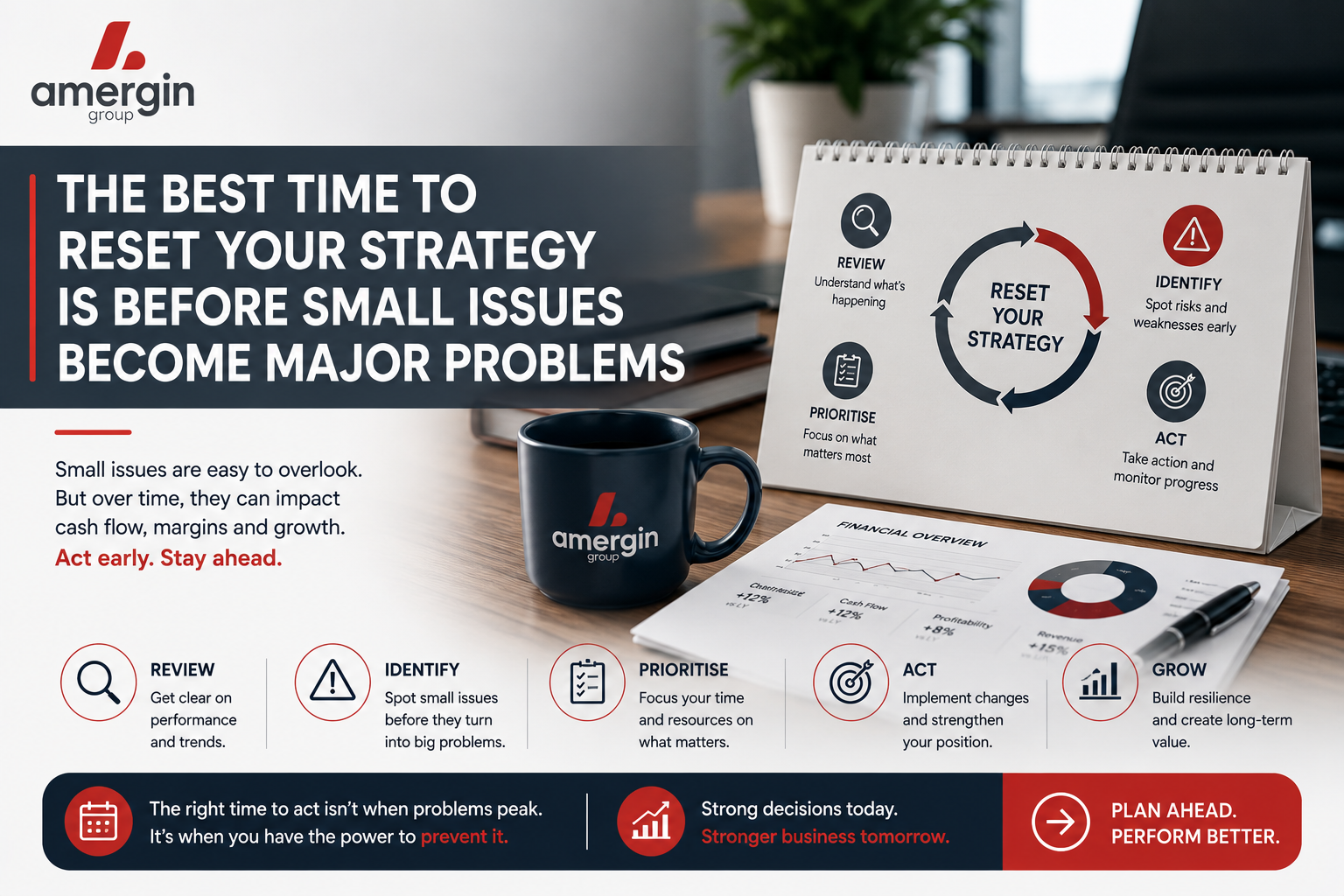
Every successful business reaches a point where its original strategy no longer reflects the reality of the market. What worked six or twelve months ago may not be the best approach today, particularly in an environment where inflation, rising employment costs, changing customer expectations, technological advances, and economic uncertainty continue to reshape the way businesses operate. For Irish SMEs, growth is rarely a straight line, and the ability to adapt has become just as important as having a strong business plan in the first place.
Many business owners believe a strategic review is something that happens when sales decline, profits begin to fall, or cashflow becomes difficult to manage. In reality, waiting until a problem becomes visible often means the underlying issue has been developing for months. Small reductions in gross margin, gradual increases in payroll costs, slowing customer payments, declining productivity, or changes in customer behaviour rarely create immediate concern. However, if left unaddressed, these seemingly minor issues can combine to create significant financial and operational challenges that are far more difficult and expensive to correct.
The most successful businesses do not wait for warning signs to become crises. Instead, they build regular strategic reviews into the way they manage their business, using financial reporting, cashflow forecasting, management accounts, business performance metrics, and market analysis to identify opportunities and risks before they have a material impact. This proactive approach allows leadership teams to make informed decisions while they still have options, rather than reacting when circumstances have already become challenging.
At Amergin, we work with Irish SMEs to strengthen strategic planning through integrated accounting, payroll, finance, Fractional CFO services, marketing, operations, and business advisory. By combining financial insight with operational expertise, we help businesses review their strategy using real-time information, ensuring that decisions are based on current performance rather than outdated assumptions. A strategic reset is not a sign that something has gone wrong—it is evidence that a business is committed to continuous improvement and long-term sustainable growth.
This article explores why every SME should review its business strategy regularly, the early warning signs that indicate it is time for a reset, and how proactive financial planning can help businesses remain profitable, resilient, and competitive in an increasingly uncertain business environment.
Business strategy should evolve as your business evolves
One of the biggest misconceptions about strategic planning is that it is an annual exercise completed during the budgeting process. Many organisations spend considerable time developing business plans at the beginning of the financial year, only to revisit them twelve months later. While annual planning remains important, businesses rarely operate in conditions that remain unchanged for an entire year.
Customer expectations evolve, competitors introduce new products and services, supplier prices fluctuate, recruitment becomes more challenging, and regulatory changes can significantly affect operating costs. If the strategy remains static while the business environment changes, management decisions gradually become disconnected from reality. This often results in businesses continuing to pursue objectives that are no longer aligned with market conditions or missing opportunities because the original plan is no longer appropriate.
Strategic planning should therefore be viewed as a continuous process rather than a fixed document. Regular reviews allow leadership teams to assess whether business priorities remain relevant, whether financial forecasts still reflect current trading conditions, and whether operational resources are aligned with long-term objectives. Businesses that regularly refine their strategy are generally more agile, more resilient, and better positioned to respond to changing market conditions than those that only review their plans once a year.
Small financial issues often indicate larger strategic problems
One of the reasons businesses struggle to respond quickly is that significant problems rarely appear overnight. Financial challenges usually begin with relatively small changes that are easy to dismiss. A slight reduction in gross profit margin may appear insignificant in one month. Customer payment terms extending by a few days may not immediately affect cashflow. Payroll costs increasing gradually through overtime or incremental recruitment may seem manageable. However, when several of these trends occur simultaneously over an extended period, their combined effect can have a substantial impact on profitability and liquidity.
Strong financial reporting helps businesses identify these trends while they are still manageable. Monthly management accounts, profitability analysis, cashflow forecasts, budget variance reports, and financial dashboards provide valuable insight into business performance and often reveal emerging issues long before they become operational problems. Rather than viewing these reports as compliance documents, successful businesses use them as strategic management tools that support better decision-making.
Early intervention almost always costs less than corrective action after a problem has become established. Adjusting pricing before margins collapse, improving debtor management before cashflow becomes strained, or reviewing staffing levels before payroll costs become unsustainable allows businesses to remain in control of their financial performance instead of constantly reacting to events.
Financial reporting should drive strategic decision-making
Every strategic decision should be supported by accurate financial information. While experience and intuition remain valuable, modern business decisions are increasingly driven by data. Financial reporting provides leadership teams with objective information about profitability, liquidity, operational efficiency, and overall business performance, allowing them to make decisions based on evidence rather than assumptions.
Comprehensive financial reporting extends far beyond annual accounts. Businesses should regularly review management accounts, cashflow forecasts, budget performance, gross profit margins, working capital, debtor ageing, creditor balances, payroll costs, and key performance indicators. Together, these reports create a complete picture of the financial health of the organisation and provide early warning of emerging risks.
For example, declining gross margins may indicate rising supplier costs or pricing issues, while increasing debtor days may suggest future cashflow challenges. Rising payroll costs could highlight the need to review workforce planning, and slowing revenue growth may indicate changes in customer demand or increased market competition. Understanding these trends early allows management to review strategy before financial performance begins to deteriorate significantly.
Cashflow forecasting provides time to act
Cashflow is one of the clearest indicators of whether a business strategy remains financially sustainable. Many SMEs focus heavily on revenue growth and profitability while paying less attention to how cash moves through the organisation. However, profitable businesses can still experience financial pressure if customer payments slow, inventory levels increase, payroll expands too quickly, or significant tax liabilities accumulate.
Rolling cashflow forecasting allows businesses to identify these pressures well before they affect day-to-day operations. Instead of simply reviewing the current bank balance, leadership teams gain visibility into expected customer receipts, supplier payments, payroll commitments, VAT obligations, corporation tax liabilities, loan repayments, and planned capital expenditure over the coming months.
This forward-looking approach provides valuable time to make strategic adjustments. Businesses may decide to strengthen debtor collection procedures, review discretionary spending, delay non-essential investment, renegotiate supplier payment terms, or adjust recruitment plans. These decisions are far easier to make when there is time to plan than when cashflow has already become constrained.
Review your pricing strategy before profitability declines
Pricing is one of the most effective ways to protect long-term profitability, yet it is also one of the areas businesses review least frequently. Many SMEs establish pricing structures based on costs at a particular point in time and then leave them unchanged despite rising supplier prices, increasing payroll costs, higher insurance premiums, inflation, and growing operational expenses.
Over time, this gradually reduces gross profit margins even if sales remain healthy. Businesses may celebrate increasing turnover while failing to recognise that profitability is steadily declining. A strategic review should therefore include a detailed analysis of pricing, cost recovery, and customer profitability to ensure that current pricing reflects the true cost of delivering products or services.
Reviewing pricing does not necessarily mean increasing prices across the board. It may involve introducing new pricing structures, reviewing service packages, improving operational efficiency, or focusing on higher-margin customer segments. The objective is to ensure that growth remains profitable rather than simply increasing workload without improving financial performance.
Business growth requires stronger financial controls
Growth is often viewed as an indicator of success, but rapid expansion can place considerable pressure on financial management systems. As businesses recruit more employees, serve more customers, expand into new markets, and increase transaction volumes, the financial processes that supported the business in its earlier stages may no longer be sufficient.
Strategic reviews should examine whether financial controls continue to support the business effectively. This includes reviewing budgeting processes, financial reporting, approval procedures, payroll management, cashflow forecasting, working capital monitoring, and management information systems. Businesses that strengthen financial controls as they grow are far more likely to maintain profitability and operational efficiency than those that rely on processes designed for much smaller organisations.
Introducing stronger financial governance does not create bureaucracy. Instead, it provides leadership with greater visibility, reduces operational risk, and supports more confident decision-making as the business becomes increasingly complex.
Customer behaviour is constantly changing
Even businesses with loyal customer bases should regularly review how customer behaviour is evolving. Changes in buying habits, economic conditions, technology, and market competition can all influence purchasing decisions. Products and services that were highly profitable two years ago may no longer deliver the same returns, while new opportunities may emerge in different sectors or customer groups.
Analysing customer profitability, retention rates, purchasing trends, and market demand allows businesses to identify opportunities for growth before competitors do. Marketing performance should also be reviewed alongside financial performance to ensure that investment is generating measurable returns and supporting overall business objectives.
Businesses that understand their customers are better positioned to adapt their strategy and remain competitive in changing markets.
Payroll planning should form part of every strategic review
Payroll is one of the largest operating costs for most SMEs, making workforce planning an essential part of strategic decision-making. As businesses grow, recruitment, salary increases, employer PRSI, pensions, training, bonuses, and employee benefits all contribute to rising employment costs.
Rather than viewing payroll purely as an administrative function, leadership teams should integrate workforce planning into broader financial forecasting. Reviewing payroll costs alongside projected revenue, productivity, and profitability provides a clearer understanding of whether recruitment plans remain commercially sustainable.
Aligning payroll planning with business strategy ensures that investment in people supports long-term growth without creating unnecessary financial pressure.
Scenario planning strengthens business resilience
One of the most valuable elements of a strategic review is scenario planning. Rather than assuming one version of the future, businesses prepare for multiple possibilities by modelling different financial outcomes based on changing market conditions.
Leadership teams can evaluate how the business would perform if sales slowed, operating costs increased, customer demand exceeded expectations, or significant investment opportunities emerged. By considering these possibilities in advance, businesses develop practical contingency plans that allow them to respond quickly and confidently if circumstances change.
Scenario planning is not about predicting the future. It is about ensuring that whatever happens, the business has already considered its options and understands the financial implications of different decisions.
Real-life example: a strategic review prevented declining profitability
An Irish engineering company had experienced several years of consistent growth and entered the new financial year with ambitious expansion plans. Revenue continued increasing, and management believed the business was performing well. However, a strategic review conducted by Amergin revealed several emerging trends that had not yet attracted significant attention. Gross profit margins had been declining gradually due to rising supplier costs, payroll expenses had increased following recruitment, and customer payment periods had extended by almost two weeks compared to the previous year.
None of these issues appeared serious when viewed individually, but together they indicated that cashflow and profitability would come under pressure if no action was taken. Amergin worked with the leadership team to review pricing, strengthen cashflow forecasting, improve debtor management, refine payroll planning, and introduce a financial dashboard that provided greater visibility into business performance. Within six months, margins had stabilised, cashflow had improved, and management had significantly greater confidence in its growth strategy. The business avoided a much larger financial challenge simply because it acted while the warning signs were still relatively small.
How Amergin helps Irish SMEs review and strengthen their strategy
Amergin helps Irish SMEs transform financial information into strategic action. Through integrated Fractional CFO services, accounting, payroll, finance, business advisory, operations, and marketing support, we provide businesses with the financial insight needed to review performance objectively and make informed decisions about future growth.
Our approach includes strategic financial planning, budgeting, business forecasting, cashflow forecasting, profitability analysis, working capital management, pricing reviews, payroll planning, financial dashboards, management reporting, and KPI development. By combining operational understanding with financial expertise, we help businesses identify opportunities, reduce risk, and adapt their strategy before small challenges become significant problems.
The objective is not simply to produce more reports. It is to provide leadership with the information needed to make better business decisions and build a stronger, more resilient organisation.
The deeper truth: resilience comes from acting early
The strongest businesses are not necessarily those that avoid challenges altogether. They are the businesses that recognise change early and respond before circumstances become difficult. Financial resilience is built through continuous improvement, regular strategic reviews, accurate financial reporting, and a willingness to adapt as market conditions evolve.
Waiting until problems become visible often limits the choices available to management. Acting early provides flexibility, preserves profitability, protects cashflow, and creates opportunities for sustainable growth. A strategic reset should never be viewed as an admission that the business has failed. Instead, it reflects strong leadership and a commitment to ensuring that the organisation continues moving in the right direction.
The takeaway
For Irish SMEs, the best time to reset a business strategy is before declining margins, cashflow pressure, rising payroll costs, or changing customer behaviour begin affecting long-term performance. Regular strategic reviews supported by financial reporting, cashflow forecasting, business forecasting, working capital management, profitability analysis, management accounts, KPI reporting, and Fractional CFO support provide the insight needed to identify emerging issues while they are still manageable.
Businesses that continuously review their strategy are better equipped to respond to economic uncertainty, changing market conditions, and new opportunities. By making small adjustments early, they avoid major corrective action later, strengthen financial resilience, and position themselves for sustainable business growth. The most successful organisations understand that strategy is never finished—it evolves alongside the business, ensuring that every decision supports long-term success.
About Amergin Consulting Ltd.
Amergin Consulting Ltd. is a Dublin-based chartered accountancy and business advisory firm serving Ireland’s SMEs and growth companies across construction, technology, professional services, and renewable energy.
We specialise in Accounting, Payroll, Taxation, and CFO Services that help businesses build stronger foundations for profit and compliance.
Need help running a year-end tax review or planning your 2026 changes?
Amergin Consulting’s finance and tax team can help you identify deductions, forecast cash flow, and ensure full compliance before the year closes.
Book your 30-minute FREE consultation: https://calendly.com/amergin-group_free/30min-finance-consultation
Disclaimer
This article is for general informational purposes only and does not constitute financial or tax advice. While every effort has been made to ensure accuracy, legislation may change upon enactment of the Finance Act 2025.
Public should seek professional advice tailored to their specific circumstances before acting on any points discussed.
Sources and Resources
Amergin Consulting – Strategic Finance, Fractional CFO, Accounting and Advisory Services for Irish SMEs
https://amergin.ie
Enterprise Ireland – Business Growth and Strategic Planning Resources
https://www.enterprise-ireland.com
Local Enterprise Office (LEO) – Business Planning and SME Supports
https://www.localenterprise.ie
Revenue Commissioners – Business Tax and Financial Planning
https://www.revenue.ie
Chartered Accountants Ireland – Financial Management and Business Advisory
https://www.charteredaccountants.ie
Institute of Directors Ireland – Corporate Governance and Strategic Leadership
https://www.iodireland.ie
Harvard Business Review – Strategy, Business Agility and Organisational Performance
https://hbr.org
MIT Sloan Management Review – Strategic Planning and Business Decision-Making
https://sloanreview.mit.edu