
Published: July 2026
Author: Amergin Consulting Ltd.
Target Audience: Business Owners, Small Business Seeking Financial Stability, Entrepreneurs, Start-Ups, Irish SMEs
Book a meeting: https://calendly.com/amergin-group_free/30min-finance-consultation
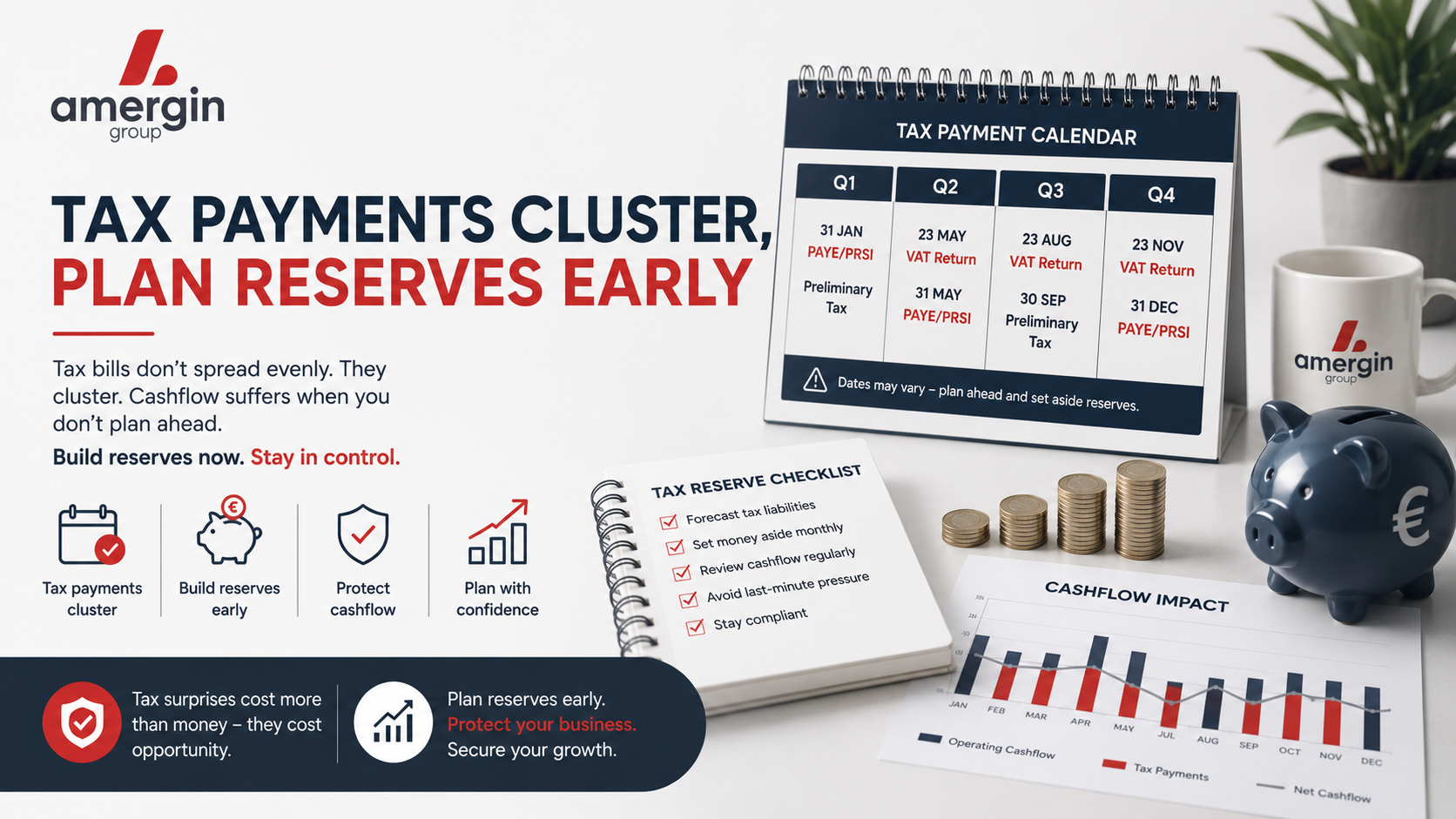
For many Irish SMEs, tax payments do not arrive evenly throughout the year.
Instead, they tend to cluster around key dates, creating periods where multiple financial obligations fall due within a short space of time. VAT returns, PAYE liabilities, employer PRSI, corporation tax, Relevant Contracts Tax (where applicable), and other statutory payments can combine to place significant pressure on business cashflow.
The problem is rarely that businesses are unaware these payments exist.
The challenge is that many businesses underestimate how quickly these obligations accumulate and how significantly they can affect liquidity when they become due at the same time. Throughout the year, management focuses on winning new customers, delivering projects, managing employees, and growing the business. Tax liabilities often remain in the background until payment deadlines approach, at which point cashflow can come under considerable pressure.
This is why proactive tax planning is an essential part of good financial management.
Businesses that build tax reserves gradually throughout the year avoid unnecessary financial stress, maintain stronger liquidity, and reduce the risk of relying on overdrafts or short-term borrowing to meet statutory obligations. Planning ahead allows tax payments to become routine financial events rather than disruptive surprises.
Amergin works with Irish SMEs and growing businesses to strengthen financial planning, improve cashflow management, and build sustainable financial systems. Amergin positions itself as an integrated partner across accounting, payroll, finance, marketing, operations, and advisory. This integrated approach helps businesses connect tax planning with budgeting, payroll, cashflow forecasting, and working capital management, ensuring that statutory obligations are fully incorporated into everyday financial decision-making.
This article explores why tax payments often create cashflow pressure, how Irish SMEs can build tax reserves effectively, and why disciplined financial planning creates greater business resilience.
Tax liabilities are predictable, even if cashflow is not
One of the most important characteristics of business taxes is that they are largely predictable.
Unlike unexpected repairs, sudden equipment failures, or unforeseen market changes, tax obligations arise because the business is trading successfully. VAT is generated through sales, PAYE and employer PRSI arise through payroll, and corporation tax reflects business profitability.
The amounts may vary, but the obligation itself should never come as a surprise.
This distinction is important because it changes how businesses should approach tax planning.
Instead of viewing tax as an occasional expense, successful SMEs treat it as a regular financial commitment that must be incorporated into cashflow forecasting from the moment revenue is generated.
Every invoice issued, every payroll processed, and every profitable month contributes towards future tax liabilities.
Businesses that recognise this relationship develop healthier financial habits and avoid treating tax payments as unexpected interruptions to cashflow.
Why tax payments create pressure for SMEs
Cashflow pressure often develops because tax payments are separated from the activities that generate them.
Revenue may be received months before VAT becomes payable. Payroll costs are processed every week or month, while PAYE and employer PRSI follow statutory reporting and payment schedules. Corporation tax is usually paid well after profits have been earned.
This timing difference creates an illusion.
The cash appears available because it remains in the business bank account, but in reality, part of that balance already belongs to Revenue.
When businesses use these funds to cover operational expenses, investments, or expansion, they unintentionally reduce the reserves available for future tax payments.
As payment deadlines approach, management may discover that cashflow is tighter than expected, despite trading successfully.
The issue is not insufficient profitability.
It is insufficient planning.
Cashflow forecasting should always include tax obligations
One of the most effective ways to improve financial resilience is to integrate tax liabilities into cashflow forecasting.
Many SMEs prepare cashflow forecasts that focus on customer receipts, supplier payments, payroll, rent, and loan repayments but underestimate future tax commitments. As a result, forecasts provide an incomplete picture of future liquidity.
Comprehensive cashflow forecasting should include:
- VAT payment dates and estimated liabilities.
- PAYE and employer PRSI obligations.
- Corporation tax provisions.
- Relevant Contracts Tax (RCT), where applicable.
- Preliminary tax payments for sole traders and partnerships where relevant.
- Any known Revenue repayment arrangements.
Including these obligations within rolling cashflow forecasts allows businesses to see future pressure points well in advance.
This creates time to adjust spending, improve debtor collections, delay discretionary investment, or strengthen cash reserves before deadlines arrive.
Strong cashflow forecasting turns tax planning into a proactive process rather than a reactive one.
Building tax reserves creates financial stability
One of the simplest and most effective financial disciplines is building dedicated tax reserves.
Rather than waiting until payment dates approach, businesses regularly transfer a proportion of revenue into a separate reserve account specifically designated for future tax obligations.
This approach provides several advantages.
Firstly, it removes the temptation to treat tax money as available working capital.
Secondly, it improves financial visibility because management can clearly distinguish operational cash from funds already allocated for statutory obligations.
Finally, it significantly reduces stress.
When payment deadlines arrive, businesses have already accumulated the required funds through gradual contributions rather than scrambling to find large amounts at short notice.
Building reserves is not simply a cash management technique.
It is a discipline that strengthens long-term financial control.
Payroll taxes require continuous attention
Payroll taxes deserve particular attention because they arise consistently throughout the year.
Every payroll cycle generates PAYE, USC, and employer PRSI obligations that must be reported accurately under Ireland's PAYE Modernisation system. As businesses grow and recruit additional employees, these liabilities increase accordingly.
Many SMEs focus primarily on gross salaries when forecasting labour costs.
However, employer PRSI and other payroll-related obligations also affect cashflow and should be reflected within financial planning.
Integrating payroll reporting with financial forecasting allows leadership teams to understand the full cost of employment rather than focusing solely on wages.
This creates more accurate budgets, improves workforce planning, and ensures that tax obligations are fully funded.
Payroll planning and tax planning should never operate independently.
They are closely connected.
Working capital supports timely tax payments
Working capital management plays an essential role in tax planning.
Businesses with strong debtor management, efficient inventory control, and disciplined supplier payment processes generally experience fewer difficulties meeting tax obligations because cash moves more efficiently through the organisation.
Conversely, businesses with slow customer collections or weak working capital discipline often find that tax deadlines expose underlying liquidity issues.
Improving working capital therefore strengthens tax planning indirectly.
Faster invoice collections, better inventory management, and improved cashflow forecasting all contribute to healthier liquidity, making it easier to meet Revenue deadlines without disrupting operations.
Working capital and tax planning are two sides of the same financial discipline.
Financial dashboards improve tax visibility
As businesses grow, monitoring tax liabilities manually becomes increasingly difficult.
Integrated financial dashboards provide valuable visibility by bringing together accounting data, payroll information, cashflow forecasts, tax provisions, and upcoming statutory deadlines within a single reporting framework.
This enables management to monitor accumulated tax liabilities alongside current cash balances and future liquidity.
Rather than reviewing tax only at filing deadlines, leadership can track financial obligations continuously.
Improved visibility leads to better decisions.
Businesses gain greater confidence because they understand exactly where they stand at any point during the financial year.
Scenario planning strengthens tax preparedness
Economic conditions rarely remain static throughout the year.
Sales may exceed expectations, resulting in higher VAT and corporation tax liabilities. Payroll expansion may increase employer PRSI obligations. Market conditions may reduce profitability, affecting cash availability.
Scenario planning allows businesses to model these possibilities before they occur.
For example, leadership can assess how stronger sales growth affects future tax liabilities or evaluate whether current cash reserves remain sufficient under different profitability scenarios.
By incorporating tax into broader financial scenario planning, businesses avoid focusing solely on operational performance while overlooking future statutory commitments.
Scenario planning improves preparedness.
Preparedness reduces financial pressure.
Real-life example: planning ahead avoided unnecessary borrowing
An Irish wholesale business experienced strong trading performance throughout the first half of the year.
Revenue exceeded expectations, customer demand remained healthy, and management invested confidently in additional stock and warehouse improvements. However, because the business had not been setting aside funds specifically for VAT and corporation tax, the growing tax liability remained largely invisible.
As payment deadlines approached, cashflow tightened considerably.
Although the business remained profitable, available cash had already been committed elsewhere. Management initially considered increasing its overdraft facility simply to meet tax obligations.
Amergin carried out a comprehensive cashflow and tax planning review.
The business introduced a dedicated tax reserve account, integrated tax forecasting into monthly financial reporting, strengthened cashflow forecasting, and implemented a rolling liquidity review that included upcoming Revenue payment dates.
Within the following financial year, every major tax payment was funded from accumulated reserves.
The business no longer relied on short-term borrowing to meet statutory obligations because the funds had already been planned for.
The improvement did not come from paying less tax.
It came from planning for it more effectively.
Tax planning should be continuous, not seasonal
Many businesses naturally focus on tax when filing deadlines approach.
However, effective financial management treats tax planning as a continuous process.
Every month provides new information about revenue, profitability, payroll costs, and future obligations. Updating forecasts regularly allows businesses to adjust reserve levels as circumstances change.
Continuous planning also improves communication with accountants, payroll providers, and financial advisers.
Rather than discussing tax only once or twice a year, leadership maintains ongoing visibility into future obligations and can make informed operational decisions throughout the year.
Tax becomes integrated into business planning rather than existing as a separate compliance activity.
How Amergin helps Irish SMEs strengthen tax planning
Amergin helps Irish SMEs build practical financial systems that integrate tax planning into everyday business management.
This includes developing rolling cashflow forecasts, improving working capital management, integrating payroll forecasting, reviewing tax reserve strategies, strengthening financial reporting, and implementing dashboards that provide visibility into future tax obligations.
By combining expertise across accounting, payroll, finance, operations, marketing, and strategic advisory, Amergin helps businesses move beyond compliance and develop financial systems that support long-term resilience.
The objective is not simply to meet tax deadlines.
It is to ensure that tax obligations never disrupt business growth.
The deeper truth: tax is a cashflow management issue
Most businesses do not experience tax difficulties because they misunderstand the rules.
They experience difficulties because they underestimate the cashflow impact.
Tax obligations are predictable.
What creates pressure is failing to reserve the cash required to meet them.
Businesses that treat tax as part of everyday financial planning rarely experience last-minute funding challenges.
Those that delay planning often discover that profitable trading does not automatically guarantee available cash.
Financial discipline begins long before payment deadlines arrive.
The takeaway
Tax payments naturally cluster throughout the financial year, making early planning essential for Irish SMEs.
By integrating tax liabilities into cashflow forecasting, building dedicated tax reserves, strengthening working capital management, monitoring payroll obligations, and using financial dashboards to improve visibility, businesses can meet statutory deadlines confidently without disrupting day-to-day operations.
Strong businesses do not wait until Revenue deadlines appear.
They prepare for them throughout the year.
Because when tax planning becomes part of everyday financial management, cashflow improves, financial stress decreases, and the business is better positioned for sustainable growth.
About Amergin Consulting Ltd.
Amergin Consulting Ltd. is a Dublin-based chartered accountancy and business advisory firm serving Ireland’s SMEs and growth companies across construction, technology, professional services, and renewable energy.
We specialise in Accounting, Payroll, Taxation, and CFO Services that help businesses build stronger foundations for profit and compliance.
Need help running a year-end tax review or planning your 2026 changes?
Amergin Consulting’s finance and tax team can help you identify deductions, forecast cash flow, and ensure full compliance before the year closes.
Book your 30-minute FREE consultation: https://calendly.com/amergin-group_free/30min-finance-consultation
Disclaimer
This article is for general informational purposes only and does not constitute financial or tax advice. While every effort has been made to ensure accuracy, legislation may change upon enactment of the Finance Act 2025.
Public should seek professional advice tailored to their specific circumstances before acting on any points discussed.
Sources and Resources
Amergin Consulting – Integrated Financial & Marketing Consulting for Irish SMEs and Growing Businesses
https://amergin.ie
Revenue Commissioners – Business Taxes, VAT, PAYE Modernisation and Corporation Tax
https://www.revenue.ie
Chartered Accountants Ireland – Tax Planning and Financial Management Resources
https://www.charteredaccountants.ie
Enterprise Ireland – Financial Planning and Business Growth Resources
https://www.enterprise-ireland.com
Local Enterprise Office (LEO) – Financial Planning Supports for SMEs
https://www.localenterprise.ie
Harvard Business Review – Cashflow Management and Financial Discipline
https://hbr.org
MIT Sloan Management Review – Financial Planning, Liquidity and Business Resilience
https://sloanreview.mit.edu