
Published: December 2025
Author: Amergin Consulting Ltd.
Target Audience: Business Owners, Finance Managers, and Small Business Seeking Financial Stability
Book a meeting: https://calendly.com/amergin-group_free/30min
Integration, documentation, sustainability pressures and the new compliance expectations shaping Irish business.
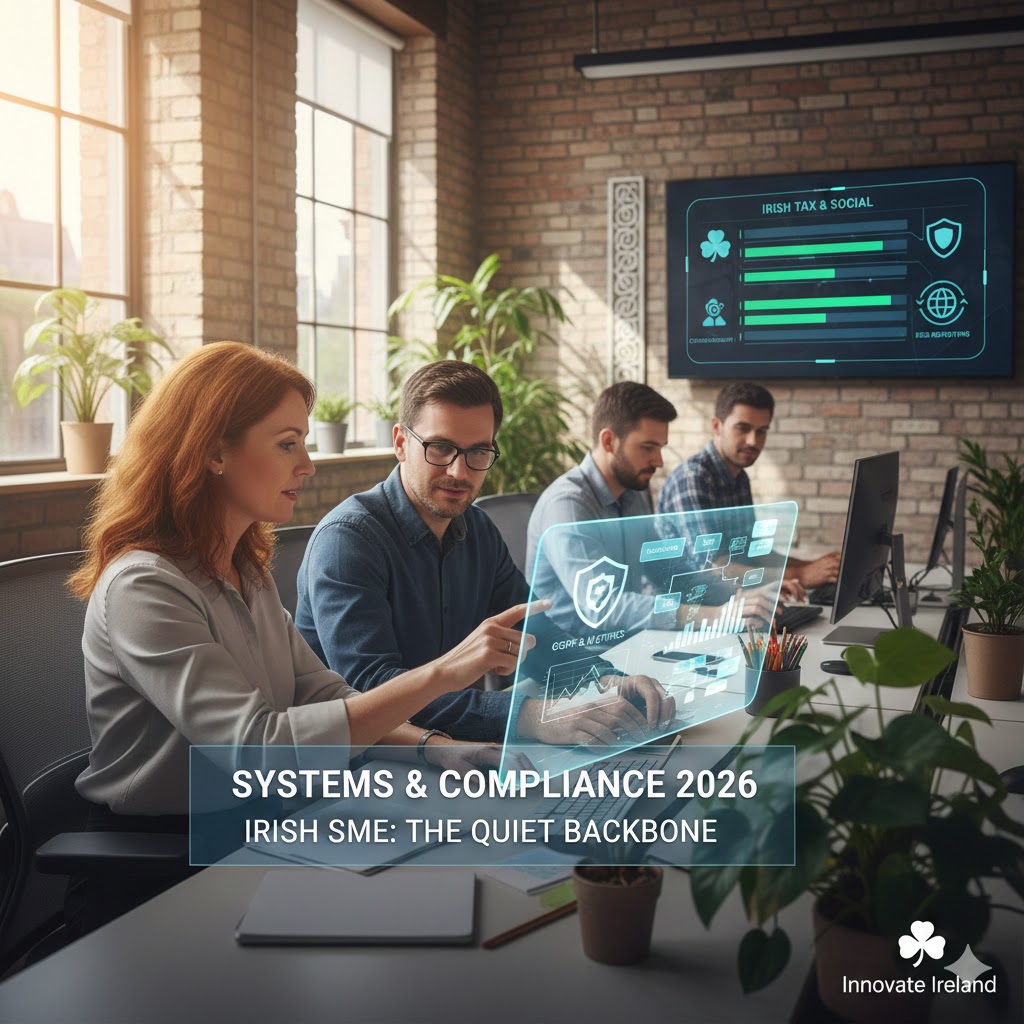
In every Irish business, there is a front stage and a backstage. The front stage is what the world sees the shop floor, the customer service, the product, the brand, the team. The backstage is what keeps that front stage functioning: the systems, the processes, the records, the reconciliations, the controls, the policies, the structure.
Most SME owners spend nearly all their time on the front stage, because that’s where the energy goes into customers, sales, operations, outputs. But in 2026, the backstage becomes the story. Systems and compliance move from the quiet corners of the business into a position of real influence. The businesses that thrive will be the ones whose internal systems are aligned, whose documentation is clear, whose processes hold up under scrutiny and whose workflows actually make their lives easier not harder.
In recent years, Ireland has seen a steady tightening of the compliance environment. Payroll reporting became real-time. Revenue’s digital infrastructure became extraordinarily sophisticated. Employment law expanded. Auto-Enrolment became imminent. Sick pay became mandatory. And large organisations began asking SMEs for sustainability documentation linked to CSRD. These shifts didn’t arrive all at once but they accumulate into one unavoidable reality: Irish SMEs now need internal systems that can withstand pressure.
Systems & Compliance in 2026 is not about bureaucracy. It is about building a structure strong enough to support a business that wants to grow, wants to stay compliant, wants to attract customers and wants to avoid panic every time Revenue or a corporate client requests information. It is about creating order where disorder used to pass unnoticed. It is about moving out of “just in time” management and into the comfort of predictability.
The Integration Question: Why Payroll and Bookkeeping Must Finally Stop Living Separate Lives
In a surprising number of SMEs, payroll and bookkeeping operate like distant cousins: related, aware of each other, but rarely in the same room. Payroll happens once a week or once a month, producing neat reports that then sit quietly in a folder. Bookkeeping happens somewhere else often irregularly with invoices, receipts and coding decisions that may or may not align with payroll entries.
For years, this separation caused inconvenience. In 2026, it causes exposure.
Payroll data feeds into Revenue systems in real time. Employee costs are central to financial reporting, cashflow planning, and compliance checks. Payments for sick leave, travel, remote work allowances, benefits, bonuses, small gifts and subsistence all link back into payroll. Meanwhile, bookkeeping must reflect these same transactions accurately, consistently and in the correct categories.
When payroll and bookkeeping are not integrated, small inconsistencies start to appear. A pension payment shown in payroll might not match what appears in the accounts. A travel allowance processed in payroll may be coded as an ordinary expense in bookkeeping. Sick pay calculations may not align with wage accruals. The financial statements may show one picture while payroll reports show another.
These inconsistencies are not harmless. Revenue’s systems are built to detect mismatches. Lenders, auditors and potential partners spot discrepancies quickly. A lack of alignment makes it harder to defend records, harder to forecast cashflow, and harder to trust the business’s own numbers.
Integration is not a software choice. It is the foundation for modern compliance. When payroll flows cleanly into the accounts, when journals are automated, when coding is consistent, when documentation is centralised, the business becomes easier to lead. Decision-making becomes stronger. Revenue queries become less daunting. Staff confusion disappears. Integration creates clarity. And clarity is the central currency of leadership in 2026.
Preparing for CSRD Pressure: Why Sustainability Will Reach SMEs Whether They Like It or Not
CSRD the Corporate Sustainability Reporting Directive sounds like something that belongs to global companies, not local SMEs. And technically, that’s true. SMEs are not yet legally required to file CSRD reports. But in practice, CSRD will affect Irish SMEs long before it reaches their legal obligations, because it works like gravity: it pulls everything around it into orbit.
Large companies must report on their supply chain. That means the people who supply them logistics firms, service providers, consultants, trades, caterers, agencies, packaging suppliers, digital teams, recruiters, software developers, facilities providers will begin receiving questionnaires and sustainability requests. The questions will not be optional. They will form part of whether an SME is chosen, renewed or approved as a supplier.
SMEs will be asked to provide policies on diversity, governance, environmental responsibility, staff wellbeing, anti-corruption, ethical sourcing and operational transparency. They may be asked about energy usage, carbon considerations, or staff protections. They will need documented practices instead of informal habits.
And perhaps most importantly: these requests will arrive suddenly, without warning, often with tight deadlines because the larger company must file its own CSRD report on time.
A business with no documentation, no centralised policies, no structured systems and no compliance record will struggle. A business that prepares early even lightly will stand out as reliable, credible and ready.
Compliance is no longer only about Revenue. It now includes reputational and commercial readiness. CSRD is not knocking on the SME door politely; it is coming through the supply chain with certainty.
Travel and Subsistence: The Quiet Corner of the Business That Causes the Loudest Problems
Among all compliance areas, travel and subsistence is the one that most SMEs underestimate and the one that causes the most consistent trouble. Every business believes they have a simple system. They reimburse mileage. They refund meals. They handle receipts. But simplicity at the employee level often hides complexity at the compliance level.
Travel data is inconsistent. Mileage is rounded instead of recorded. Receipts go missing. Staff write vague descriptions. Meals blend with personal purchases. Work-from-home days overlap with travel claims. Subsistence allowances are applied incorrectly. And because Revenue’s Enhanced Reporting Requirements have expanded what must be reported and how closely data is scrutinised, a messy travel process becomes a compliance risk.
In 2026, travel and subsistence is no longer just an internal HR or payroll task. It has become a financial, tax and governance responsibility. SMEs need to know who travelled, when, why, for how long, with what receipts, and under what rules. They need accurate logs and consistent documentation. They need controls, clarity and systems that support the truth not systems that obscure it.
A clean travel process protects the business. A messy one exposes it. The difference is leadership deciding that travel needs structure, not improvisation.
Internal Policies: The Operating Manual Every Business Forgot to Write
Irish SMEs are built on trust. Owners trust their staff. Staff trust their managers. Everyone trusts that they “know how things are done.” But trust, on its own, is not a compliance strategy.
The Work Life Balance Act introduces new entitlements and new rights for employees. Statutory Sick Pay has strict rules that must be followed consistently. Auto-Enrolment introduces new pension responsibilities, opt-out rules, communication requirements and record-keeping obligations. Flexible work requests require structured responses. Parental leave policies must be clear. Remote work guidelines must exist. Internal conduct, wellbeing and governance expectations must be documented.
When policies exist only “in someone’s memory,” mistakes happen. Employees receive different answers. Managers apply different interpretations. Payroll processes become inconsistent. Records do not match decisions. And when a dispute arises with an employee, with Revenue, with a compliance body, or with a major client the absence of documentation becomes the business’s greatest weakness.
Documentation is not about bureaucracy. It is about fairness, clarity and protection. It ensures that every employee receives the same information, every manager applies the same rules, every payroll entry reflects the same logic, and every compliance requirement can be proven, not just claimed.
In 2026, undocumented policies are liabilities. Documented policies are leadership.
The New Shape of SME Stability
When Amergin works with businesses on systems and compliance, we often see the same transformation unfold. It begins with frustration receipts scattered across emails, payroll reports that don’t match bookkeeping entries, staff uncertain about sick pay, managers unsure of how to handle travel claims, and business owners feeling that everything is harder than it should be.
Then clarity begins to emerge. Payroll integrates with accounts. Policies are written down. Travel processes are standardised. Sustainability requests become manageable. Systems begin speaking the same language. Errors disappear because processes catch them before they matter.
This clarity changes not just the finance function, but the culture of the business. Staff gain confidence. Leadership makes decisions faster. Revenue queries feel less intimidating. And the business becomes more resilient not by working harder, but by working in alignment.
Systems & Compliance is not a chore. It is a stability strategy.
Frequently Asked Questions. The Real Concerns SME Owners Ask Us Every Day
One of the most common questions owners ask is whether integrating payroll and bookkeeping is really necessary if things “seem fine.” The answer is that seeming fine is no longer the benchmark. Integration is what allows Revenue, auditors, clients and even internal teams to see one consistent version of the truth. When payroll and bookkeeping are separate, small discrepancies become large risks.
Another frequent concern is whether CSRD will truly affect SMEs. Many owners believe it’s something they’ll never have to worry about, until the first request lands from a corporate customer asking for sustainability policies, governance documents or supply-chain data. SMEs will not need to file CSRD reports, but they will need to support those who do.
We are also often asked how strict travel and subsistence processes really need to be. The short answer is: much stricter than before. Enhanced reporting and real-time Revenue oversight mean that vague descriptions, missing receipts and inconsistent claims are no longer workable. A structured approach protects both the business and the employee.
Finally, owners ask whether documenting internal policies creates unnecessary paperwork. In truth, documentation reduces work. It prevents disputes. It ensures fairness. It protects the business during compliance checks. It provides clarity for staff. And it strengthens credibility with clients, banks and partners. In the modern Irish regulatory environment, undocumented policies are far more costly than documented ones.
Conclusion: 2026 Will Reward Structure, Not Scramble
Irish SMEs have survived recessions, unexpected shocks, regulatory overhauls and a rapidly changing economy. But 2026 demands a different kind of strength not the strength of working harder, but the strength of working with structure.
Systems & Compliance is the quiet backbone that supports every part of the business. Integration creates accuracy. Documentation creates fairness. Process creates consistency. Clarity creates confidence. And confidence is what allows leadership to emerge, even when the environment becomes more complex.
Dublin SMEs do not just need compliance in 2026.
They need clarity.
They need predictability.
They need systems they trust, and support they can rely on.
And that is where Amergin stands beside them helping businesses build the internal structures that turn complexity into calm, uncertainty into direction, and pressure into stability.
About Amergin Consulting Ltd.
Amergin Consulting Ltd. is a Dublin-based chartered accountancy and business advisory firm serving Ireland’s SMEs and growth companies across construction, technology, professional services, and renewable energy.
We specialise in Accounting, Payroll, Taxation, and CFO Services that help businesses build stronger foundations for profit and compliance.
Need help running a year-end tax review or planning your 2026 payroll changes?
Amergin Consulting’s finance and tax team can help you identify deductions, forecast cash flow, and ensure full compliance before the year closes.
Book your 30-minute consultation: https://calendly.com/amergin-group_free/30min
Disclaimer
This article is for general informational purposes only and does not constitute financial or tax advice. While every effort has been made to ensure accuracy, Budget 2026 legislation may change upon enactment of the Finance Act 2025.
Public should seek professional advice tailored to their specific circumstances before acting on any points discussed.