
Published: June 2026
Author: Amergin Consulting Ltd.
Target Audience: Business Owners, Small Business Seeking Financial Stability, Entrepreneurs, Start-Ups, Irish SMEs
Book a meeting: https://calendly.com/amergin-group_free/30min-finance-consultation
As businesses grow, the quality of decision-making becomes increasingly important. Owners and leadership teams are expected to make decisions about hiring, investment, pricing, cashflow, risk, growth, and strategy, often while balancing day-to-day operational demands. Yet many SMEs attempt to make these decisions using fragmented reports, outdated financial information, or data that lacks context.
This creates a common problem.
The business may have access to information, but not necessarily the right information. Reports exist, but they do not provide a clear picture of performance. Meetings take place, but discussions focus on symptoms rather than underlying issues. Leadership teams spend valuable time debating numbers instead of making decisions.
This is where a structured board pack becomes valuable.
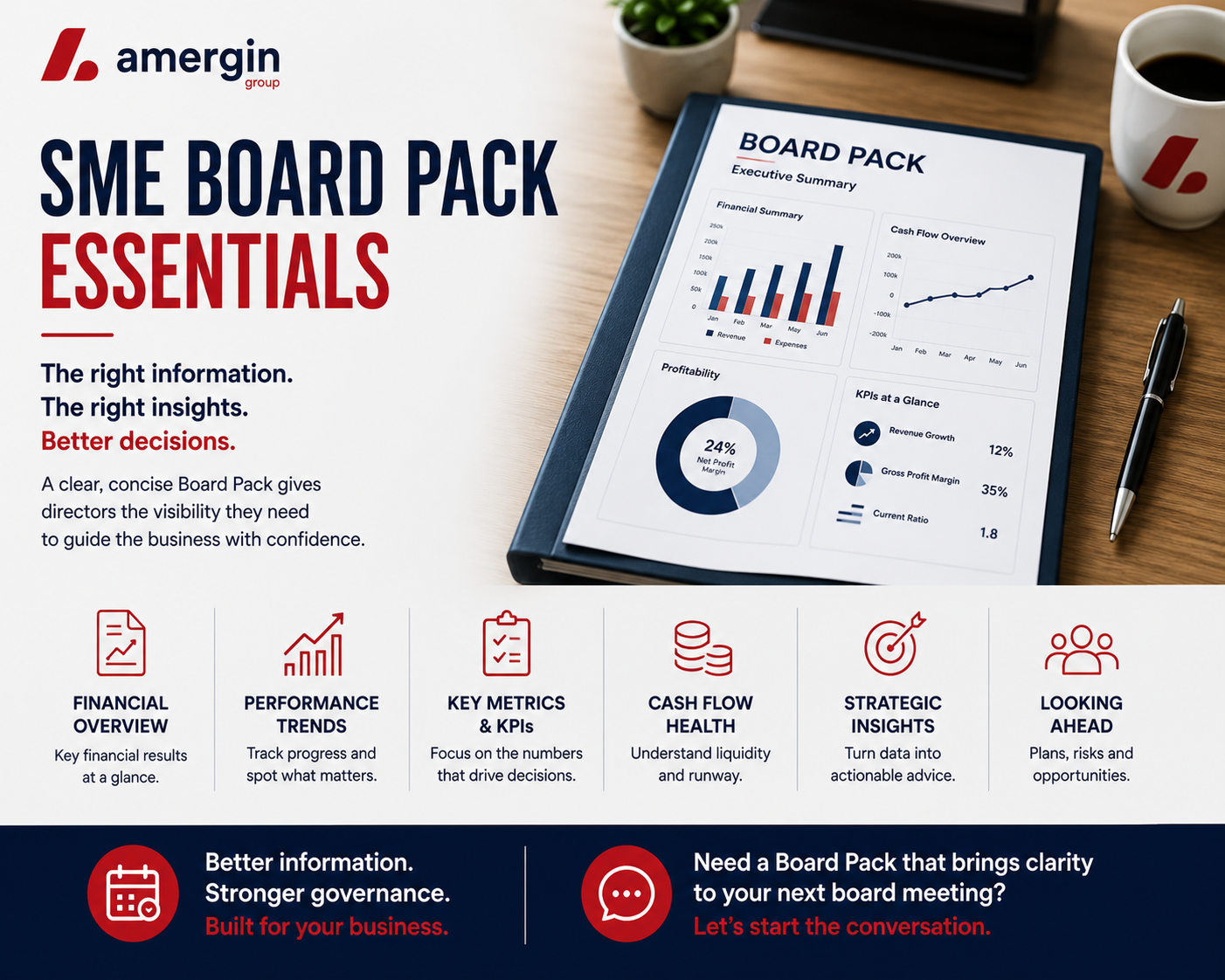
A board pack is not simply a collection of reports. It is a decision-making tool. It provides leadership with a clear, consistent, and comprehensive view of business performance, helping directors, owners, and senior managers focus on what matters most. A well-designed SME board pack brings together financial performance, operational metrics, risks, opportunities, and strategic priorities in a format that supports effective governance and informed decision-making.
Amergin works with Irish SMEs and growing businesses that want to move from reactive management to structured leadership. Amergin positions itself as an integrated partner across accounting, payroll, finance, marketing, operations, and advisory. This integration matters because strong decisions require more than financial reports. They require a complete view of the business.
This article explores the essential components of an SME board pack, why many businesses struggle without one, and how a structured reporting framework supports growth, control, and long-term success.
Why SMEs need a board pack
Many SME owners believe board packs are only relevant for large organisations with formal boards and complex governance structures.
In reality, the opposite is often true. Growing businesses face constant decisions about resources, priorities, and risk. These decisions become increasingly difficult when information is inconsistent or incomplete. Without a structured reporting framework, leadership discussions often focus on immediate operational issues rather than long-term performance.
A board pack creates discipline.
It ensures that key information is reviewed consistently and that discussions are grounded in facts rather than assumptions. It also creates accountability by establishing a regular rhythm of reporting and review.
The purpose of a board pack is not bureaucracy. Its purpose is clarity.
Financial performance must sit at the centre
The financial section is the foundation of any effective board pack.
However, presenting financial statements alone is not enough.
Leadership teams need information that helps them understand performance, not just record it. This means financial data should be presented in a way that highlights trends, explains variances, and supports decision-making.
An effective board pack typically includes profit and loss performance, balance sheet position, cashflow analysis, and budget versus actual comparisons. These reports should not simply show numbers. They should provide context.
For example, if margins have declined, leadership should understand why. If revenue has increased, the board should know whether that growth is sustainable. If costs have risen, the impact on future profitability should be visible.
Financial reporting should answer questions before they are asked.
Cashflow deserves dedicated attention
One of the most common reasons businesses experience financial pressure is a lack of visibility into cashflow.
Profitability and cash availability are not the same thing. A business may appear successful on paper while experiencing liquidity challenges in practice. This is why cashflow should be a dedicated section within every board pack.
A strong board pack should include current cash position, projected cashflow, debtor performance, creditor balances, and upcoming financial obligations. This information helps leadership identify potential pressure points before they become problems.
Cashflow reporting is particularly important in growing SMEs because growth itself often consumes cash. Additional staff, larger projects, increased inventory, and investment in infrastructure all affect liquidity.
Without cashflow visibility, growth can create risk rather than opportunity.
Payroll and labour cost reporting are essential
For many SMEs, payroll represents the largest single expense.
Despite this, labour cost reporting is often limited to a total figure within financial statements. This provides little insight into workforce efficiency, productivity, or cost trends.
An effective board pack should include payroll analysis that helps leadership understand how labour costs are evolving. This includes headcount trends, labour cost as a percentage of revenue, overtime patterns, employer PRSI costs, and planned hiring activity.
Payroll reporting should not be viewed purely as an expense review.
It should be treated as a strategic resource management tool.
When leadership understands workforce costs clearly, hiring decisions become more informed and long-term planning becomes more accurate.
KPI reporting creates operational visibility
Financial results tell part of the story.
Key Performance Indicators (KPIs) help explain the rest.
Every SME should identify a small number of operational metrics that reflect business performance. These metrics vary by sector, but the principle remains the same. KPIs provide insight into the drivers behind financial results.
For example, a service business may track utilisation rates, customer retention, and project profitability. A retail business may focus on average transaction value, stock turnover, and customer acquisition costs. A manufacturing business may monitor production efficiency and delivery performance.
The purpose of KPI reporting is to connect operational activity with financial outcomes.
This helps leadership understand not only what happened, but why it happened.
Risk management should be visible
Every business faces risk.
The challenge is not eliminating risk entirely. The challenge is ensuring that risks are identified, monitored, and discussed before they become significant problems.
Many SMEs address risk informally, relying on experience and instinct rather than structured review. While this approach may work in the early stages of growth, it becomes increasingly difficult as the business expands.
A board pack should include a dedicated section on business risks. This may cover cashflow exposure, compliance obligations, customer concentration, operational dependencies, recruitment challenges, and market conditions.
The goal is not to create fear.
The goal is to create awareness.
When risks are visible, they become manageable.
Strategic priorities keep leadership focused
One of the most valuable functions of a board pack is its ability to connect daily activity with long-term goals.
Without this connection, businesses can become consumed by operational demands. Meetings focus on immediate issues, while strategic priorities receive less attention.
A board pack should include a section that reviews progress against key strategic objectives. This may include growth initiatives, operational improvements, market expansion plans, technology projects, or organisational development goals.
Regular review ensures that long-term priorities remain visible.
It also creates accountability for progress.
Real-life example: structure improves decision-making
An Irish SME had experienced strong growth over several years.
Financial reports were produced monthly, payroll was managed effectively, and operational data was available across different systems. However, leadership meetings often felt unstructured. Significant time was spent reviewing information, and discussions frequently focused on historical issues rather than future decisions.
Amergin worked with the business to develop a structured board pack.
Financial reporting, payroll analysis, cashflow forecasting, KPI tracking, and strategic updates were consolidated into a single reporting framework. Each section was designed to provide clarity and support decision-making.
The impact was immediate.
Meetings became more focused. Leadership spent less time gathering information and more time discussing actions. Risks were identified earlier, and strategic priorities received greater attention.
The quality of information improved.
As a result, the quality of decisions improved as well.
Consistency is more important than complexity
Many businesses assume that an effective board pack must be extensive and highly detailed.
In practice, the opposite is often true.
The best board packs are clear, focused, and consistent. They provide the information needed for decision-making without overwhelming readers with unnecessary detail.
Consistency is what creates value.
When the same information is reviewed regularly, trends become visible. Variances are easier to identify. Performance can be tracked more effectively over time.
A simple board pack that is used consistently is far more valuable than a complex one that is ignored.
How Amergin helps SMEs build effective board packs
Amergin helps Irish SMEs develop reporting frameworks that support leadership, governance, and strategic growth.
This includes integrating financial reporting, payroll analysis, KPI tracking, cashflow forecasting, and operational performance into a single board pack structure. The focus is on creating a reporting system that reflects the realities of the business while supporting informed decision-making.
By connecting accounting, payroll, finance, and operational insight, Amergin helps businesses move beyond reporting for compliance and towards reporting for performance.
The deeper truth: better information creates better decisions
Most businesses already have access to the data they need.
What they often lack is structure.
A board pack provides that structure. It transforms disconnected reports into a coherent picture of business performance. It ensures that leadership discussions are grounded in facts, focused on priorities, and aligned with long-term objectives.
Good governance does not start with complex systems.
It starts with clear information.
The takeaway
An effective SME board pack is not a reporting exercise.
It is a leadership tool.
By bringing together financial performance, cashflow visibility, payroll reporting, operational KPIs, risk management, and strategic priorities, a board pack creates the clarity needed for better decision-making.
For Irish SMEs, the goal is not simply to review performance.
It is to understand performance.
Because when leadership has the right information, discussions become more productive, decisions become stronger, and the business becomes better equipped for sustainable growth.
About Amergin Consulting Ltd.
Amergin Consulting Ltd. is a Dublin-based chartered accountancy and business advisory firm serving Ireland’s SMEs and growth companies across construction, technology, professional services, and renewable energy.
We specialise in Accounting, Payroll, Taxation, and CFO Services that help businesses build stronger foundations for profit and compliance.
Need help running a year-end tax review or planning your 2026 changes?
Amergin Consulting’s finance and tax team can help you identify deductions, forecast cash flow, and ensure full compliance before the year closes.
Book your 30-minute FREE consultation: https://calendly.com/amergin-group_free/30min-finance-consultation
Disclaimer
This article is for general informational purposes only and does not constitute financial or tax advice. While every effort has been made to ensure accuracy, legislation may change upon enactment of the Finance Act 2025.
Public should seek professional advice tailored to their specific circumstances before acting on any points discussed.
Sources and Resources
Amergin Consulting – Integrated Financial & Marketing Consulting for Irish SMEs and Growing Businesses
https://amergin.ie
Institute of Directors Ireland – Governance Guidance for Irish Businesses
https://www.iodireland.ie
Revenue Commissioners – Financial Reporting and Tax Compliance Guidance
https://www.revenue.ie
Companies Registration Office (CRO) – Corporate Governance and Filing Requirements
https://www.cro.ie
Department of Enterprise, Trade and Employment – SME Governance and Business Supports
https://enterprise.gov.ie
Harvard Business Review – Strategic Leadership and Performance Reporting
https://hbr.org
MIT Sloan Management Review – Data-Driven Decision-Making and Business Performance
https://sloanreview.mit.edu