
Published: March 2026
Author: Amergin Consulting Ltd.
Target Audience: Business Owners, Small Business Seeking Financial Stability, Entrepreneurs, Start-Ups, Irish SMEs
Book a meeting: https://calendly.com/amergin-group_free/30min-finance-consultation
Ireland’s Auto-Enrolment pension system is designed to be implemented through payroll.
This means that for most businesses, the operational reality of Auto-Enrolment will not appear first in legislation or policy documents. It will appear in payroll reports, contribution calculations, and the monthly cost of employing staff.
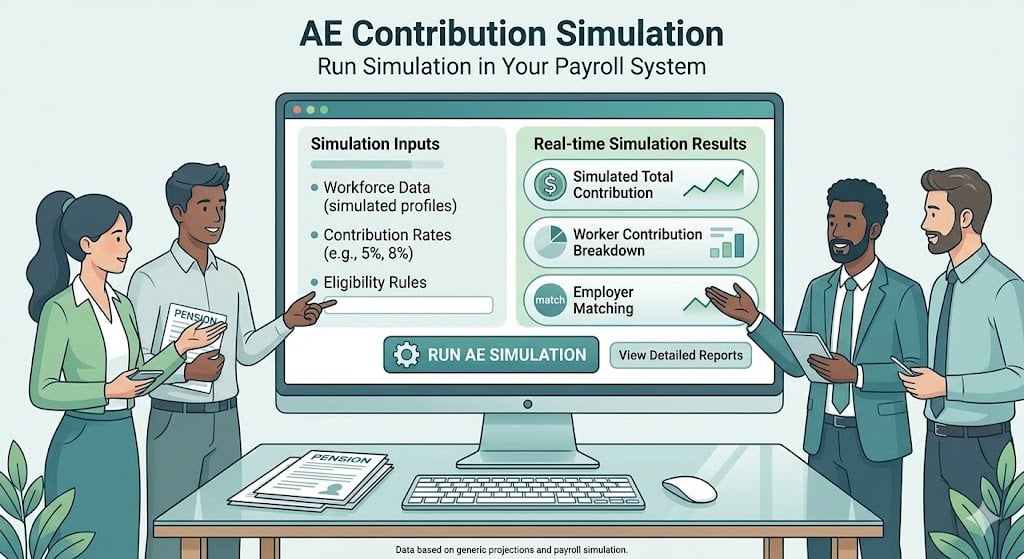
Because of this, one of the most practical steps businesses can take before full implementation is to run a contribution simulation inside their payroll system.
A simulation allows employers to see how Auto-Enrolment contributions will affect payroll costs, employee payslips, and financial forecasts before the system becomes mandatory.
Rather than waiting for implementation day, businesses can test the impact early and adjust their planning accordingly.
Amergin works with Irish SMEs and growing businesses that want to prepare for regulatory change in a structured way. Amergin positions itself as an integrated partner across accounting, payroll, finance, marketing, operations, and advisory. That integration matters because payroll changes affect much more than compliance. They influence cashflow planning, staffing costs, financial forecasting, and employee communication.
Running a payroll simulation for Auto-Enrolment is one of the most practical ways to move from policy awareness to operational readiness.
Why simulation matters before implementation
Regulatory reforms often look simple in principle.
Auto-Enrolment appears straightforward: eligible employees are automatically enrolled into a pension scheme and both the employer and employee contribute a percentage of salary.
However, the operational impact becomes clearer only when the numbers are applied to real payroll data.
For many SMEs, questions only become tangible once contributions are calculated:
- How much will employer contributions add to payroll costs?
- Which employees will be eligible immediately?
- How will pension deductions affect employee payslips?
- How will payroll reporting change?
A payroll simulation answers these questions using your actual workforce data.
It transforms a policy change into a measurable financial reality.
Understanding the contribution structure
Under Ireland’s Auto-Enrolment system, contributions are shared between three parties:
- the employee
- the employer
- the government
The contribution rates will be phased in gradually over ten years.
At the start of the scheme:
- employees contribute 1.5% of their gross salary
- employers contribute 1.5%
- the government contributes 0.5%
Over time, these contributions will increase until both employers and employees contribute 6% each, with additional state support.
Contributions apply to earnings up to €80,000 per year.
While these percentages appear modest, they represent a permanent structural addition to payroll costs.
Running a simulation helps businesses understand this impact before it becomes mandatory.
Step 1: Identify employees likely to be eligible
The first stage of any simulation is identifying employees who will likely fall within the Auto-Enrolment eligibility criteria.
Current guidelines suggest employees will be automatically enrolled if they:
- are aged between 23 and 60
- earn €20,000 or more per year
- are not already contributing to a workplace pension through payroll
Payroll systems already contain most of this information.
Running a simulation involves filtering payroll data to identify which employees meet these criteria.
This allows employers to estimate how many staff members will be affected when the system becomes fully operational.
Step 2: Apply simulated contribution rates
Once eligible employees are identified, the next step is to apply contribution calculations within payroll.
For example, a payroll simulation might show:
- employee contribution deduction
- employer contribution cost
- projected government contribution
For a salary of €40,000 in the first phase of the scheme:
- employee contribution: €600 annually
- employer contribution: €600 annually
- government contribution: €200 annually
Running these calculations across your payroll data provides a realistic estimate of the financial impact.
The goal is not perfect precision but informed planning.
Step 3: Estimate employer cost exposure
One of the most important outcomes of a simulation is understanding employer contribution costs.
For SMEs with multiple eligible employees, even small percentage contributions accumulate quickly.
A payroll simulation helps businesses answer questions such as:
- What will Auto-Enrolment cost the business this year?
- What will it cost once contribution rates increase?
- How does this affect staffing cost forecasts?
Employer pension contributions should be incorporated into financial planning early rather than treated as an unexpected expense later.
Amergin frequently highlights that many businesses experience financial strain not because they lack profit but because costs were not anticipated in cashflow models.
Simulation provides that foresight.
Step 4: Review payroll reporting capabilities
Auto-Enrolment contributions must be reported accurately through payroll systems.
Running a simulation helps businesses determine whether their payroll software can:
- calculate contributions automatically
- track employee eligibility
- manage opt-outs and re-enrolments
- report contribution data correctly
If payroll systems cannot handle these requirements easily, upgrades or system adjustments may be necessary.
It is better to discover this early rather than during implementation.
Step 5: Test the impact on employee payslips
Auto-Enrolment will introduce new deductions for many employees.
For workers who have never contributed to a pension through payroll, this may be the first time their payslip reflects retirement savings deductions.
A payroll simulation allows employers to see exactly how these deductions will appear.
This preparation helps businesses communicate clearly with employees before the changes occur.
When employees understand why deductions are appearing on their payslips, confusion and concern are reduced.
Step 6: Integrate simulation results into financial forecasting
The final step in the simulation process is incorporating results into financial planning.
Employer pension contributions should be reflected in:
- payroll cost forecasts
- staffing budgets
- margin calculations
- cashflow models
Auto-Enrolment will not affect profitability immediately in many businesses. However, as contribution rates increase gradually over time, the cost will become more significant.
Businesses that model this early will be able to adjust pricing, staffing plans, or operational budgets calmly.
Real-life example: simulation reveals hidden cost growth
Consider a growing SME with fifteen employees.
Before running a payroll simulation, the leadership team assumed the financial impact of Auto-Enrolment would be minimal.
However, once eligible employees were identified and contribution rates applied, the business discovered that employer contributions would add several thousand euro annually to payroll costs.
The impact was manageable, but it required adjusting staffing cost forecasts and updating financial planning models.
Because the business ran a simulation early, the adjustment was made calmly rather than under pressure.
Simulation is preparation, not prediction
Payroll simulations do not attempt to predict every detail of the future scheme.
Contribution rates may evolve. Eligibility criteria may change slightly. Administrative procedures may be refined.
However, the core structure of Auto-Enrolment is already clear enough for businesses to begin planning.
Simulation provides clarity.
It transforms policy into operational insight.
How Amergin helps businesses prepare for Auto-Enrolment
Amergin supports Irish SMEs by integrating Auto-Enrolment preparation into payroll, compliance, and financial planning systems.
Payroll workflows are reviewed to ensure they can manage contribution calculations. Financial models incorporate employer pension costs. Compliance calendars include future pension reporting obligations. Advisory support helps businesses communicate changes clearly with employees.
This integrated approach ensures regulatory change becomes part of structured financial management rather than an unexpected disruption.
The deeper truth: preparation reduces stress
Most regulatory reforms create pressure not because they are impossible to implement but because preparation happens too late.
Running a payroll contribution simulation moves preparation forward.
It allows businesses to see the numbers, understand the operational impact, and strengthen systems before the scheme becomes mandatory.
Prepared businesses experience change calmly.
Unprepared businesses experience the same change as disruption.
The takeaway
Auto-Enrolment 2026 will introduce employer pension contributions for many Irish SMEs.
Running a contribution simulation in your payroll system is one of the most practical steps you can take today.
It reveals:
- which employees will be affected
- how contributions will appear on payslips
- what the employer cost will be
- whether payroll systems are ready
Auto-Enrolment is not just a policy reform.
It is a payroll system change that will affect how businesses manage employment costs and compliance.
Simulation turns uncertainty into planning.
About Amergin Consulting Ltd.
Amergin Consulting Ltd. is a Dublin-based chartered accountancy and business advisory firm serving Ireland’s SMEs and growth companies across construction, technology, professional services, and renewable energy.
We specialise in Accounting, Payroll, Taxation, and CFO Services that help businesses build stronger foundations for profit and compliance.
Need help running a year-end tax review or planning your 2026 changes?
Amergin Consulting’s finance and tax team can help you identify deductions, forecast cash flow, and ensure full compliance before the year closes.
Book your 30-minute FREE consultation: https://calendly.com/amergin-group_free/30min-finance-consultation
Disclaimer
This article is for general informational purposes only and does not constitute financial or tax advice. While every effort has been made to ensure accuracy, legislation may change upon enactment of the Finance Act 2025.
Public should seek professional advice tailored to their specific circumstances before acting on any points discussed.
Sources and Resources
Department of Social Protection – Auto-Enrolment Retirement Savings System
https://www.gov.ie
Citizens Information – MyFutureFund Auto-Enrolment Pension Scheme
https://www.citizensinformation.ie
Revenue Commissioners – Employer Payroll Reporting Obligations
https://www.revenue.ie
Pensions Authority Ireland – Workplace Pension Guidance
https://www.pensionsauthority.ie