
Published: June 2026
Author: Amergin Consulting Ltd.
Target Audience: Business Owners, Small Business Seeking Financial Stability, Entrepreneurs, Start-Ups, Irish SMEs
Book a meeting: https://calendly.com/amergin-group_free/30min-finance-consultation
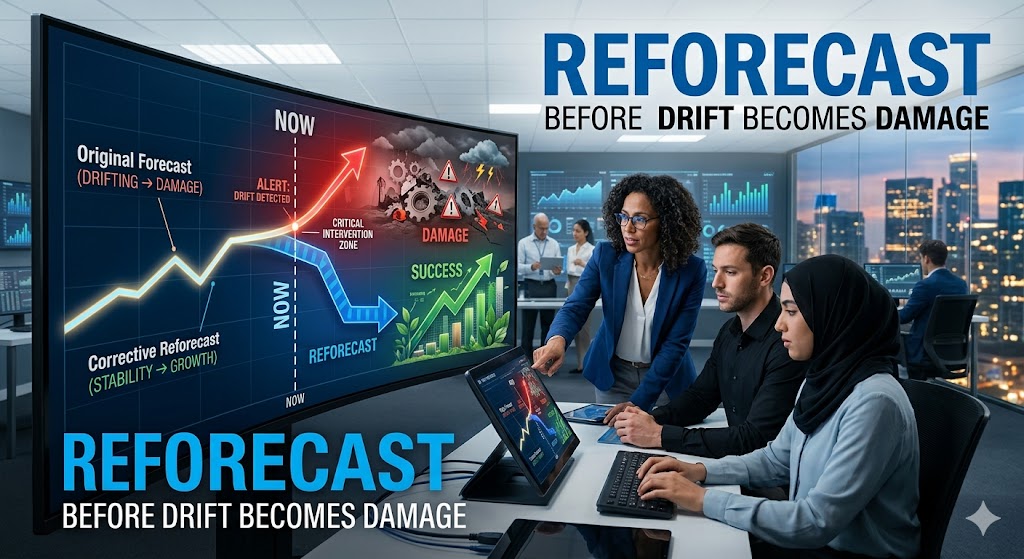
Most financial problems in SMEs do not begin with a sudden shock or a single poor decision.
They begin with drift.
Performance moves slightly away from plan. Revenue comes in below expectation for a period, but not dramatically enough to trigger concern. Costs increase gradually due to hiring decisions, supplier changes, or operational inefficiencies. Margins tighten quietly, often masked by continued activity and busyness within the business.
Because these changes happen incrementally, they are rarely treated as urgent.
They are explained, rationalised, or deferred for review at a later stage.
Over time, however, the gap between the original plan and actual performance widens. What began as a small variance becomes a structural issue. By the time it is fully recognised, corrective action is more difficult, more expensive, and more disruptive.
Reforecasting before drift becomes damage is what prevents this escalation.
It introduces discipline into financial planning by ensuring that forecasts are updated regularly to reflect current reality. Instead of relying on static budgets or outdated projections, businesses maintain a dynamic view of performance that evolves as conditions change.
Amergin works with Irish SMEs and growing businesses that want to strengthen financial control through proactive planning. Amergin positions itself as an integrated partner across accounting, payroll, finance, marketing, operations, and advisory. This integration is critical because financial performance is not driven by one factor alone. Revenue, payroll, cost structure, and operational decisions all interact, and reforecasting ensures that these elements remain aligned.
Financial drift is gradual, not dramatic
One of the most challenging aspects of financial drift is that it does not present itself as a clear problem.
There is rarely a single moment where performance suddenly deteriorates. Instead, there are small deviations from plan that accumulate over time. A missed sales target in one month may be offset by stronger performance in another. A slight increase in costs may not materially affect short-term profitability. These variations are often seen as normal.
However, when these small deviations are not addressed, they begin to compound.
Revenue may consistently fall short of expectations, even if only by a small percentage. Costs may continue to rise, driven by incremental decisions. Payroll expenses may increase as the team grows or salaries are adjusted. Each of these changes reduces the margin for error.
Without reforecasting, these shifts remain embedded in the original plan.
The business continues to operate based on assumptions that are no longer accurate.
Static budgets create false confidence
Many SMEs rely on annual budgets as their primary financial planning tool.
While budgets provide a useful framework, they are inherently static. They are based on assumptions made at a specific point in time, often before the full year unfolds. As conditions change, these assumptions may no longer reflect reality.
This creates a risk.
The business may continue to measure performance against a budget that is no longer relevant. Variances may be noted, but not fully incorporated into forward planning. Decisions may be based on outdated expectations rather than current conditions.
Reforecasting addresses this issue by updating projections regularly.
It ensures that financial planning reflects the current state of the business, not just the original plan.
Reforecasting creates forward visibility
The primary purpose of reforecasting is to provide forward visibility.
Instead of focusing solely on past performance, the business looks ahead and adjusts its expectations based on current data. This includes updating revenue projections, cost assumptions, payroll expenses, and cashflow forecasts.
This forward-looking approach allows businesses to answer critical questions:
- Are we on track to meet our targets?
- How have changes in revenue affected our outlook?
- Are costs increasing faster than expected?
- What does our cashflow position look like over the next few months?
By addressing these questions regularly, the business maintains control over its financial direction.
Budget variance is a signal, not just a report
Variance analysis is often treated as a reporting exercise.
Actual performance is compared to budget, and differences are noted. While this provides useful insight, it is only valuable if it leads to action.
Variance is not just a historical observation. It is a signal.
A consistent gap between expected and actual performance indicates that the original assumptions were incorrect or that conditions have changed. Ignoring this signal allows drift to continue.
Reforecasting uses variance as a starting point for adjustment.
It ensures that the financial plan evolves in response to real performance rather than remaining fixed.
Cashflow forecasting depends on accurate assumptions
Cashflow is particularly sensitive to financial drift.
If revenue projections are not updated, expected inflows may not materialise as planned. If costs increase without being reflected in forecasts, outflows may exceed expectations. This creates pressure on liquidity, even if the business remains profitable overall.
Reforecasting ensures that cashflow projections remain accurate.
By updating assumptions regularly, businesses can anticipate changes in liquidity and take action before issues arise. This may involve adjusting spending, prioritising collections, or revising investment plans.
Accurate forecasting reduces uncertainty.
Payroll and cost structures must be reflected in real time
One of the most common sources of financial drift is payroll.
Hiring decisions, salary increases, and changes in statutory contributions such as employer PRSI can all increase labour cost. These changes are often made in response to operational needs, but their financial impact may not be fully reflected in existing forecasts.
Reforecasting ensures that payroll changes are incorporated into financial planning.
It aligns labour cost with revenue projections and highlights the impact on margins and cashflow. This allows businesses to assess whether current cost structures are sustainable.
Without this alignment, payroll becomes a hidden driver of drift.
Real-life example: reforecasting prevents escalation
An Irish SME had established a strong annual budget based on expected growth.
During the first quarter, revenue was slightly below target, while payroll costs increased due to new hires. These changes were not significant enough to trigger immediate concern, and the business continued to operate based on the original plan.
Amergin conducted a reforecast.
By updating revenue projections, incorporating actual payroll costs, and revising cashflow assumptions, the business gained a clearer view of its financial trajectory. The revised forecast showed that margins would tighten significantly if no adjustments were made.
With this insight, the business took action early.
Pricing was reviewed, hiring plans were adjusted, and cost controls were introduced. The business remained on a stable path.
The issue was not performance. It was alignment.
Rolling forecasts create continuous control
One of the most effective approaches to reforecasting is the use of rolling forecasts.
Instead of updating projections once or twice a year, the business maintains a continuous forecasting process. Each period, the forecast is extended forward, incorporating the latest data and adjusting assumptions as needed.
This creates a dynamic financial planning system.
Rolling forecasts provide ongoing visibility into performance and ensure that the business is always planning based on current information.
This approach reduces reliance on static budgets and improves responsiveness.
Integration strengthens forecasting accuracy
Reforecasting is most effective when it is integrated across all financial systems.
Revenue data, payroll information, cost structures, and cashflow projections must be aligned to provide a complete picture. A consolidated financial dashboard supports this integration by bringing all relevant data into one place.
This ensures that:
- forecasts are based on accurate data
- changes in one area are reflected across the system
- decision-making is supported by consistent information
Integration improves accuracy and reduces the risk of misalignment.
How Amergin supports proactive reforecasting
Amergin helps Irish SMEs implement structured reforecasting processes that align financial planning with real-time performance.
This includes analysing variance, updating projections, integrating payroll and accounting data, and developing rolling forecasts that provide continuous visibility. The focus is on creating a system that allows businesses to adapt quickly and maintain control over their financial direction.
This approach ensures that planning is not static.
It is responsive.
The deeper truth: drift is only dangerous when ignored
Financial drift is a natural part of business.
Markets change, costs evolve, and performance varies. The issue is not the presence of drift, but the failure to respond to it.
When drift is identified early and incorporated into updated forecasts, it remains manageable.
When it is ignored, it becomes damage.
About Amergin Consulting Ltd.
Amergin Consulting Ltd. is a Dublin-based chartered accountancy and business advisory firm serving Ireland’s SMEs and growth companies across construction, technology, professional services, and renewable energy.
We specialise in Accounting, Payroll, Taxation, and CFO Services that help businesses build stronger foundations for profit and compliance.
Need help running a year-end tax review or planning your 2026 changes?
Amergin Consulting’s finance and tax team can help you identify deductions, forecast cash flow, and ensure full compliance before the year closes.
Book your 30-minute FREE consultation: https://calendly.com/amergin-group_free/30min-finance-consultation
Disclaimer
This article is for general informational purposes only and does not constitute financial or tax advice. While every effort has been made to ensure accuracy, legislation may change upon enactment of the Finance Act 2025.
Public should seek professional advice tailored to their specific circumstances before acting on any points discussed.
The takeaway
Reforecasting is not about changing plans for the sake of it.
It is about ensuring that plans remain relevant.
For Irish SMEs, the goal is not to predict the future perfectly, but to adapt to it continuously. By updating forecasts regularly, businesses maintain alignment between expectation and reality.
Strong businesses do not rely on static budgets.
They reforecast.
Because when performance changes, plans must change with it.
And when plans stay aligned with reality, the business remains in control.
Sources and Resources
Amergin Consulting – Integrated Financial & Marketing Consulting for Irish SMEs and Growing Businesses
https://amergin.ie
Revenue Commissioners – Financial Reporting and Cashflow Guidance
https://www.revenue.ie
Department of Enterprise, Trade and Employment – SME Financial Planning Resources
https://enterprise.gov.ie
Companies Act 2014 (Ireland) – Financial Reporting Requirements
https://www.irishstatutebook.ie
Harvard Business Review – Forecasting and Financial Planning
https://hbr.org
MIT Sloan Management Review – Rolling Forecasts and Business Agility
https://sloanreview.mit.edu