
Published: August 2026
Author: Amergin Consulting Ltd.
Target Audience: Business Owners, Small Business Seeking Financial Stability, Entrepreneurs, Start-Ups, Irish SMEs
Book a meeting: https://calendly.com/amergin-group_free/30min-finance-consultation
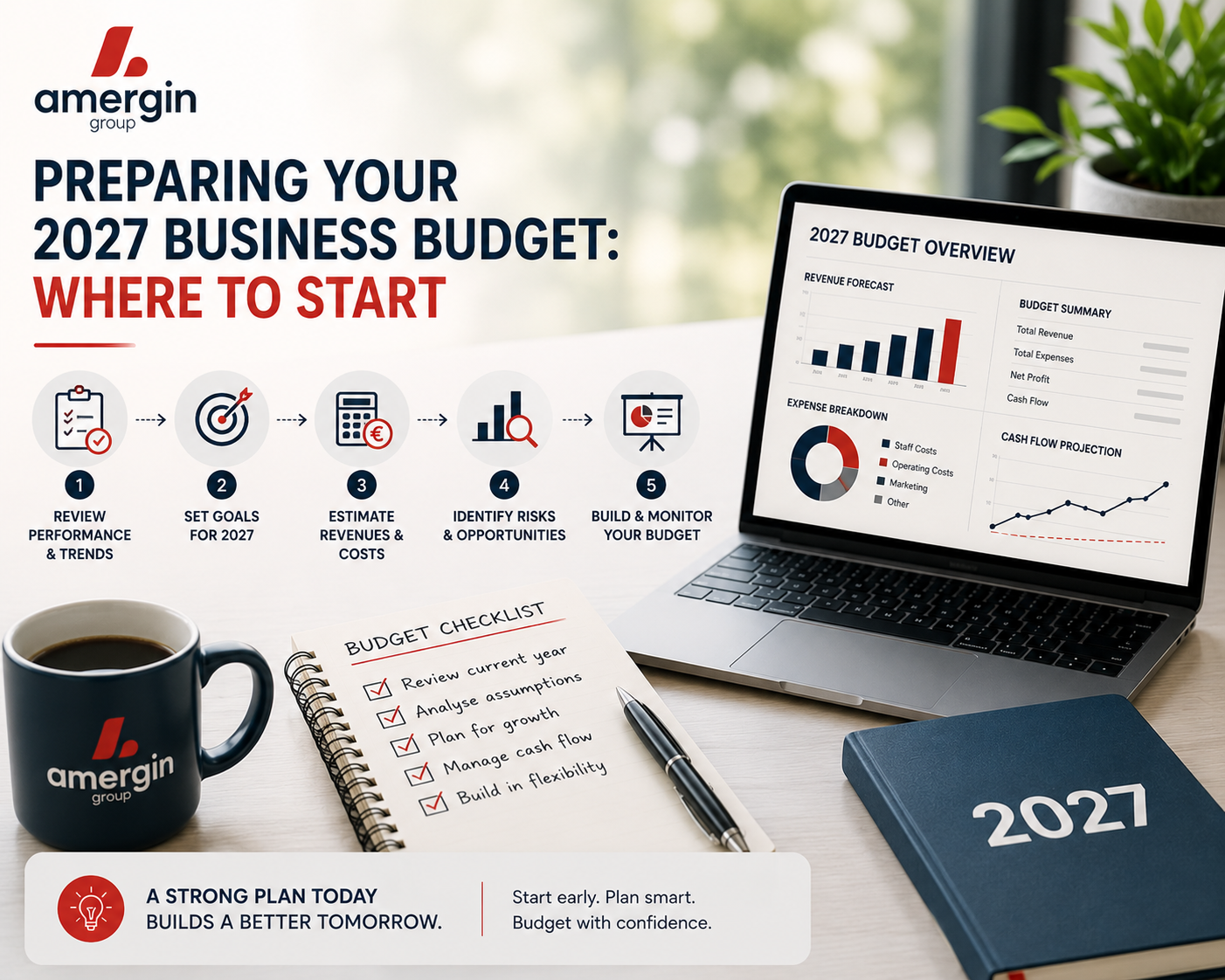
Preparing a business budget for 2027 should not begin with a blank spreadsheet, a percentage increase on last year’s figures, or an ambitious revenue target chosen because it sounds achievable. A strong 2027 business budget should begin with a clear understanding of how the business is performing today, what has changed during 2026, and what those changes are likely to mean for the year ahead.
For Irish SMEs, this matters more than ever because budgeting is no longer simply an annual finance exercise. Labour costs, tax obligations, customer behaviour, pricing, working capital requirements, supplier costs, technology investment, and wider economic conditions can all change significantly within twelve months. A budget built without examining these factors may look detailed, but it can still provide misleading guidance to management.
The strongest SME budgets are therefore not built around hope. They are built around evidence. They connect financial forecasting, cash flow forecasting, payroll planning, profitability analysis, working capital management, tax planning, scenario planning, and business strategy into one practical financial roadmap for the year ahead. Rather than simply asking how much revenue the business wants to generate in 2027, the budgeting process should examine what level of revenue is realistic, what it will cost to deliver, how much cash will be required to support it, and whether the resulting growth will actually improve profitability.
Timing is particularly important this year. Ireland’s Budget 2027 process is already underway, with the National Economic Dialogue held in June 2026 as part of the Government’s preparations for Budget 2027. Businesses preparing their own 2027 budgets before final national tax and policy measures are confirmed should therefore build flexibility into their assumptions and update relevant payroll, tax, employment-cost, or investment assumptions once final measures are known.
At Amergin, we work with Irish SMEs to turn budgeting into a practical management tool rather than a spreadsheet that is prepared once and forgotten. Through integrated accounting, payroll, finance, Fractional CFO support, operations, marketing, and business advisory, we help businesses connect their 2027 financial plan to real trading performance, operational priorities, and strategic objectives.
This guide explains where to start when preparing your 2027 SME budget, which assumptions deserve the most scrutiny, how to build realistic revenue and cost forecasts, and why cash flow, payroll, working capital, and scenario planning should be central to the process.
Start with 2026 actual performance, not 2027 ambition
One of the most common budgeting mistakes is beginning with the question, “How much do we want to grow next year?” A more useful starting point is asking, “What is the business actually doing now?” Before creating any 2027 projections, leadership should have a clear picture of current revenue, gross margin, operating expenses, payroll costs, cash flow, debtor performance, working capital, and profitability.
Historical performance provides the foundation for credible financial forecasting because it reveals how the business behaves in reality. A business may have set a €2 million revenue target for 2026, for example, but if current trading suggests the year will close closer to €1.7 million, building a 2027 budget from the original €2 million target immediately creates an unrealistic starting point. The same principle applies to costs. Supplier expenditure, payroll, technology subscriptions, insurance, marketing, utilities, and professional fees should be based on current run rates rather than figures that were approved twelve months ago.
This does not mean the 2027 budget should simply replicate 2026. The purpose of reviewing actual performance is to create an accurate baseline from which realistic changes can be modelled. Management accounts, financial dashboards, budget-versus-actual reports, payroll reports, and cash flow forecasts should all contribute to this baseline.
Irish Local Enterprise Office guidance similarly emphasises that financial projections should be built from clear assumptions and should include projected profit and loss, cash flow, and balance-sheet information. Its guidance also highlights the importance of monthly forecasting because annual totals can hide seasonal cash-flow problems.
Understand what drove your 2026 results
Knowing that revenue increased or profit declined is useful, but it is not enough to build an effective 2027 business budget. Leadership needs to understand what caused the result because different causes require different assumptions for the year ahead.
Revenue growth may have come from higher prices, new customers, additional capacity, one unusually large contract, or increased repeat business. Each of those drivers has different implications for 2027. A one-off project should not automatically be included in next year’s revenue baseline, while recurring revenue may provide greater confidence in future projections.
The same applies to expenditure. Higher costs may have resulted from deliberate investment in people, temporary project expenditure, inflation, poor cost control, or operational inefficiency. If an expense was genuinely one-off, carrying it automatically into the 2027 budget could understate expected profitability. If the increase reflects a structural change to the cost base, excluding it would make the budget artificially optimistic.
This analysis transforms budgeting from arithmetic into business planning. Instead of simply applying a percentage increase to last year’s figures, management begins to understand which aspects of performance are repeatable and which require adjustment.
Build the revenue budget from commercial reality
Revenue is often the most optimistic line in an SME budget, which is why it deserves particularly careful scrutiny. Sales projections should not begin with the profit figure management wants to achieve and work backwards into the revenue required. They should begin with evidence about customers, capacity, pricing, market demand, recurring income, confirmed work, and the sales pipeline.
A practical 2027 revenue forecast should distinguish between revenue that is highly predictable and revenue that depends on assumptions. Contracted recurring income, committed customer orders, and established repeat business can generally be forecast with greater confidence than early-stage sales opportunities or new-market expansion.
Leadership should also test whether the organisation has the capacity to deliver the projected revenue. A professional services firm cannot simply budget for 25% growth if its existing team is already operating at full capacity unless the financial model also includes recruitment or productivity improvements. A manufacturer planning stronger sales may require additional stock, equipment, production capacity, or supplier commitments. A growing retailer may require more inventory and working capital long before customer revenue is received.
Revenue growth therefore has financial consequences. The budget should capture those consequences rather than treating additional sales as pure upside.
Connect the sales pipeline to the financial forecast
A strong SME budget should create a visible connection between sales activity and financial outcomes. If management expects significant growth in 2027, there should be a credible commercial explanation behind the figure. That might include existing customer expansion, planned pricing changes, a measurable sales pipeline, increased marketing investment, new product launches, additional locations, or a defined route to market.
The Local Enterprise Office recommends that financial planning includes clear financial assumptions and, in its planning materials, connects projections with sales expectations, pricing, staffing requirements, operating costs, and cash flow.
This connection is important because revenue assumptions affect almost every other part of the budget. If higher revenue depends on additional marketing investment, that expenditure should be included. If it requires three new hires, payroll must reflect those hires. If it depends on giving customers longer payment terms, the cash flow forecast must account for slower cash collection.
A budget becomes significantly more reliable when every major growth assumption has a corresponding operational and financial assumption.
Review pricing before setting 2027 revenue targets
Revenue growth should not be confused with profitable growth. An SME can increase turnover and still produce weaker financial results if prices fail to cover rising labour, supplier, and overhead costs. Before finalising 2027 sales targets, businesses should therefore review whether their current pricing remains commercially sustainable.
A pricing and profitability review should consider gross margin by product or service, customer profitability, project profitability, discounting practices, labour requirements, supplier costs, and overhead recovery. Businesses that have not reviewed pricing recently may discover that long-standing customers or service packages are producing significantly lower margins than expected.
Pricing decisions can have a powerful effect on the 2027 budget because relatively small improvements in margin may generate more value than substantial increases in sales volume. A business that improves its gross margin while maintaining existing turnover may strengthen both profitability and cash generation without increasing operational workload at the same rate.
For this reason, budgeting should focus not only on “How much can we sell?” but also on “How profitable will those sales be?”
Build a realistic payroll budget
For many Irish SMEs, payroll is the largest recurring operating expense, which means 2027 payroll planning deserves substantially more attention than simply copying current salaries into the new budget. Payroll forecasting should include the complete cost of employment and reflect both existing employees and planned workforce changes.
Management should consider salary reviews, recruitment, employer PRSI, pension costs, overtime, bonuses, commissions, benefits, training, software licences, equipment, onboarding costs, and planned changes in staffing structure. If recruitment is expected during 2027, the budget should reflect when each employee is likely to join rather than assuming twelve months of cost automatically.
Businesses should also model recruitment against expected revenue and operational demand. Hiring earlier than necessary increases fixed costs, while hiring too late can restrict growth or place excessive pressure on existing employees. A robust financial forecast helps management determine when additional headcount becomes commercially sustainable.
Payroll planning should also remain adaptable because statutory rates and policy measures can change. Businesses finalising budgets before all 2027 measures are confirmed should maintain clearly identified assumptions that can be updated once final legislation or Revenue guidance is available.
Do not forget the full cost of growth
Growth requires investment, and some of the most dangerous SME budgets are those that forecast significant revenue increases without increasing the resources required to produce those sales. Additional turnover may require more employees, marketing expenditure, inventory, subcontractors, technology, insurance, vehicles, premises, professional support, or customer service capacity.
A growth budget for 2027 should therefore ask what the organisation must spend before additional revenue can be generated. In many cases, those costs will occur months before the associated income is collected, creating a larger working capital requirement.
This is particularly important where businesses are planning a major expansion, entering new markets, launching services, increasing stock levels, or investing in technology. The budget should include both the direct expenditure and the financial effect of implementation delays or slower-than-expected revenue generation.
Growth should strengthen the business rather than create hidden liquidity pressure.
Build the cash flow forecast alongside the budget
One of the most important distinctions in financial planning is the difference between a profit forecast and a cash flow forecast. A business can produce an impressive budgeted profit while still experiencing serious liquidity problems during the year because customers do not pay at the same time revenue is recognised.
This is why 2027 cash flow forecasting should be developed alongside the profit and loss budget rather than after it. The cash flow forecast should reflect when customers are expected to pay, when suppliers must be settled, and when payroll, tax, rent, loan repayments, capital expenditure, and other commitments will leave the bank account.
Local Enterprise Office guidance describes cash flow projections as estimates of how money will move into and out of the business on a monthly basis and notes that they help identify cash surges or shortages before significant decisions such as recruitment, investment, or borrowing are made.
This distinction can completely change how management views the 2027 plan. A profitable growth strategy may still require additional working capital or a funding facility if expenditure occurs before customer cash is collected.
Examine working capital assumptions carefully
Working capital management should form a central part of the 2027 budgeting process because changes in customer payments, supplier terms, and inventory levels can materially affect liquidity even when the profit forecast remains unchanged.
Businesses should review current debtor days and determine whether customer payment behaviour is improving or deteriorating. If the 2027 budget assumes stronger sales while debtor days remain high, the value of outstanding invoices may grow considerably, tying up more cash within the business.
Inventory-based businesses should examine expected stock levels, turnover, seasonal requirements, and supplier lead times. Growth may require additional inventory, but over-ordering can quickly consume cash that could otherwise fund payroll or investment.
Supplier terms should also be included in working capital assumptions. A business that collects from customers after 60 days but pays suppliers after 30 days is effectively financing that gap itself. Understanding these timing relationships allows management to calculate whether existing cash reserves are sufficient to support the 2027 plan.
Budget for tax instead of reacting to deadlines
Tax obligations should be treated as predictable cash commitments within the budget rather than surprise payments when deadlines arrive. VAT, PAYE, employer PRSI, corporation tax, and other relevant taxes should be included within financial forecasts based on the expected trading profile of the business.
Revenue requires companies to calculate and pay preliminary Corporation Tax and file their corporation tax return within the applicable deadlines, with the return and balance generally due nine months after the accounting period ends and electronic filing requirements applying through ROS.
Revenue also provides facilities for certain current tax liabilities to be managed through direct debit, including VAT and employers’ Income Tax obligations such as PRSI and USC.
The exact approach will depend on the business, but the budgeting principle remains consistent: funds that will ultimately be payable to Revenue should not be mistaken for surplus operational cash. Building tax provisions and tax reserves into the 2027 budget improves liquidity planning and reduces the risk of statutory payments disrupting business operations.
Review capital expenditure and strategic investment
The 2027 budget should clearly distinguish between everyday operating expenses and larger strategic investments. Equipment, vehicles, technology platforms, premises improvements, automation projects, product development, and market expansion may require significant cash commitments but could also improve productivity or growth over several years.
Every major investment should be connected to a business objective. Management should understand the expected cost, timing, financial return, impact on cash flow, and any additional costs that may arise after implementation.
Businesses should also challenge the assumption that everything must happen immediately. Phasing investment throughout 2027 can preserve liquidity while still allowing strategic projects to progress. Scenario planning can further show whether the business could continue supporting those investments if revenue were weaker than expected.
Good budgeting is not about avoiding expenditure. It is about allocating capital deliberately.
Build a best-case, expected and downside scenario
No 2027 budget should assume that one outcome will occur with certainty. A more resilient approach combines the main budget with scenario planning for Irish SMEs, allowing management to understand how different trading conditions could affect profitability and cash.
The expected scenario should represent management’s most realistic view based on current information. A best-case scenario can model stronger sales, improved margins, faster debtor collection, or successful new contracts while accounting for the additional cost and working capital that growth may require. A downside scenario can model weaker demand, customer losses, higher costs, delayed payments, or operational disruption.
Scenario planning is particularly powerful when each model includes clear management responses. The business may decide that additional hiring will only proceed when specific revenue thresholds are achieved, for example, or that discretionary investment will be reviewed if cash falls below an agreed level.
Local Enterprise Office planning guidance specifically includes financial assumptions and sensitivity analysis within business planning, reinforcing the value of testing how changing assumptions affect financial outcomes.
Agree the KPIs that will tell you whether the budget is working
A budget only creates value if actual performance is measured against it. Before 2027 begins, management should agree which financial KPIs and business performance metrics will be reviewed regularly throughout the year.
Relevant measures may include monthly revenue, gross margin, EBITDA or operating profit, payroll as a percentage of revenue, debtor days, working capital, cash reserves, recurring revenue, inventory turnover, customer acquisition costs, or project profitability. The right KPIs depend on the business model, but they should clearly connect with the assumptions used to build the budget.
A consolidated financial dashboard can make this information easier to monitor by bringing accounting, payroll, cash flow, and operational performance into one reporting structure. This allows leadership to identify variance early rather than discovering at year-end that the business has been drifting away from plan for months.
The purpose of KPIs is not to produce more reports. It is to create earlier, better decisions.
Decide how often the 2027 budget will be reforecast
One of the most valuable decisions a business can make during the budgeting process is agreeing in advance that the budget will change.
A budget is based on assumptions, and assumptions inevitably evolve. Rather than treating variance as failure, businesses should establish a regular reforecasting process that incorporates actual performance and updated expectations.
Quarterly reforecasting may be sufficient for relatively stable organisations, while rapidly growing or seasonal businesses may benefit from monthly rolling forecasts. The important principle is that leadership does not continue making decisions using assumptions it already knows are outdated.
The budgeting process should therefore establish not only the financial plan for January 2027, but also the management rhythm that will keep that plan relevant through December.
Real-life example: a stronger budget changed the growth plan
Consider an Irish professional services SME entering its 2027 planning cycle after a strong year of revenue growth. Management initially intended to increase turnover by another 20% and recruit several employees early in the year to support expected demand.
A detailed budgeting review, however, showed that the picture was more complicated. Although turnover had increased, gross margin had fallen because salary and subcontractor costs had grown faster than pricing. Customer payment periods had also lengthened, meaning the business was carrying a greater debtor balance despite stronger sales.
Rather than simply applying another growth target to the existing cost base, the leadership team rebuilt the budget from current trading performance. Pricing assumptions were reviewed, recruitment was phased against confirmed revenue, cash flow forecasting was strengthened, and a working capital target was introduced. Best-case, expected, and downside scenarios were then developed to understand how different sales outcomes would affect liquidity.
The revised plan still targeted growth, but it prioritised profitable and financially sustainable growth. Management entered 2027 with clearer hiring triggers, stronger pricing discipline, improved cash reserves, and far greater visibility over the financial consequences of expansion.
The business did not become less ambitious. It became more prepared.
How Amergin helps Irish SMEs prepare their 2027 budgets
Amergin helps Irish SMEs build practical financial plans that connect strategy with the numbers required to deliver it. Our approach combines 2027 business budgeting, financial forecasting, rolling forecasts, management accounts, cash flow forecasting, working capital management, payroll planning, tax planning, profitability analysis, scenario planning, KPI reporting, and Fractional CFO support.
We work with leadership teams to understand current trading performance, challenge assumptions, build realistic revenue and cost projections, identify future cash requirements, and create financial models that support commercial decision-making. Because Amergin also works across accounting, payroll, operations, marketing, finance, and strategic advisory, the budgeting process can incorporate the wider decisions that drive business performance rather than considering finance in isolation.
The objective is not simply to produce a spreadsheet that shows where the business hopes to be by December 2027. It is to create an operating financial plan that helps management decide when to recruit, where to invest, how to protect margins, how much working capital will be required, and what action to take when performance differs from expectations.
The deeper truth: the best budgets create better conversations
A strong business budget does much more than produce financial targets. It forces leadership teams to have the conversations that determine whether strategy is genuinely achievable.
Can the sales team support the revenue forecast? Does the organisation have enough capacity to deliver the work? Are current prices protecting gross margin? Can cash flow support recruitment before customers pay? Are tax reserves sufficient? Which investments deserve priority? What happens if market conditions become more difficult?
These questions are where the real value of budgeting exists. The numbers provide structure, but the conversations behind those numbers improve decision-making.
The strongest 2027 budgets will therefore not necessarily be the most detailed. They will be the ones built around realistic assumptions, clear strategic choices, strong financial visibility, and a management process that allows the plan to evolve throughout the year.
The takeaway
Preparing your 2027 business budget should begin with understanding the business you have today rather than projecting the business you hope to have tomorrow. Current trading performance, revenue quality, pricing, margins, payroll, working capital, tax obligations, operational capacity, and cash flow should all shape the assumptions used for the year ahead.
For Irish SMEs, combining budgeting, financial forecasting, cash flow planning, payroll forecasting, working capital management, tax planning, profitability analysis, scenario planning, management accounts, financial dashboards, and Fractional CFO support creates a far stronger foundation for decision-making.
The aim should not be to predict every detail of 2027 perfectly. No business can do that. The aim is to create a financial plan that is realistic enough to guide decisions, flexible enough to adapt when conditions change, and detailed enough to reveal financial pressure before it becomes a problem.
A good budget tells you what you want to achieve. A great budget shows you whether you can afford to achieve it, what must happen for the plan to work, and how you will respond when reality inevitably differs from the forecast.
About Amergin Consulting Ltd.
Amergin Consulting Ltd. is a Dublin-based chartered accountancy and business advisory firm serving Ireland’s SMEs and growth companies across construction, technology, professional services, and renewable energy.
We specialise in Accounting, Payroll, Taxation, and CFO Services that help businesses build stronger foundations for profit and compliance.
Need help running a year-end tax review or planning your 2026 changes?
Amergin Consulting’s finance and tax team can help you identify deductions, forecast cash flow, and ensure full compliance before the year closes.
Book your 30-minute FREE consultation: https://calendly.com/amergin-group_free/30min-finance-consultation
Disclaimer
This article is for general informational purposes only and does not constitute financial or tax advice. While every effort has been made to ensure accuracy, legislation may change upon enactment of the Finance Act 2025.
Public should seek professional advice tailored to their specific circumstances before acting on any points discussed.
Sources and Resources
Revenue Commissioners – Business taxes, Corporation Tax, VAT, PAYE and payment guidance. Revenue confirms companies’ Corporation Tax payment and filing obligations and provides current information on ROS and tax payment options.
Department of Finance – Budget 2027 preparation and Ireland’s National Economic Dialogue. The June 2026 dialogue forms part of the Government’s current Budget 2027 preparation process.
Local Enterprise Office – Business planning, financial projections, budgeting and cash flow forecasting guidance for Irish businesses.
Amergin Consulting – Accounting, payroll, financial planning, Fractional CFO and business advisory support for Irish SMEs.