
Published: March 2026
Author: Amergin Consulting Ltd.
Target Audience: Business Owners, Small Business Seeking Financial Stability, Entrepreneurs, Start-Ups, Irish SMEs
Book a meeting: https://calendly.com/amergin-group_free/30min-finance-consultation
Payroll compliance is often treated as an administrative obligation.
In many SMEs, it sits quietly in the background of operations. Salaries are processed, PAYE submissions are sent through Revenue’s system, and payslips are issued. As long as employees are paid and filings are completed, the assumption is that everything is under control.
However, payroll compliance is not simply a technical exercise.
It is a discipline.
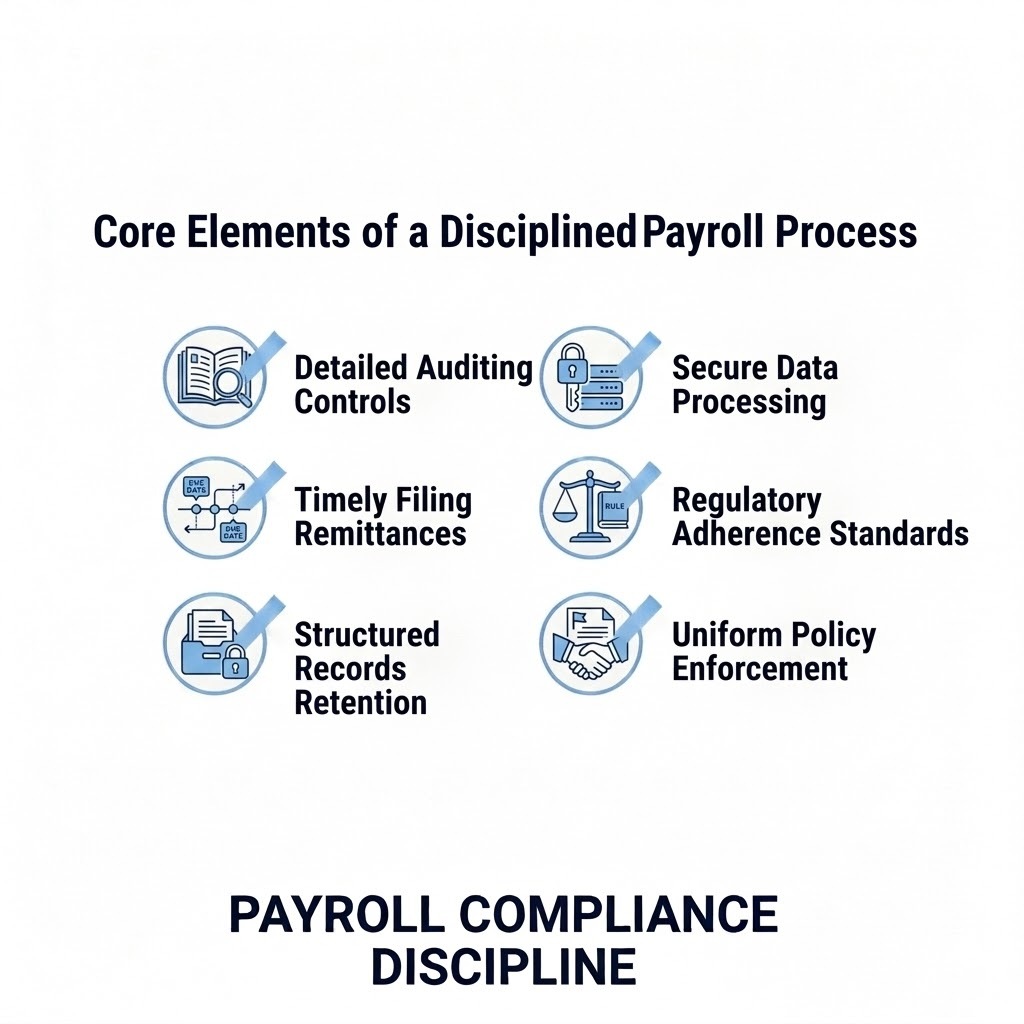
Payroll compliance discipline protects the organisation from financial risk, regulatory exposure, reputational damage, and internal instability. It ensures that payroll processes remain reliable as the business grows, employees join or leave, tax rules evolve, and financial pressure increases.
In Ireland, the payroll environment has become more structured since the introduction of PAYE Modernisation. Employers must report pay and deductions to Revenue in real time, maintain accurate employee records, and ensure payroll calculations comply with evolving statutory requirements. This level of transparency means informal payroll processes are increasingly fragile.
Amergin works with Irish SMEs and growing businesses that recognise payroll compliance as part of a broader financial discipline. Amergin positions itself as an integrated partner across accounting, payroll, finance, marketing, operations, and advisory. That integration matters because payroll compliance does not exist in isolation. It intersects with cashflow management, hiring decisions, financial reporting, and organisational trust.
This article explores why payroll compliance discipline matters, how weaknesses develop quietly inside SMEs, and how structured payroll governance protects people, performance, and long-term stability.
Compliance is not a once-a-month task
One of the most common misconceptions about payroll compliance is that it happens only when payroll runs.
In reality, compliance is continuous.
Employee information must be accurate before payroll is processed. Changes to tax credits must be reflected correctly. Benefits-in-kind must be recorded and reported properly. Pension deductions must align with contractual agreements. PAYE, PRSI, and USC calculations must follow Revenue guidelines precisely.
Compliance therefore begins long before a payslip is generated.
When payroll systems are informal, errors often originate upstream. An employee’s contract may change but not be updated in payroll records. A benefit may be introduced without adjusting tax treatment. Overtime or commission payments may be calculated inconsistently.
Each small inconsistency introduces risk.
Payroll compliance discipline ensures that every stage of the payroll process supports accurate reporting.
PAYE Modernisation has increased accountability
Ireland’s PAYE Modernisation system fundamentally changed payroll compliance expectations.
Employers must now report payroll information to Revenue on or before the date employees are paid. This real-time reporting requirement means payroll errors cannot be corrected quietly at the end of the year.
If incorrect payroll data is submitted, adjustments must be made immediately.
Revenue expects employers to maintain accurate payroll records and to operate PAYE correctly. These obligations include correct calculation of PAYE, PRSI, and USC, accurate recording of benefits-in-kind, and timely submission of payroll data.
For SMEs, this system increases transparency but also increases responsibility.
Payroll compliance discipline ensures that reporting obligations are met consistently rather than reactively.
Weak compliance structures fail under pressure
In many SMEs, payroll compliance works well until pressure increases.
Pressure can arrive in several forms. Rapid hiring increases payroll complexity. Remote working arrangements introduce new benefit considerations. Revenue compliance updates require process changes. Staff turnover disrupts internal knowledge.
When payroll processes rely heavily on individual expertise rather than documented systems, compliance becomes vulnerable.
Errors multiply when the person responsible for payroll is absent. Submission deadlines become stressful rather than routine. Leadership becomes anxious about potential Revenue exposure.
Compliance discipline transforms payroll from a fragile process into a structured system.
Financial discipline and payroll compliance are connected
Payroll compliance is often discussed separately from financial planning, but the two are closely connected.
Payroll commitments represent one of the largest recurring costs in most SMEs. PAYE, PRSI, pension contributions, and benefits must all be processed accurately and funded reliably.
Amergin frequently emphasises that many businesses fail due to poor cashflow rather than lack of profitability. If payroll obligations are not integrated into cashflow forecasting, financial strain may appear suddenly.
Compliance discipline ensures payroll obligations are visible within financial planning.
When payroll commitments, tax liabilities, and contribution costs are mapped clearly in advance, the organisation avoids reactive stress.
Documentation protects the organisation
A critical element of payroll compliance discipline is documentation.
Many SMEs rely on institutional knowledge rather than written processes. A trusted employee understands the system, knows where information is stored, and manages adjustments informally.
While this may function during stable periods, it creates a single point of failure.
If that individual leaves or becomes unavailable, the payroll process becomes vulnerable. Compliance obligations may be misunderstood or overlooked.
Strong payroll discipline includes documented workflows that clarify:
Where payroll data originates
Who validates payroll inputs
Who processes payroll calculations
Who submits payroll data to Revenue
How payroll records are retained
Documentation ensures continuity and protects the organisation against disruption.
Compliance discipline strengthens employee trust
Payroll compliance is not only about Revenue obligations. It also affects employee confidence.
Employees expect payroll accuracy. Payslips should reflect correct deductions. Tax treatment should be consistent. Pension contributions should match agreements. Benefits should be reported properly.
When payroll errors occur repeatedly, trust erodes.
Employees may question whether the organisation manages financial matters responsibly. Even small inaccuracies can create frustration if they occur frequently.
Compliance discipline ensures employees experience reliability rather than uncertainty.
Real-life example: compliance clarity reduces stress
An Irish SME had grown steadily from a small team to more than twenty employees. Payroll had been managed internally for years and appeared to function well. Salaries were paid on time, and Revenue submissions were completed regularly.
However, as hiring accelerated, complexity increased. Pension contributions varied across employees. Commission structures were introduced. Remote working allowances required additional reporting.
Payroll adjustments began occurring more frequently. PAYE submissions occasionally required corrections. Leadership grew concerned about compliance exposure.
Amergin conducted a payroll compliance review. Payroll processes were documented. Input deadlines were standardised. Validation procedures were introduced. Payroll reporting was aligned with Revenue compliance requirements. Payroll obligations were integrated into the company’s rolling cashflow forecast.
The outcome was not simply administrative improvement. Leadership confidence increased. Employees experienced greater consistency. Payroll deadlines became routine rather than stressful.
Compliance discipline had stabilised the system.
Integration strengthens payroll resilience
Payroll compliance discipline works best when integrated into broader financial systems.
Payroll data should align with bookkeeping records. Payroll costs should be reflected accurately in management reports. Payroll obligations should be included in cashflow forecasts. Hiring decisions should consider payroll contribution impact.
When payroll operates independently from financial planning, blind spots emerge.
Amergin’s integrated advisory approach ensures payroll compliance supports financial clarity and organisational stability simultaneously.
Simplicity encourages consistent compliance
Compliance systems often become unnecessarily complex.
The goal of payroll discipline is not complexity but clarity.
Clear deadlines for payroll inputs
Clear validation steps before submission
Clear documentation of payroll procedures
Clear alignment with Revenue requirements
Clear integration with financial reporting
Simplicity encourages consistent adherence. When processes are understandable, they are followed reliably.
The deeper truth: compliance discipline reflects leadership discipline
Payroll compliance ultimately reflects organisational culture.
Businesses that treat payroll compliance seriously demonstrate respect for employees, regulators, and financial responsibility. Businesses that treat compliance casually expose themselves to unnecessary risk.
Compliance discipline signals maturity.
It shows that leadership understands the importance of stability as well as growth.
The takeaway
Payroll compliance discipline is not merely about avoiding penalties.
It protects the organisation’s credibility. It safeguards employees. It strengthens financial stability. It ensures the business can grow without exposing itself to unnecessary regulatory risk.
Weak payroll compliance structures may appear adequate during calm periods. Under pressure, they break.
Disciplined payroll systems absorb pressure rather than amplify it.
For Irish SMEs, compliance discipline is not optional. It is foundational.
About Amergin Consulting Ltd.
Amergin Consulting Ltd. is a Dublin-based chartered accountancy and business advisory firm serving Ireland’s SMEs and growth companies across construction, technology, professional services, and renewable energy.
We specialise in Accounting, Payroll, Taxation, and CFO Services that help businesses build stronger foundations for profit and compliance.
Need help running a year-end tax review or planning your 2026 changes?
Amergin Consulting’s finance and tax team can help you identify deductions, forecast cash flow, and ensure full compliance before the year closes.
Book your 30-minute FREE consultation: https://calendly.com/amergin-group_free/30min-finance-consultation
Disclaimer
This article is for general informational purposes only and does not constitute financial or tax advice. While every effort has been made to ensure accuracy, legislation may change upon enactment of the Finance Act 2025.
Public should seek professional advice tailored to their specific circumstances before acting on any points discussed.
Sources and Resources
Amergin Consulting – Integrated Financial & Marketing Consulting for Irish SMEs and Growing Businesses
https://amergin.ie
Amergin Payroll Services – Payroll Processing and Compliance Support
https://amergin.ie
Revenue Commissioners – PAYE Modernisation and Employer Obligations
https://www.revenue.ie
Revenue Tax and Duty Manual Part 42-04-35 – Employer Obligations Under PAYE
https://www.revenue.ie
Companies Act 2014 (Ireland), Section 282 – Accounting Records
https://www.irishstatutebook.ie
Harvard Business Review – Operational Discipline and Organisational Stability
https://hbr.org
MIT Sloan Management Review – Organisational Resilience Under Growth Pressure
https://sloanreview.mit.edu