
Published: July 2026
Author: Amergin Consulting Ltd.
Target Audience: Business Owners, Small Business Seeking Financial Stability, Entrepreneurs, Start-Ups, Irish SMEs
Book a meeting: https://calendly.com/amergin-group_free/30min-finance-consultation
The middle of the year is one of the most valuable yet underused opportunities for any SME to strengthen its financial performance.
January is often filled with planning. Budgets are approved, sales targets are set, recruitment plans are agreed, and leadership teams begin the year with a clear sense of direction. The months that follow, however, rarely unfold exactly as expected. Customer demand changes, operating costs increase, suppliers adjust pricing, recruitment takes longer than planned, and unexpected opportunities or challenges reshape business priorities.
By the time the business reaches the halfway point of the year, the financial landscape has often changed significantly.
Continuing to operate using assumptions made six months earlier can lead to poor decisions, missed opportunities, and unnecessary financial pressure. Yet many SMEs do exactly that. They wait until year-end to assess performance, only to discover that there was still time to correct course had they reviewed their position earlier.
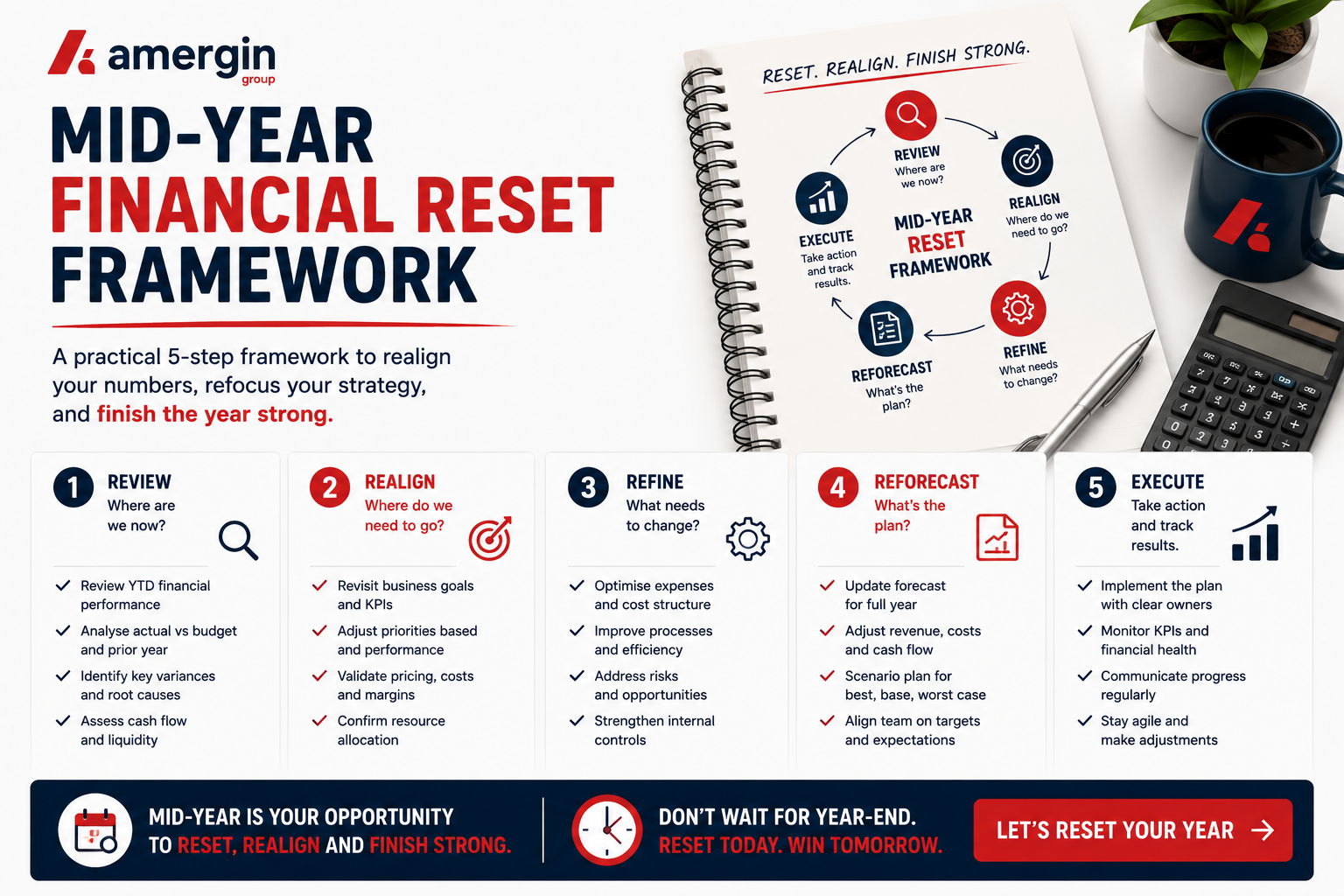
This is why every growing business should have a structured Mid-Year Financial Reset Framework.
Rather than treating June or July as simply another month, businesses should use this period to reassess performance, validate assumptions, update financial forecasts, and realign operational priorities. A mid-year financial reset is not about rewriting the entire business plan. It is about ensuring that decisions for the second half of the year are based on current reality rather than outdated expectations.
Amergin works with Irish SMEs and growing businesses that want to strengthen financial clarity and improve long-term decision-making. Amergin positions itself as an integrated partner across accounting, payroll, finance, marketing, operations, and advisory. This integrated approach ensures that financial reviews extend beyond accounting reports and consider every aspect of business performance that influences profitability, cashflow, and sustainable growth.
This article explores how Irish SMEs can build a practical Mid-Year Financial Reset Framework, what areas should be reviewed, and why businesses that reset regularly are better positioned to finish the year successfully.
Why the middle of the year is the best time to reassess financial performance
Business planning should never be treated as a once-a-year exercise.
Annual budgets and forecasts provide an important starting point, but they are based on assumptions that inevitably change. Markets evolve, customer behaviour shifts, inflation affects operating costs, recruitment plans develop differently than expected, and new opportunities emerge throughout the year.
The middle of the year provides enough historical information to assess performance accurately while leaving sufficient time to influence the remainder of the financial year.
Unlike year-end reviews, which primarily evaluate what has already happened, a mid-year review allows leadership teams to make meaningful adjustments before it is too late.
This timing makes the mid-year review uniquely valuable. It bridges the gap between planning and execution.
Businesses that review their financial position halfway through the year are able to respond to changing circumstances with confidence instead of waiting until year-end to discover that opportunities have already been missed.
Compare performance against reality, not just against the budget
One of the first objectives of a financial reset should be to compare actual business performance with the assumptions that shaped the original budget.
Many businesses focus exclusively on whether targets have been achieved. While this is important, the more valuable question is why performance differs from expectations.
Revenue may be ahead of target because demand exceeded forecasts, or because pricing changed. It may be below expectations because customers delayed purchasing decisions or market conditions softened. Payroll costs may have increased because recruitment accelerated, while supplier costs may have risen due to inflation or supply chain pressures.
Understanding these underlying causes provides much greater insight than simply measuring variance.
A Mid-Year Financial Reset Framework should therefore encourage businesses to analyse trends, identify recurring patterns, and understand the drivers behind financial performance rather than concentrating solely on headline figures.
The goal is to improve future decisions, not simply explain past results.
Update financial forecasts to reflect current conditions
Forecasts lose value when they are not updated.
A forecast prepared in January reflects the information available at that time. Six months later, much of that information has changed. Continuing to rely on outdated projections creates unnecessary uncertainty and weakens financial planning.
A mid-year financial reset should include a comprehensive review of revenue forecasts, operating costs, payroll expenditure, gross margins, cashflow projections, capital investment plans, and financing requirements.
Updating these forecasts provides a far more accurate picture of where the business is heading.
This enables leadership teams to identify potential challenges early, allocate resources more effectively, and make investment decisions with greater confidence.
Forecasting should be viewed as a living process rather than a fixed document.
Businesses that continually refine their forecasts are better prepared to adapt to changing market conditions.
Cashflow should receive the same attention as profitability
Profitability measures success over time.
Cashflow determines whether the business can continue operating comfortably every day.
Many SMEs focus heavily on profit and loss reports while paying considerably less attention to liquidity. However, strong profits do not automatically guarantee strong cashflow.
Customer payment delays, seasonal fluctuations, increasing payroll commitments, supplier obligations, and tax liabilities all influence the availability of cash throughout the year.
A Mid-Year Financial Reset Framework should therefore include a detailed review of cashflow performance.
Leadership should assess debtor ageing, creditor balances, projected payroll commitments, VAT and tax obligations, financing arrangements, and forecast liquidity for the remainder of the year.
This review often identifies opportunities to strengthen cashflow before financial pressure develops.
Managing liquidity proactively is significantly easier than responding to cash shortages after they occur.
Review payroll and workforce investment
Payroll is often the largest recurring investment made by an SME.
For this reason, it deserves careful consideration during any mid-year financial review.
Businesses should examine whether current staffing levels remain aligned with operational requirements and future growth plans. Recruitment strategies developed at the beginning of the year may require adjustment based on current trading conditions, customer demand, and financial performance.
The review should also consider labour cost trends, overtime, employer PRSI, pension contributions, employee productivity, retention, and workforce utilisation.
This analysis helps ensure that payroll investment continues to support both operational performance and financial sustainability.
Rather than viewing payroll solely as an expense, businesses should evaluate it as an investment in long-term capability.
Examine profitability at a deeper level
Revenue growth does not necessarily indicate stronger financial performance.
A mid-year financial reset provides an excellent opportunity to examine profitability in greater detail.
This includes reviewing gross margins, net margins, customer profitability, project profitability, product performance, and pricing structures.
Businesses frequently discover that some of their busiest customers or services generate relatively modest returns once labour, overheads, and indirect costs are fully considered.
Likewise, some products or services may consistently outperform expectations and deserve greater strategic focus.
Understanding where profit is actually generated allows businesses to allocate resources more effectively during the second half of the year.
Profitability analysis transforms financial reporting into strategic decision-making.
Reassess strategic priorities
Financial performance should never be reviewed in isolation.
A Mid-Year Financial Reset Framework should also consider whether the business's strategic priorities remain appropriate.
Projects that appeared critical in January may no longer deliver the same value. Market conditions may have created new opportunities. Customer needs may have evolved. Technology investments may require acceleration, while other initiatives may need to be postponed.
Reviewing strategic priorities ensures that leadership attention remains focused on the areas with the greatest potential impact.
This does not mean abandoning the annual plan. It means refining it based on current evidence. The strongest businesses are not those that follow a plan without question.
They are the ones that adapt intelligently while remaining committed to their long-term objectives.
Strengthen financial reporting and business visibility
A successful financial reset depends on accurate and timely information.
Many SMEs continue to rely on disconnected spreadsheets, manually prepared reports, and fragmented financial data. This makes it difficult to identify trends quickly and slows decision-making.
A consolidated financial dashboard provides significantly greater visibility.
By integrating accounting data, payroll information, cashflow forecasts, operational KPIs, and profitability reporting into one system, leadership teams gain a complete understanding of business performance.
This level of visibility supports faster, more confident decisions and ensures that the financial reset is based on reliable information. Clear reporting creates clarity of thought.
Real-life example: a mid-year review changed the direction of the business
An Irish SME entered the year with ambitious growth objectives, expecting strong demand across several key service areas.
By June, turnover was broadly in line with expectations, but profitability had declined. Labour costs had increased due to additional recruitment, supplier prices had risen more quickly than anticipated, and several long-standing clients were still operating under pricing agreements established years earlier.
Management initially believed the solution was simply to generate more sales.
Amergin conducted a structured mid-year financial reset.
The review identified several areas where assumptions no longer reflected reality. Revenue forecasts were updated, pricing structures were reviewed, payroll projections were revised, and cashflow forecasting was strengthened.
Rather than increasing sales activity indiscriminately, the business focused on improving margins, refining customer pricing, and prioritising its most profitable service lines.
By the end of the financial year, profitability had improved despite only modest revenue growth. The turning point was not a new strategy. It was taking the time to review the existing one.
A financial reset builds confidence for the second half of the year
Business owners often feel under pressure to remain committed to the plans they established at the beginning of the year.
In reality, the ability to adjust plans based on new information is a sign of effective leadership. A structured financial reset creates confidence because it replaces uncertainty with evidence.
Leadership teams gain a clearer understanding of current performance, future risks, and available opportunities. Decisions become more objective because they are supported by accurate financial information rather than assumptions.
The second half of the year becomes an opportunity to improve outcomes rather than simply complete the original plan.
How Amergin helps businesses implement a Mid-Year Financial Reset Framework
Amergin helps Irish SMEs build structured mid-year financial review processes that strengthen decision-making and improve business performance.
This includes reviewing financial statements, updating forecasts, analysing profitability, improving cashflow forecasting, assessing payroll costs, evaluating working capital, and developing financial dashboards that provide ongoing visibility into business performance.
By combining expertise across accounting, payroll, finance, operations, marketing, and strategic advisory, Amergin provides businesses with a comprehensive framework for making better decisions during the second half of the year.
The objective is not simply to review numbers. It is to improve the quality of every decision that follows.
The deeper truth: the strongest plans are the ones that evolve
Every successful business begins with a plan. The most successful businesses also understand that plans must evolve.
Markets change. Customers change. Costs change. Opportunities change.
Businesses that review their financial position regularly remain aligned with reality. They make decisions based on current information rather than historical assumptions, allowing them to adapt confidently without losing sight of their long-term goals.
A Mid-Year Financial Reset Framework provides the structure needed to make those adjustments deliberately rather than reactively.
The takeaway
The middle of the year is far more than a calendar milestone.
It is one of the most valuable opportunities for Irish SMEs to strengthen financial performance before the year concludes.
By reviewing financial results, updating forecasts, improving cashflow planning, reassessing payroll investment, analysing profitability, refining strategic priorities, and strengthening financial reporting, businesses position themselves for a stronger second half of the year.
A structured Mid-Year Financial Reset Framework transforms financial reviews from retrospective reporting into proactive business management.
Strong businesses do not simply measure progress. They use what they learn to improve the journey ahead. Because the best time to correct course is not at year-end. It is while there is still time to influence the outcome.
About Amergin Consulting Ltd.
Amergin Consulting Ltd. is a Dublin-based chartered accountancy and business advisory firm serving Ireland’s SMEs and growth companies across construction, technology, professional services, and renewable energy.
We specialise in Accounting, Payroll, Taxation, and CFO Services that help businesses build stronger foundations for profit and compliance.
Need help running a year-end tax review or planning your 2026 changes?
Amergin Consulting’s finance and tax team can help you identify deductions, forecast cash flow, and ensure full compliance before the year closes.
Book your 30-minute FREE consultation: https://calendly.com/amergin-group_free/30min-finance-consultation
Disclaimer
This article is for general informational purposes only and does not constitute financial or tax advice. While every effort has been made to ensure accuracy, legislation may change upon enactment of the Finance Act 2025.
Public should seek professional advice tailored to their specific circumstances before acting on any points discussed.
Sources and Resources
Amergin Consulting – Integrated Financial & Marketing Consulting for Irish SMEs and Growing Businesses
https://amergin.ie
Revenue Commissioners – Business Tax, Cashflow and Financial Planning Guidance
https://www.revenue.ie
Enterprise Ireland – Financial Planning and Business Growth Resources
https://www.enterprise-ireland.com
Local Enterprise Office (LEO) – Business Planning and SME Development Supports
https://www.localenterprise.ie
Institute of Directors Ireland – Strategic Governance and Business Performance
https://www.iodireland.ie
Harvard Business Review – Strategic Planning, Business Reviews and Organisational Performance
https://hbr.org
MIT Sloan Management Review – Financial Agility, Forecasting and Decision-Making
https://sloanreview.mit.edu