
Mid-Year Financial Check for Irish SMEs: Reviewing Performance, Cash Flow and Priorities
Published: July 2026
Author: Amergin Consulting Ltd.
Target Audience: Business Owners, Small Business Seeking Financial Stability, Entrepreneurs, Start-Ups, Irish SMEs
Book a meeting: https://calendly.com/amergin-group_free/30min-finance-consultation
For many Irish SMEs, the first half of the year passes in a blur. Businesses focus on delivering projects, managing employees, winning new customers, meeting payroll, keeping clients happy, and responding to the day-to-day demands of running a company. Before long, six months have passed, and attention naturally turns towards the second half of the financial year.
This point in the calendar presents an invaluable opportunity.
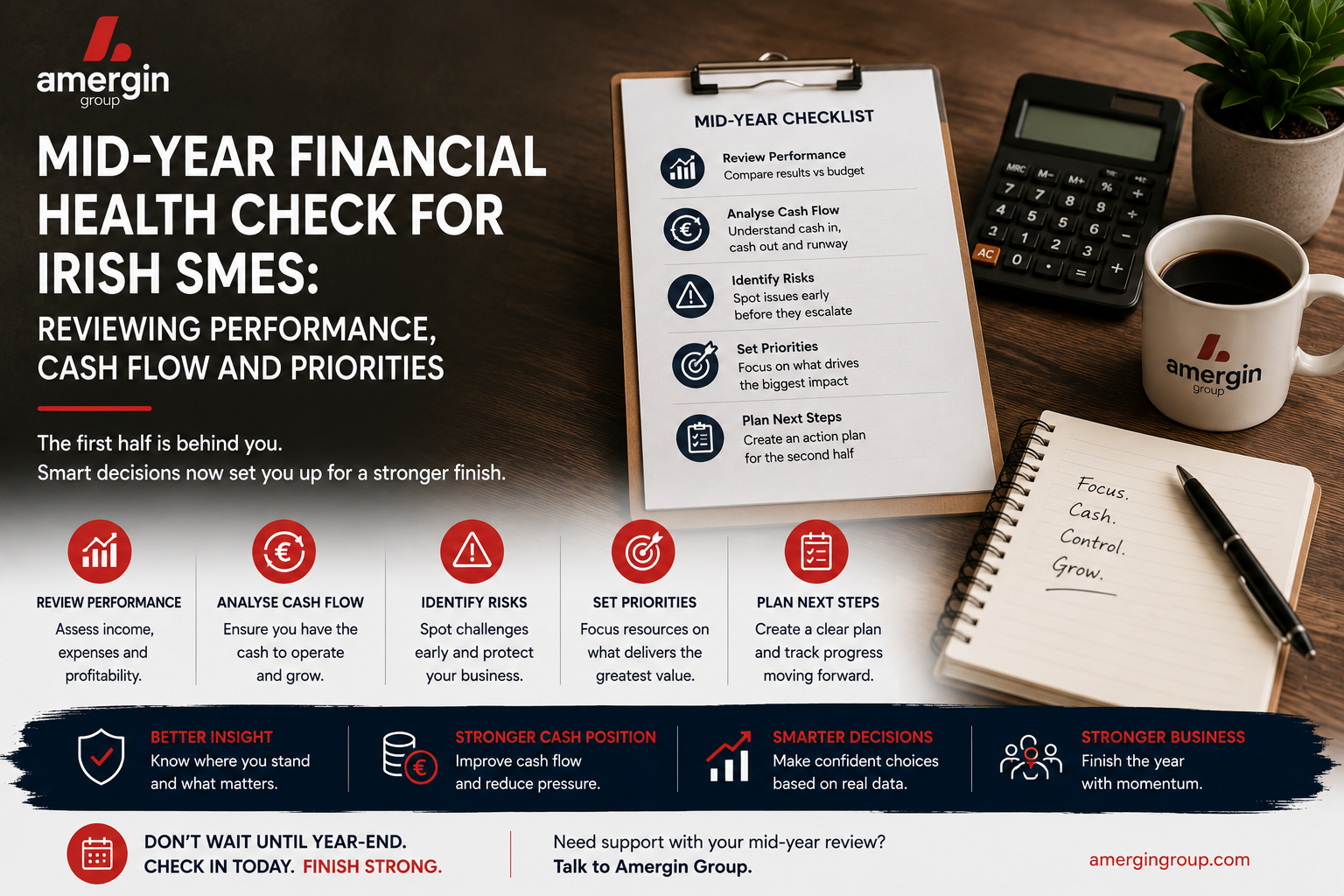
A mid-year financial health check allows business owners to step back from day-to-day operations and objectively assess whether the business is performing as expected. It is a chance to compare actual results against budgets, review cash flow, analyse profitability, reassess priorities, and identify emerging risks before they affect year-end performance. Rather than waiting until annual accounts are prepared, businesses can make meaningful adjustments while there is still plenty of time to improve results.
Many SMEs only review their financial performance in depth when preparing year-end accounts or meeting with their accountant after the financial year has ended. While annual reviews remain important, they are retrospective by nature. They explain what has already happened but offer limited opportunity to influence the outcome. A mid-year financial review, by contrast, provides management with current information that can be used to improve profitability, strengthen cash flow, refine business strategy, and achieve better financial results before the year is complete.
At Amergin, we help Irish SMEs use financial information as a management tool rather than simply a compliance requirement. Through integrated accounting, payroll, finance, Fractional CFO services, business advisory, marketing, and operational support, we help businesses transform financial reporting into strategic decision-making. A comprehensive mid-year financial health check provides clarity, strengthens financial resilience, and gives business owners the confidence to make informed decisions for the remainder of the year.
This guide explores why every Irish SME should carry out a mid-year financial health check, what areas should be reviewed, and how regular financial planning can support sustainable business growth.
Why a mid-year financial review is essential
Business plans are developed using assumptions. Budgets estimate expected sales, forecast operating costs, project cash flow, and establish financial targets for the year ahead. While these assumptions provide direction, they are based on information available at a specific point in time. Over the following months, business conditions inevitably change.
Customer demand may increase or decrease, supplier prices may rise, inflation may affect operating expenses, payroll costs may grow, and new business opportunities may emerge. Even businesses performing well often discover that the assumptions underpinning their original budget no longer reflect reality.
A mid-year financial review bridges the gap between planning and performance. It allows management to compare actual results against expectations and determine whether the business remains on course to achieve its objectives. More importantly, it provides sufficient time to adjust strategy, refine budgets, improve operational efficiency, and strengthen financial performance before the year ends.
Businesses that review performance regularly are generally more agile than those that rely solely on annual reporting. They make better decisions because they have access to current information rather than historical data alone.
Compare actual performance against your budget
The first step in any financial health check is comparing actual performance against the original budget. This exercise should extend far beyond reviewing total revenue or overall profit. Every significant income and expenditure category should be examined carefully to understand where performance differs from expectations and why.
Revenue should be analysed by customer, product, or service line to identify which parts of the business are performing well and which require attention. Similarly, expenditure should be reviewed across payroll, supplier costs, marketing, utilities, insurance, technology, rent, and other operating expenses. Variances between budgeted and actual figures often highlight emerging trends that require strategic action.
The purpose of this exercise is not to assign blame for missed targets. Instead, it provides management with valuable information that supports better decision-making. Understanding why results differ from the budget allows businesses to update forecasts and focus resources where they will have the greatest impact during the second half of the year.
Review cash flow, not just profitability
One of the biggest mistakes SMEs make is assuming that strong profits automatically translate into healthy cash flow. While profitability remains an essential measure of business performance, cash flow ultimately determines whether a business can pay its suppliers, employees, taxes, and other financial commitments.
A mid-year financial health check should therefore include a detailed review of cash flow. Businesses should assess customer payment trends, outstanding invoices, supplier payment terms, payroll commitments, VAT liabilities, corporation tax provisions, loan repayments, and planned capital expenditure.
Rolling cash flow forecasting provides valuable visibility into future liquidity. Rather than focusing solely on the current bank balance, businesses gain insight into how cash is expected to move over the coming months. This allows management to identify potential pressure points early and make informed decisions regarding expenditure, recruitment, investment, or financing before liquidity becomes constrained.
Strong cash flow management is one of the most effective ways to improve financial resilience, particularly during periods of economic uncertainty.
Assess profitability across the business
Revenue growth alone does not guarantee improved financial performance. In many cases, businesses increase sales while profitability declines because operating costs have risen or pricing has not kept pace with inflation and other cost increases.
A comprehensive financial health check should include a detailed profitability analysis. Gross profit margins should be reviewed alongside direct costs, payroll expenses, overhead allocation, and customer profitability. Businesses should consider whether existing pricing structures continue to reflect the true cost of delivering products and services and whether certain customers, projects, or product lines generate significantly stronger returns than others.
This analysis often reveals opportunities to improve profitability without increasing sales. Adjusting pricing, improving operational efficiency, reducing waste, or focusing on higher-margin work can have a significant impact on overall financial performance during the remainder of the year.
Evaluate your working capital position
Working capital plays a central role in maintaining financial stability. Businesses experiencing healthy sales growth can still encounter liquidity challenges if customer payments slow, inventory levels increase unnecessarily, or supplier payment terms become less favourable.
A mid-year review should examine debtor days, creditor balances, inventory levels, and overall working capital efficiency. Businesses should assess whether invoices are being collected promptly, whether stock levels remain appropriate, and whether supplier relationships continue supporting healthy cash flow.
Improving working capital management often delivers immediate benefits. Faster debtor collections, improved inventory management, and disciplined expenditure create additional liquidity without requiring external funding. These improvements strengthen the financial position of the business and provide greater flexibility for future investment.
Review payroll and workforce planning
For most SMEs, payroll represents one of the largest operating expenses. Recruitment, salary reviews, employer PRSI, pensions, overtime, training, and employee benefits all contribute to workforce costs, making payroll planning an essential part of any financial health check.
Management should review current staffing levels alongside projected revenue and business activity to ensure that employment costs remain aligned with commercial performance. Businesses should also consider whether planned recruitment remains necessary, whether productivity improvements could reduce overtime, and whether future workforce investment supports long-term strategic objectives.
Integrating payroll planning with financial forecasting enables leadership teams to make informed decisions that balance operational requirements with financial sustainability.
Review tax obligations before year-end
Tax planning should never be left until deadlines approach. By the middle of the financial year, businesses have already accumulated significant VAT, PAYE, employer PRSI, and corporation tax obligations. Reviewing these liabilities early helps prevent unnecessary cash flow pressure later in the year.
A mid-year financial review should include updated tax forecasts, assessment of existing tax reserves, and confirmation that sufficient funds are being set aside to meet future obligations. Businesses should also discuss potential tax planning opportunities with their accountant or financial adviser to ensure they remain compliant while making the most of available reliefs and allowances.
Proactive tax planning supports stronger cash flow and reduces the risk of relying on short-term borrowing to meet statutory obligations.
Measure business performance using meaningful KPIs
Financial statements provide valuable information, but leadership teams also benefit from monitoring operational key performance indicators that support strategic objectives. Depending on the business, these may include customer acquisition costs, gross margin percentage, recurring revenue, debtor days, employee productivity, project profitability, average transaction value, customer retention, or sales conversion rates.
A mid-year review provides an opportunity to evaluate whether existing KPIs continue to measure what matters most. Businesses should ensure that performance indicators align with strategic priorities and provide actionable information rather than simply producing additional reports.
Well-designed KPIs help management identify trends, monitor progress, and make better business decisions throughout the remainder of the year.
Reassess business priorities
The priorities established at the beginning of the year may no longer reflect current market conditions. New opportunities may have emerged, customer demand may have shifted, or external factors may require changes to operational plans.
A mid-year strategy review should therefore accompany every financial health check. Leadership should assess whether current objectives remain realistic, whether resources are being allocated effectively, and whether planned investments continue to support long-term growth.
This does not necessarily require a complete change of direction. In many cases, small strategic adjustments produce significant improvements in financial performance while allowing the business to remain focused on its broader objectives.
Scenario planning prepares the business for the second half of the year
Economic conditions can change quickly, making scenario planning an important component of a mid-year financial review. Rather than assuming that the remainder of the year will unfold exactly as originally planned, businesses should model several potential outcomes based on different levels of sales growth, operating costs, payroll expenses, customer demand, and market conditions.
Developing best-case, expected, and downside scenarios enables leadership teams to understand the financial implications of changing circumstances before they occur. This approach strengthens business resilience by ensuring that management has already considered potential responses to future challenges.
Scenario planning is particularly valuable during periods of economic uncertainty, helping businesses remain agile while protecting profitability and cash flow.
Real-life example: a mid-year review transformed year-end results
An Irish professional services company entered the year with ambitious revenue targets and a detailed annual budget. By June, management believed the business was performing well because overall sales remained close to expectations. However, a comprehensive mid-year financial health check carried out with Amergin revealed several underlying issues that had not been fully recognised.
Payroll costs had increased significantly following recruitment, customer payment periods had extended by almost three weeks, and gross profit margins had gradually declined because pricing had not kept pace with rising operating costs. Individually, none of these issues appeared alarming, but together they threatened cash flow and year-end profitability.
Amergin worked with the leadership team to update financial forecasts, strengthen cash flow management, review pricing, improve debtor collection procedures, and introduce monthly KPI reporting. The business also revised its priorities for the remainder of the year, delaying non-essential expenditure while focusing on higher-margin services.
By year-end, profitability had exceeded the revised forecast, cash flow had strengthened considerably, and the business entered the following financial year with greater confidence. The improvements were achieved not because the business worked harder, but because it reviewed its financial health while there was still time to make informed strategic decisions.
How Amergin helps Irish SMEs strengthen financial performance
Amergin supports Irish SMEs by providing practical financial leadership that goes beyond traditional accounting. Through integrated Fractional CFO services, accounting, payroll, finance, marketing, operations, and business advisory, we help businesses understand their financial performance and translate that insight into better commercial decisions.
Our services include financial reporting, management accounts, cash flow forecasting, business forecasting, budgeting, profitability analysis, working capital management, KPI development, payroll planning, tax planning, strategic reviews, and financial dashboards. By bringing these disciplines together, we provide leadership teams with a clear understanding of where the business stands today and what actions will create stronger results tomorrow.
A mid-year financial health check is not simply an opportunity to review numbers. It is an opportunity to strengthen strategy, improve financial resilience, and ensure that the second half of the year delivers better outcomes than the first.
The deeper truth: successful businesses review before they react
Businesses rarely encounter financial difficulty without warning. The signs usually appear gradually through declining margins, slower customer payments, increasing payroll costs, rising overheads, or weakening cash flow. Organisations that review their financial performance regularly recognise these trends early and respond before they become significant problems.
A mid-year financial health check provides the time and perspective needed to assess performance objectively, challenge assumptions, and refine priorities. Rather than waiting for year-end accounts to explain what went wrong, businesses gain the opportunity to influence the outcome while there is still time to improve it.
Financial success is rarely the result of one major decision. More often, it comes from making a series of informed adjustments throughout the year.
The takeaway
A mid-year financial health check is one of the most valuable exercises an Irish SME can undertake. By reviewing financial performance, cash flow, profitability, working capital, payroll costs, tax obligations, KPIs, and business priorities, leadership teams gain the insight needed to make informed decisions for the remainder of the year.
Businesses that regularly assess their financial health are better equipped to respond to changing market conditions, strengthen cash flow, improve profitability, and achieve sustainable long-term growth. Rather than waiting for year-end to evaluate performance, they use the middle of the year as an opportunity to reset priorities, refine strategy, and position the business for continued success.
The strongest businesses do not simply measure performance—they use it to shape what happens next.
About Amergin Consulting Ltd.
Amergin Consulting Ltd. is a Dublin-based chartered accountancy and business advisory firm serving Ireland’s SMEs and growth companies across construction, technology, professional services, and renewable energy.
We specialise in Accounting, Payroll, Taxation, and CFO Services that help businesses build stronger foundations for profit and compliance.
Need help running a year-end tax review or planning your 2026 changes?
Amergin Consulting’s finance and tax team can help you identify deductions, forecast cash flow, and ensure full compliance before the year closes.
Book your 30-minute FREE consultation: https://calendly.com/amergin-group_free/30min-finance-consultation
Disclaimer
This article is for general informational purposes only and does not constitute financial or tax advice. While every effort has been made to ensure accuracy, legislation may change upon enactment of the Finance Act 2025.
Public should seek professional advice tailored to their specific circumstances before acting on any points discussed.
Sources and Resources
Amergin Consulting – Strategic Finance, Fractional CFO, Accounting and Business Advisory for Irish SMEs
https://amergin.ie
Revenue Commissioners – Business Tax, VAT, PAYE and Financial Planning
https://www.revenue.ie
Enterprise Ireland – Business Growth and Financial Planning Resources
https://www.enterprise-ireland.com
Local Enterprise Office (LEO) – SME Business Support and Strategic Planning
https://www.localenterprise.ie
Chartered Accountants Ireland – Financial Reporting, Budgeting and Business Advisory
https://www.charteredaccountants.ie
Institute of Directors Ireland – Strategic Leadership and Business Governance
https://www.iodireland.ie
Harvard Business Review – Financial Performance, Strategic Planning and Business Growth
https://hbr.org
MIT Sloan Management Review – Business Strategy, Financial Leadership and Organisational Performance
https://sloanreview.mit.edu