
Published: June 2026
Author: Amergin Consulting Ltd.
Target Audience: Business Owners, Small Business Seeking Financial Stability, Entrepreneurs, Start-Ups, Irish SMEs
Book a meeting: https://calendly.com/amergin-group_free/30min-finance-consultation
Many SME owners focus heavily on growing revenue.
Sales targets are monitored, marketing campaigns are measured, and business development efforts are prioritised. Revenue growth is often seen as the primary indicator of business success, and while growth is important, it does not automatically translate into stronger profitability.
A business can increase turnover year after year and still experience financial pressure.
This happens because profit is rarely lost through one major decision. More often, it disappears gradually through small inefficiencies, hidden costs, pricing inconsistencies, operational waste, and uncontrolled spending. These issues are often difficult to detect because they develop over time and become embedded within daily operations.
This is where a margin leak audit becomes valuable.
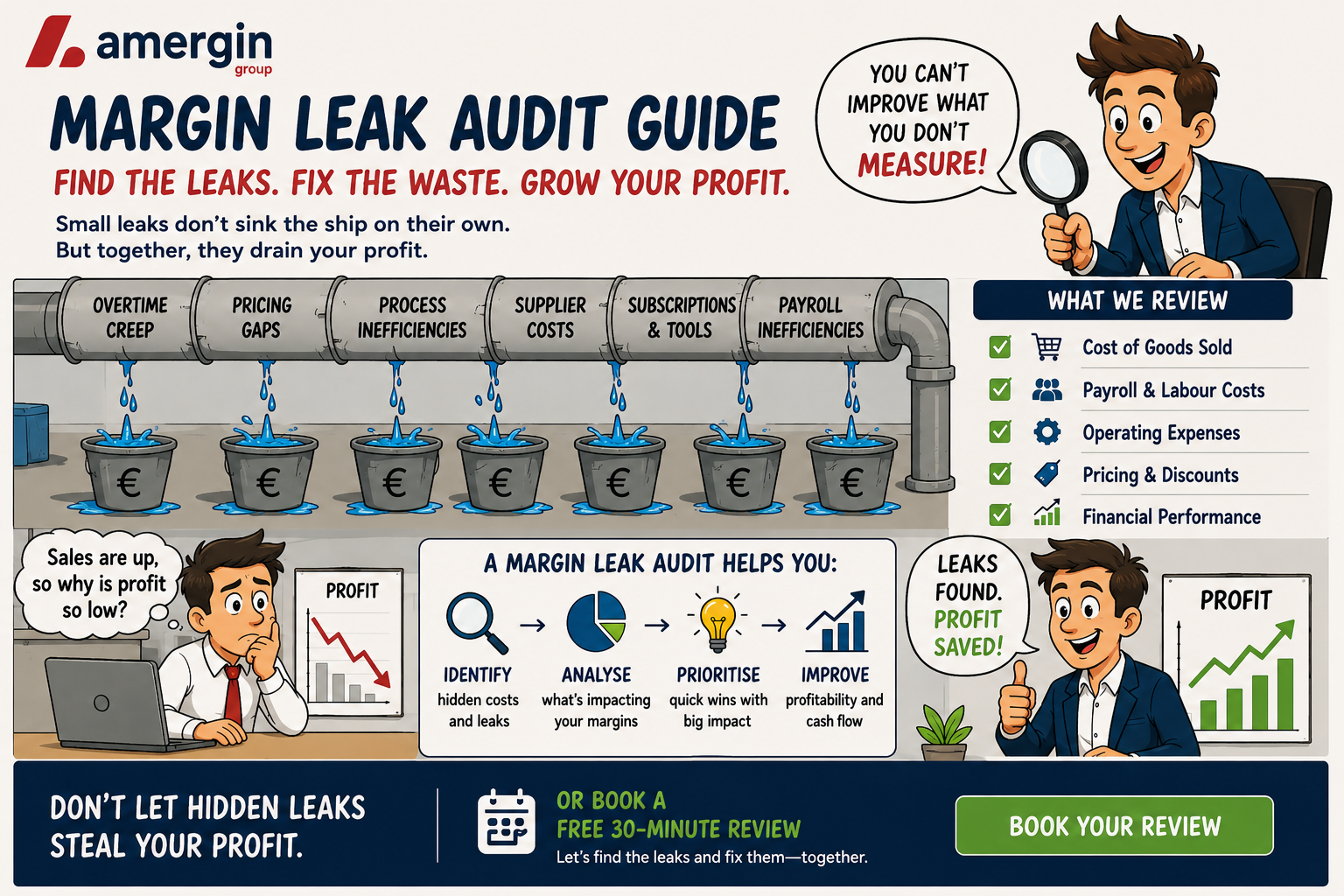
A margin leak audit helps businesses identify the hidden factors that reduce profitability. It examines where money is being lost, where costs are increasing without corresponding value, and where operational practices are quietly eroding margins. Instead of focusing solely on revenue growth, a margin leak audit focuses on retaining more of the profit the business already generates.
Amergin works with Irish SMEs and growing businesses that want stronger financial visibility and sustainable profitability. Amergin positions itself as an integrated partner across accounting, payroll, finance, marketing, operations, and advisory. This integrated perspective is essential because margin leakage rarely comes from one department alone. It is usually the result of multiple small issues across finance, payroll, operations, pricing, and business processes.
This article explores how margin leakage develops, the most common areas where SMEs lose profitability, and how a structured margin audit can strengthen financial performance.
What is margin leakage?
Margin leakage occurs when a business loses profitability through avoidable inefficiencies that are not immediately visible within financial reports.
Unlike major financial problems, margin leaks are often subtle. They develop gradually and become accepted as part of normal business operations. Because they do not create an immediate crisis, they are rarely addressed with urgency.
Examples of margin leakage include underpriced services, excessive overtime costs, supplier price increases that go unnoticed, duplicated software subscriptions, inefficient workflows, excessive rework, poor project scoping, and weak expense controls.
Individually, these issues may appear insignificant.
Collectively, they can have a substantial impact on profitability.
Many businesses spend considerable effort pursuing additional revenue while overlooking the profit already being lost through these hidden leaks.
Revenue growth can hide margin problems
One of the reasons margin leakage often goes unnoticed is because revenue growth can disguise it.
When sales are increasing, the business may appear healthy on the surface. Turnover is rising, activity levels are high, and cash continues to flow through the organisation. However, if costs are increasing at the same pace or faster than revenue, profitability may remain stagnant or even decline.
This creates a dangerous illusion.
The business appears successful because revenue is growing, yet the financial return generated from that growth is weaker than expected.
A margin leak audit helps separate activity from profitability.
It focuses not only on how much revenue is being generated but on how much value is being retained.
Pricing is one of the biggest sources of margin leakage
Many SMEs underestimate the financial impact of pricing decisions.
Prices are often established when the business is smaller and then adjusted only occasionally. Over time, payroll costs increase, supplier costs rise, inflation affects operating expenses, and the complexity of delivering products or services grows.
If pricing does not evolve alongside these changes, margins begin to shrink.
This erosion is often gradual, making it difficult to identify without analysis.
A margin leak audit examines whether current pricing accurately reflects the true cost of delivery. It evaluates customer profitability, project profitability, and service margins to determine whether the business is capturing sufficient value from its work.
Businesses frequently discover that some of their busiest activities are also their least profitable.
Labour costs often contain hidden inefficiencies
Payroll is one of the largest expenses in most SMEs, making it one of the most common sources of margin leakage.
The issue is rarely payroll itself.
The issue is how labour is used.
Excessive overtime, duplicated responsibilities, inefficient processes, poor scheduling, and unclear accountability can all increase labour costs without increasing output. These inefficiencies often develop gradually and become normalised within the organisation.
A margin leak audit examines labour cost not only as a financial figure but as an operational metric.
This includes reviewing labour cost as a percentage of revenue, identifying productivity trends, evaluating workforce allocation, and assessing whether staffing structures support business objectives effectively.
Small improvements in workforce efficiency can create significant improvements in profitability.
Operational inefficiencies quietly reduce profit
Many margin leaks originate within operational processes.
Tasks that take longer than necessary, repeated corrections, duplicated work, manual administration, and unclear workflows all consume time and resources. Because these inefficiencies are often spread across different departments, they may not appear significant individually.
However, when measured collectively, they can represent a substantial hidden cost.
For example, a process that requires an additional hour of work each day may seem minor. Across a full year and multiple employees, the financial impact becomes considerable.
A margin leak audit helps identify these operational inefficiencies and quantify their cost to the business.
This allows leadership teams to prioritise improvements that generate measurable financial benefits.
Supplier costs deserve regular review
Supplier relationships are critical for most businesses, but supplier costs are not always reviewed with the same frequency as revenue targets.
Many SMEs continue paying for services, subscriptions, or supply arrangements that no longer represent the best value. Incremental price increases may be accepted without challenge, and contracts may renew automatically without detailed review.
Over time, these costs accumulate.
A margin leak audit examines supplier expenditure to identify opportunities for renegotiation, consolidation, or elimination. Even modest reductions in recurring costs can have a direct and lasting impact on profitability.
Unlike revenue growth, which often requires additional effort and investment, reducing unnecessary costs improves margins immediately.
Customer profitability is not always equal
One of the most revealing aspects of a margin audit is customer profitability analysis.
Not all customers contribute equally to profit. Some clients generate strong margins and require minimal support. Others consume significant resources, request frequent changes, delay payments, or require extensive administration.
Without analysis, these differences remain hidden. Revenue figures alone do not reveal whether a customer relationship is financially beneficial. A margin leak audit evaluates the true cost of serving different customers and helps businesses understand where value is being created and where it is being lost.
This insight supports more informed decisions about pricing, service delivery, and client management.
Real-life example: identifying hidden profit loss
An Irish SME had experienced steady revenue growth for several years.
Sales performance was strong, and the business was achieving its turnover targets consistently. Despite this growth, profitability remained relatively flat, and leadership could not identify the cause.
Amergin conducted a margin leak audit.
The review revealed several contributing factors. Labour costs had increased significantly due to process inefficiencies. Certain long-term clients were operating on outdated pricing structures. Multiple software subscriptions were being paid for without active use, and project overruns were reducing profitability on key accounts.
None of these issues were significant individually.
Together, they were reducing margins considerably.
By addressing these leaks, the business improved profitability without increasing revenue. The solution was not selling more.
It was retaining more of the value already being generated.
Financial dashboards strengthen margin visibility
Margin leaks are easier to identify when businesses have access to clear, integrated financial reporting.
A well-designed financial dashboard allows leadership teams to monitor profitability, labour cost ratios, customer performance, project margins, and operational efficiency metrics in real time.
This visibility helps businesses identify trends early and take corrective action before small issues become larger problems.
Financial dashboards do not eliminate margin leakage.
They make it visible.
Visibility is the first step toward improvement.
Regular audits create long-term profitability discipline
A margin leak audit should not be viewed as a one-time exercise.
Businesses change continuously. Costs evolve, processes adapt, and customer requirements shift. New margin leaks can emerge as the organisation grows.
Regular review creates discipline. By examining profitability systematically throughout the year, businesses maintain greater control over costs, pricing, and operational efficiency. This ongoing approach ensures that profitability remains a strategic priority rather than an afterthought.
The objective is not simply to reduce costs but to maximise value.
How Amergin helps businesses identify margin leakage
Amergin helps Irish SMEs improve profitability through structured financial reviews, operational analysis, payroll assessment, and business performance reporting.
This includes examining pricing structures, labour cost efficiency, customer profitability, operational workflows, and financial reporting systems. By connecting accounting, payroll, finance, and operational insight, Amergin helps businesses identify hidden margin leaks and implement practical solutions.
The goal is not simply to increase revenue.
It is to improve the quality of profit generated from that revenue.
The deeper truth: profit is protected, not found
Many businesses search for profitability through growth alone.
While growth is important, sustainable profitability often comes from protecting the value that already exists within the business. Every unnecessary cost, inefficient process, underpriced service, or unmanaged expense reduces the return generated from hard-earned revenue.
Margin leakage is not always dramatic.
It is usually gradual.
The businesses that protect their margins most effectively are those that review them regularly, measure them consistently, and act on the insights they uncover.
The takeaway
A margin leak audit helps businesses identify where profitability is being lost and where improvements can have the greatest impact.
For Irish SMEs, the goal is not simply to generate more revenue. It is to ensure that more of that revenue becomes profit.
By reviewing pricing, labour costs, operational efficiency, supplier expenditure, customer profitability, and financial reporting, businesses gain a clearer understanding of where value is leaking from the organisation.
Strong businesses do not assume profitability will improve automatically.
They audit it.
Because when margin leaks are identified early, profitability becomes easier to protect, easier to grow, and easier to sustain.
About Amergin Consulting Ltd.
Amergin Consulting Ltd. is a Dublin-based chartered accountancy and business advisory firm serving Ireland’s SMEs and growth companies across construction, technology, professional services, and renewable energy.
We specialise in Accounting, Payroll, Taxation, and CFO Services that help businesses build stronger foundations for profit and compliance.
Need help running a year-end tax review or planning your 2026 changes?
Amergin Consulting’s finance and tax team can help you identify deductions, forecast cash flow, and ensure full compliance before the year closes.
Book your 30-minute FREE consultation: https://calendly.com/amergin-group_free/30min-finance-consultation
Disclaimer
This article is for general informational purposes only and does not constitute financial or tax advice. While every effort has been made to ensure accuracy, legislation may change upon enactment of the Finance Act 2025.
Public should seek professional advice tailored to their specific circumstances before acting on any points discussed.
Sources and Resources
Amergin Consulting – Integrated Financial & Marketing Consulting for Irish SMEs and Growing Businesses
https://amergin.ie
Revenue Commissioners – Business Tax and Financial Management Guidance
https://www.revenue.ie
Enterprise Ireland – Business Efficiency and Performance Resources
https://www.enterprise-ireland.com
Local Enterprise Office (LEO) – SME Financial Planning and Growth Supports
https://www.localenterprise.ie
Harvard Business Review – Profitability, Pricing Strategy, and Operational Efficiency
https://hbr.org
MIT Sloan Management Review – Cost Management and Business Performance Improvement
https://sloanreview.mit.edu