
Published: May 2026
Author: Amergin Consulting Ltd.
Target Audience: Business Owners, Small Business Seeking Financial Stability, Entrepreneurs, Start-Ups, Irish SMEs
Book a meeting: https://calendly.com/amergin-group_free/30min-finance-consultation
Compliance in Irish SMEs is rarely about complexity.
It is about coordination. Most businesses are aware of their obligations. They know that VAT must be filed, payroll submissions must be made, annual returns must be completed, and various reporting requirements must be met throughout the year. The challenge is not understanding that these obligations exist.
The challenge is managing when they happen, how they connect, and who is responsible for ensuring they are completed consistently.
Without a clear structure, compliance becomes reactive. Deadlines feel scattered, tasks are completed under pressure, and the business operates in cycles of urgency rather than control.
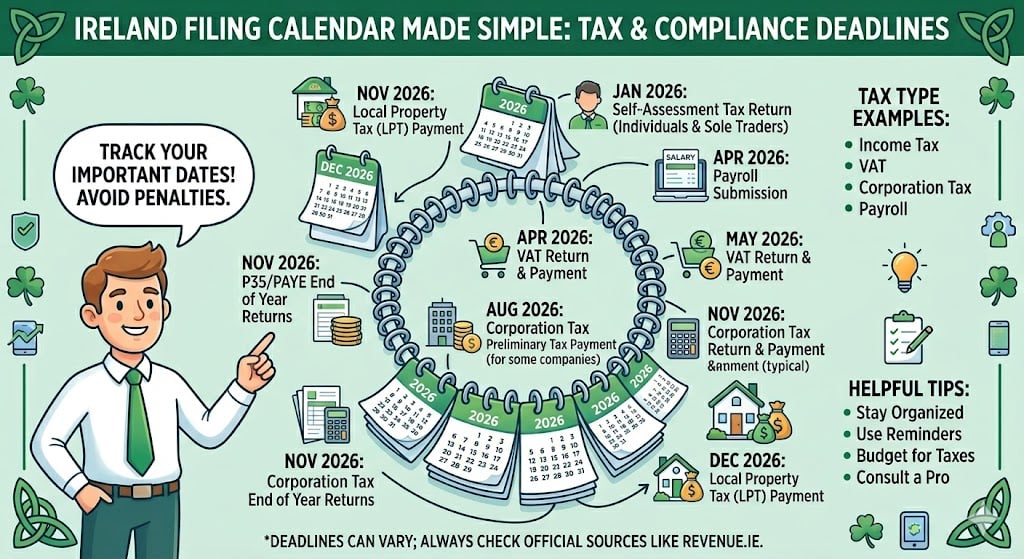
A simplified filing calendar changes that dynamic. It brings structure to compliance by turning multiple obligations into a single, visible system that the business can manage proactively.
Amergin works with Irish SMEs and growing businesses that want compliance to be predictable rather than stressful. Amergin positions itself as an integrated partner across accounting, payroll, finance, marketing, operations, and advisory. That integration matters because compliance deadlines are not isolated events. Payroll reporting, tax filings, and company obligations are interconnected, and when they are not managed together, the system becomes fragmented.
This article explores how to simplify the Irish filing calendar, why SMEs often struggle with it, and how a structured approach improves consistency and reduces risk.
The problem is not the number of deadlines
Many SMEs feel overwhelmed by compliance because of the number of deadlines throughout the year.
Payroll reporting under PAYE Modernisation requires submissions to be made in real time. VAT returns are typically due every two months. Annual returns must be filed with the Companies Registration Office. Corporation tax filings follow their own schedule. Additional reporting requirements may apply depending on the size and structure of the business.
Individually, each of these obligations is manageable.
The difficulty arises when they are viewed separately.
When deadlines are tracked in different places, managed by different people, and approached as individual tasks, the system becomes difficult to coordinate. Deadlines may overlap. Priorities may conflict. Visibility is reduced.
The issue is not volume. It is fragmentation.
A calendar creates visibility across the business
A simplified filing calendar brings all obligations into one place.
Instead of tracking deadlines across emails, spreadsheets, and individual knowledge, the business creates a single, structured view of compliance throughout the year. This includes payroll reporting dates, VAT deadlines, CRO filings, corporation tax timelines, and any additional reporting requirements relevant to the business.
This visibility changes how compliance is managed.
Deadlines are no longer surprises. They are planned events.
When the full calendar is visible, the business can anticipate busy periods, allocate resources effectively, and ensure that tasks are completed without last-minute pressure.
Visibility is the first step toward control.
Timing is as important as the task itself
One of the key benefits of a structured filing calendar is that it highlights timing patterns.
Certain periods of the year are naturally more demanding from a compliance perspective. VAT deadlines may coincide with payroll reporting cycles. Annual returns may align with financial reporting requirements. Year-end processes may create additional workload.
Without a calendar, these overlaps are often only recognised when they occur.
With a calendar, they are visible in advance.
This allows businesses to prepare for periods of higher activity, ensuring that resources are available and that tasks are completed without compromising accuracy.
Understanding timing reduces pressure.
Simplification reduces cognitive load
Compliance can feel complex not because of the tasks themselves, but because of how they are managed.
When deadlines are scattered and responsibilities are unclear, the mental effort required to keep track of everything increases. Team members rely on memory, reminders, and informal communication to manage obligations.
This creates cognitive load.
A simplified filing calendar reduces this burden.
By consolidating all deadlines into a clear structure, the business no longer needs to rely on memory. Tasks are visible, responsibilities can be assigned, and progress can be tracked.
Simplification does not remove responsibility.
It makes responsibility easier to manage.
Consistency is built through structure
Compliance is not about completing tasks once.
It is about completing them consistently over time.
A filing calendar supports this consistency by creating a repeatable system. Each deadline is part of a structured cycle. Each task follows a defined process. Each period builds on the last.
When this structure is in place, compliance becomes routine.
When it is absent, compliance becomes reactive.
Consistency is what reduces risk.
Responsibility becomes clearer within a calendar
A filing calendar is not only a list of deadlines.
It is a framework for accountability.
Each filing should have a clearly defined owner, and that ownership should be visible within the calendar. This ensures that every task has someone responsible for its completion, supported by a clear timeline.
Without this clarity, tasks may be assumed to be completed without confirmation.
With it, accountability becomes explicit. Responsibility is not shared vaguely. It is assigned clearly.
Real-life example: from scattered deadlines to structured control
An Irish SME managed its compliance obligations effectively on a case-by-case basis.
Payroll submissions were completed regularly. VAT returns were filed on time. Annual returns were submitted without major issues.
However, the process relied heavily on individual knowledge and manual tracking.
Deadlines were stored in different systems. Responsibilities were not always documented. Busy periods created pressure, and tasks were sometimes completed close to their deadlines.
Amergin introduced a structured filing calendar. All obligations were mapped across the year. Responsibilities were assigned clearly. Deadlines were aligned with internal processes.
The result was immediate. Compliance became more predictable. Workload was distributed more evenly. The team operated with greater confidence. The tasks had not changed. The structure had.
Integration strengthens the calendar
A filing calendar is most effective when it is integrated with the business’s broader systems.
Payroll reporting should align with payroll processing schedules. VAT filings should reflect financial reporting timelines. Annual returns should connect with year-end processes.
When these elements are integrated, the calendar becomes more than a list of dates.
It becomes part of how the business operates. Integration ensures that compliance is not treated as an external requirement. It is embedded within internal processes.
Simplicity ensures the system is used
The most effective filing calendars are simple.
They provide a clear overview of deadlines, responsibilities, and timelines without unnecessary complexity. Overly detailed systems can become difficult to maintain and may be ignored over time.
A simple, well-structured calendar is more likely to be used consistently. Consistency is what creates value.
How Amergin supports simplified compliance systems
Amergin helps Irish SMEs design filing calendars that align with real business operations.
Compliance obligations are mapped clearly across the year. Responsibilities are assigned and documented. Deadlines are integrated with internal processes. Systems are structured to ensure visibility and consistency.
This approach ensures that compliance is not managed in isolation. It becomes part of a broader, disciplined operating model.
The deeper truth: clarity removes stress
Compliance stress rarely comes from the complexity of obligations.
It comes from lack of clarity. When deadlines are unclear, tasks are rushed. When responsibilities are undefined, accountability is weakened. When systems are fragmented, errors become more likely.
A simplified filing calendar removes this uncertainty. It provides a clear, structured view of compliance throughout the year. Clarity reduces stress.
The takeaway
The Irish filing calendar does not need to be complicated.
It needs to be visible, structured, and integrated. For Irish SMEs, the goal is not to reduce compliance obligations.
It is to manage them more effectively. A simplified filing calendar brings all deadlines into a single system, improves visibility, strengthens accountability, and reduces risk.
Strong businesses do not manage compliance reactively. They design systems that make it predictable.
Because when deadlines are clear, compliance becomes routine. And when compliance is routine, the business becomes stronger.
About Amergin Consulting Ltd.
Amergin Consulting Ltd. is a Dublin-based chartered accountancy and business advisory firm serving Ireland’s SMEs and growth companies across construction, technology, professional services, and renewable energy.
We specialise in Accounting, Payroll, Taxation, and CFO Services that help businesses build stronger foundations for profit and compliance.
Need help running a year-end tax review or planning your 2026 changes?
Amergin Consulting’s finance and tax team can help you identify deductions, forecast cash flow, and ensure full compliance before the year closes.
Book your 30-minute FREE consultation: https://calendly.com/amergin-group_free/30min-finance-consultation
Disclaimer
This article is for general informational purposes only and does not constitute financial or tax advice. While every effort has been made to ensure accuracy, legislation may change upon enactment of the Finance Act 2025.
Public should seek professional advice tailored to their specific circumstances before acting on any points discussed.
Sources and Resources
Amergin Consulting – Integrated Financial & Marketing Consulting for Irish SMEs and Growing Businesses
https://amergin.ie
Revenue Commissioners – Filing Deadlines and Compliance Obligations
https://www.revenue.ie
Companies Registration Office (CRO) – Annual Return and Filing Requirements
https://www.cro.ie
Department of Enterprise, Trade and Employment – SME Governance Guidance
https://enterprise.gov.ie
Harvard Business Review – Operational Discipline and Organisational Clarity
https://hbr.org
MIT Sloan Management Review – Process Design and Business Efficiency
https://sloanreview.mit.edu