
Published: March 2026
Author: Amergin Consulting Ltd.
Target Audience: Business Owners, Small Business Seeking Financial Stability, Entrepreneurs, Start-Ups, Irish SMEs
Book a meeting: https://calendly.com/amergin-group_free/30min-finance-consultation
Payroll accuracy is not only about paying employees correctly.
It is about reporting correctly.
In Ireland, payroll does not end when salaries are processed. Under PAYE Modernisation, employers must submit payroll information to Revenue in real time through the Employer Reporting Requirement (ERR) system. This means every payroll run generates both a payment and a compliance event.
For many SMEs, this is where risk quietly increases.
Payroll may appear correct internally, but reporting inaccuracies—incorrect tax calculations, missing adjustments, or late submissions can create compliance exposure, administrative rework, and unnecessary stress.
ERR has fundamentally changed payroll. Accuracy is no longer internal. It is visible.
Amergin works with Irish SMEs and growing businesses that want payroll to be accurate, compliant, and controlled. Amergin positions itself as an integrated partner across accounting, payroll, finance, marketing, operations, and advisory. That integration matters because payroll reporting accuracy affects compliance, financial reporting, and organisational trust.
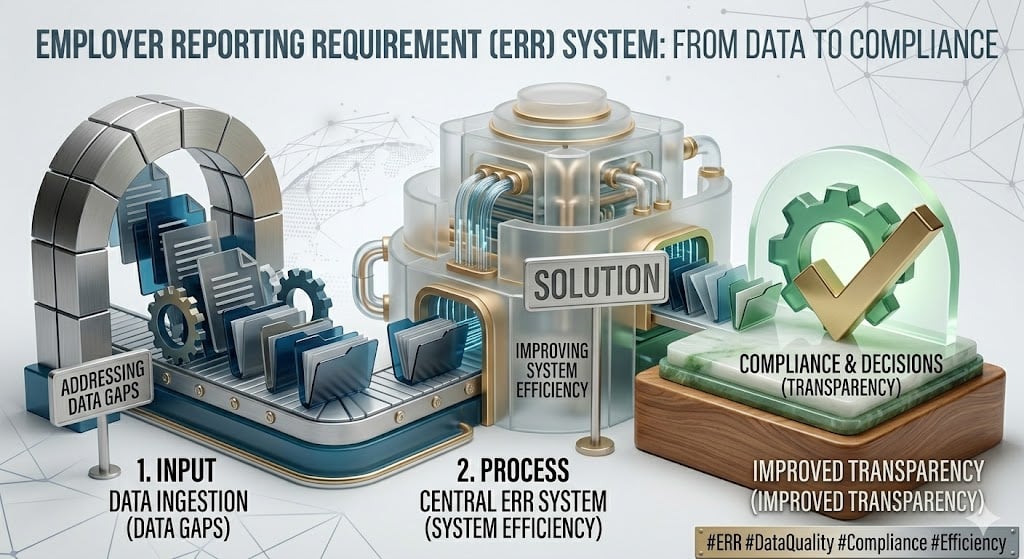
This article explores why ERR accuracy matters, where reporting errors originate, and how structured payroll discipline ensures accurate, consistent submissions.
What ERR means in practice
The Employer Reporting Requirement (ERR) requires employers to report payroll information to Revenue on or before the date employees are paid.
Each payroll submission must include:
- gross pay
- PAYE deducted
- PRSI contributions
- USC deductions
- pension and benefit adjustments
This real-time reporting replaces the old annual or periodic reporting systems.
There is no longer an opportunity to “correct things later” at year-end.
Payroll reporting is now continuous.
Every submission must be accurate at the point of processing.
Why reporting accuracy matters more than ever
Under ERR, payroll reporting is directly linked to employee tax records.
If incorrect payroll data is submitted:
- employees may be taxed incorrectly
- tax credits may be misapplied
- discrepancies may appear in Revenue records
- corrections must be processed quickly
Errors are no longer contained within the business.
They affect employees immediately and are visible to Revenue.
Reporting accuracy is therefore not just a compliance requirement.
It is a trust requirement.
Where reporting errors come from
Payroll reporting errors rarely originate at the submission stage. They originate earlier in the process.
Incomplete or incorrect input data
If payroll inputs are inaccurate, reporting will be inaccurate.
Late timesheets, incorrect commission figures, or outdated employee information all flow through to ERR submissions.
ERR does not correct input errors.
It reflects them.
Weak validation processes
When payroll calculations are not reviewed properly, small errors pass through unnoticed.
Incorrect tax calculations, misapplied deductions, or unusual net pay variations can be submitted without being flagged.
Without validation checkpoints, errors become part of official reporting.
Misalignment between payroll and accounting
Payroll data should align with financial records.
If payroll costs, deductions, or adjustments are not reconciled properly, inconsistencies can arise between reported payroll data and financial statements.
This creates both compliance and reporting challenges.
Rushed end-of-cycle processing
Compressed payroll timelines increase error risk.
When payroll is processed quickly at the end of a period, there is less time for validation and compliance checks.
Rushed submissions lead to avoidable corrections.
The cost of inaccurate reporting
The impact of reporting errors extends beyond compliance.
Errors create administrative workload.
Corrections require time and attention.
Employees lose confidence in payroll accuracy.
Leadership experiences avoidable stress.
Revenue expects accurate payroll reporting and proper record-keeping. Repeated inaccuracies may increase scrutiny.
The cost of fixing errors is often higher than the cost of preventing them.
Building reporting accuracy into payroll systems
Reporting accuracy is not achieved at the submission stage.
It is designed into the payroll process.
Step 1: Strengthen input discipline
Accurate reporting begins with accurate data.
Clear deadlines for timesheets, commission submissions, and payroll adjustments ensure that data is complete before processing begins.
Consistency at this stage reduces downstream errors.
Step 2: Introduce structured validation checkpoints
Payroll calculations should be reviewed before submission.
This includes:
- comparing payroll totals to prior periods
- reviewing unusual changes in net pay
- verifying tax calculations
- checking pension and benefit adjustments
Validation creates a buffer between calculation and reporting.
Step 3: Align payroll with compliance requirements
ERR submissions must reflect correct PAYE, PRSI, and USC calculations.
Payroll processes should include a compliance checkpoint before submission.
This ensures that reporting aligns with Revenue requirements.
Step 4: Integrate payroll with financial reporting
Payroll data should be reconciled with accounting records.
Employer PRSI, payroll costs, and deductions should align with financial statements.
Integration reduces discrepancies and improves overall financial clarity.
Step 5: Build time into the process
Accuracy requires time.
Spreading payroll checks across the month reduces pressure at the final stage.
When payroll is not rushed, reporting accuracy improves.
Real-life example: from corrections to control
An Irish SME processed payroll accurately most of the time, but frequently needed to make corrections after submission.
ERR submissions occasionally contained small errors due to late data or rushed validation. While corrections were made, the process created administrative overhead and leadership concern.
Amergin introduced structured payroll checkpoints, improved data submission discipline, and aligned payroll validation with compliance requirements.
Within a few cycles:
- reporting errors reduced significantly
- corrections became rare
- payroll submissions felt controlled
- leadership confidence improved
The payroll system had not changed dramatically.
The discipline had.
Why simplicity improves accuracy
Complex payroll processes often reduce accuracy because they are difficult to follow consistently.
Simple, structured processes improve accuracy because they are repeatable.
Clear input deadlines.
Clear validation steps.
Clear compliance checks.
Clear submission procedures.
Simplicity ensures consistency. Consistency ensures accuracy.
How Amergin supports ERR accuracy
Amergin helps Irish SMEs build payroll systems that support accurate reporting.
Payroll workflows are structured to ensure data quality. Validation checkpoints are integrated into processing. Compliance requirements are embedded into routine operations. Payroll data is aligned with financial reporting systems.
This integrated approach ensures ERR submissions are accurate, consistent, and controlled.
The deeper truth: accuracy is a system outcome
Reporting accuracy is not achieved by working harder at the end of payroll.
It is achieved by designing the process correctly from the beginning.
When payroll systems are structured, accuracy becomes a natural outcome.
When systems are weak, accuracy depends on effort.
Effort is inconsistent. Systems are reliable.
The takeaway
ERR has changed payroll reporting in Ireland.
Accuracy is now required in real time. Errors are visible immediately. Corrections create unnecessary work and stress.
The solution is not more effort. It is better structure.
By strengthening inputs, introducing validation checkpoints, aligning payroll with compliance, and spreading workload across the month, SMEs can ensure reporting accuracy becomes routine.
Strong payroll systems do not rely on correction. They rely on control.
About Amergin Consulting Ltd.
Amergin Consulting Ltd. is a Dublin-based chartered accountancy and business advisory firm serving Ireland’s SMEs and growth companies across construction, technology, professional services, and renewable energy.
We specialise in Accounting, Payroll, Taxation, and CFO Services that help businesses build stronger foundations for profit and compliance.
Need help running a year-end tax review or planning your 2026 changes?
Amergin Consulting’s finance and tax team can help you identify deductions, forecast cash flow, and ensure full compliance before the year closes.
Book your 30-minute FREE consultation: https://calendly.com/amergin-group_free/30min-finance-consultation
Disclaimer
This article is for general informational purposes only and does not constitute financial or tax advice. While every effort has been made to ensure accuracy, legislation may change upon enactment of the Finance Act 2025.
Public should seek professional advice tailored to their specific circumstances before acting on any points discussed.
Sources and Resources
Amergin Consulting – Integrated Financial & Marketing Consulting for Irish SMEs and Growing Businesses
https://amergin.ie
Revenue Commissioners – Employer Reporting Requirements (ERR) and PAYE Modernisation
https://www.revenue.ie
Revenue Tax and Duty Manual – Payroll and Record-Keeping Requirements
https://www.revenue.ie
Companies Act 2014 (Ireland) – Accounting Records
https://www.irishstatutebook.ie
Harvard Business Review – Operational Discipline and Organisational Stability
https://hbr.org
MIT Sloan Management Review – Organisational Resilience Through Process Design
https://sloanreview.mit.edu