
Published: April 2026
Author: Amergin Consulting Ltd.
Target Audience: Business Owners, Small Business Seeking Financial Stability, Entrepreneurs, Start-Ups, Irish SMEs
Book a meeting: https://calendly.com/amergin-group_free/30min-finance-consultation
Statutory Sick Pay looks simple from the outside. An employee is out sick, the business applies the statutory rule, payroll is updated, and the payslip reflects the correct payment. In practice, however, SSP becomes fragile very quickly if it is handled manually, inconsistently, or too late in the payroll cycle.
That is why Irish SMEs should stop treating SSP as a one-off adjustment and start treating it as a payroll design issue.
When SSP is calculated differently each time, businesses create unnecessary risk. The risk is not only that an employee is paid incorrectly. The risk is that payroll records become inconsistent, leave records stop matching payroll outcomes, compliance documentation weakens, and leadership starts spending time fixing issues that should never have reached final payroll close in the first place.
Amergin works with Irish SMEs and growing businesses that want payroll and compliance systems to be strong under pressure, not only when conditions are calm. Amergin positions itself as an integrated partner across accounting, payroll, finance, marketing, operations, and advisory. That integration matters because SSP is not only an HR issue and not only a payroll issue. It sits across leave tracking, payroll calculations, compliance records, cashflow planning, and employee trust.
This article explains why building an SSP calculation template inside your payroll system matters, how that template should work in practice, and why structured SSP handling protects both the business and the people inside it.
Why SSP needs structure, not interpretation
Ireland’s statutory sick leave framework gives eligible employees a legal entitlement to paid sick leave, subject to specific conditions. Employees who have completed 13 weeks of continuous service and provide a medical certificate are entitled to statutory sick pay for eligible sick days. The current entitlement remains at five days per calendar year, and the payment rate remains 70% of usual daily earnings, subject to a maximum of €110 per day. Employers must also maintain records of statutory sick leave taken, including dates and the rate of payment.
The reason this matters operationally is simple. Once SSP exists as a statutory entitlement, payroll can no longer treat sick pay as an informal adjustment. It needs to be calculated the same way every time. It needs to be linked to eligibility rules, leave balances, daily earnings logic, and record-keeping requirements. If any part of that chain is manual or vague, the process starts depending on interpretation rather than structure.
Interpretation creates inconsistency. Structure creates repeatability.
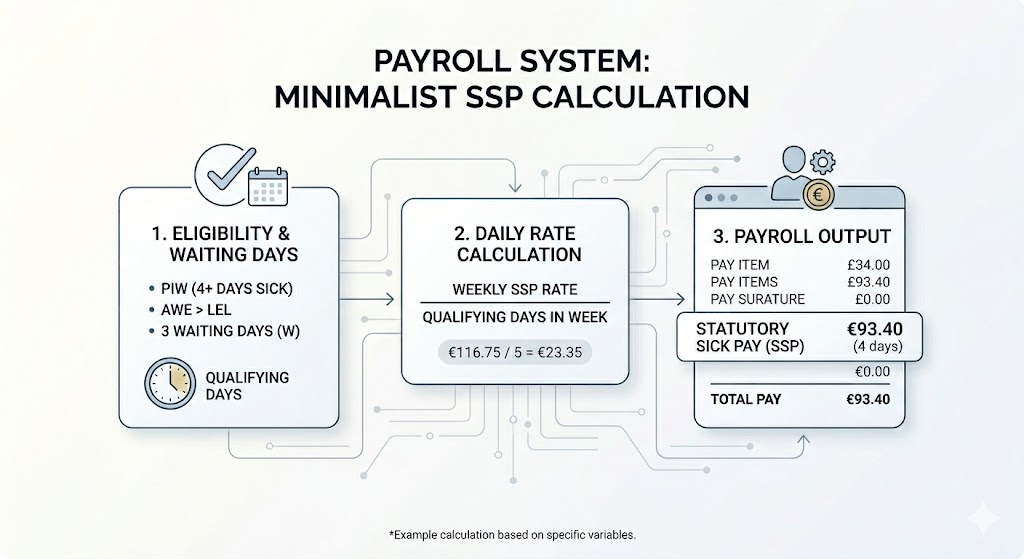
An SSP calculation template inside the payroll system is what turns legal entitlement into operational accuracy.
The real problem is not the rule, but the repetition
Most SMEs can calculate one SSP payment correctly if they stop and think about it. The challenge is not one case. The challenge is handling many cases over time with the same level of accuracy.
An employee may be sick for one day in February, two more days in May, and another day in October. A part-time employee may work irregular days. Another employee may already be covered by a more favourable employer sick pay scheme. Another may not yet meet the 13-week service threshold. Another may reach the annual statutory cap. None of these scenarios is impossible, but all of them require payroll logic that is consistent.
Without a template embedded in payroll, businesses end up recalculating SSP from scratch every time. That usually means checking service length manually, confirming whether the absence is medically certified, counting days already used in the calendar year, calculating 70% of daily earnings, checking the €110 cap, and then entering the figure into payroll as an adjustment. Even if the person doing the work is careful, the process is vulnerable because too much depends on memory and timing.
A template changes that. It creates a defined logic path so the process no longer restarts from zero each time an employee is absent.
What the SSP template should actually do
A useful SSP calculation template inside payroll should not be complicated. It should simply make the correct decision easier than the incorrect one.
At its most basic level, the template should pull together the core variables that determine statutory sick pay. It should confirm whether the employee has completed the required 13 weeks of continuous service. It should show how many statutory sick leave days have already been used in the current calendar year. It should apply the statutory payment rate of 70% of usual daily earnings, while automatically capping payment at €110 per day. It should distinguish statutory sick leave from any additional employer-provided sick pay arrangement. It should also record the dates of absence, the certified nature of the leave, and the payment rate applied, because employers are required to retain those records.
In practice, that means the template is not merely a formula. It is a control point. It ensures payroll does not pay SSP where service eligibility is not met. It prevents the annual statutory limit from being exceeded accidentally. It standardises daily earnings treatment. It makes record-keeping part of the process rather than something added afterwards.
The more the template can sit inside the normal payroll workflow, the stronger the outcome. SSP should not feel like a side calculation. It should feel like part of payroll.
Why daily earnings logic needs to be settled in advance
One of the most common payroll weaknesses is not the SSP percentage itself, but the definition of “usual daily earnings.” The statutory rule gives the percentage and the daily cap, but businesses still need a consistent internal method for deriving the daily figure used as the base for the 70% calculation.
If this is not defined in advance, payroll teams tend to improvise. One month the daily rate may be based on annual salary divided by working days. Another month it may be based on a monthly average. In more complex cases, variable pay may be included inconsistently. That is where small discrepancies begin to multiply.
An SSP template solves this only if the business has already agreed the earnings logic behind it. The payroll system should not be asking fresh philosophical questions every time someone is sick. It should be applying a pre-agreed calculation method that is consistent with statutory requirements and with the business’s wider payroll policy.
This is one of the reasons payroll discipline matters so much. Most payroll problems do not begin with the final number. They begin with an undefined rule earlier in the process.
Why leave records and payroll must speak to each other
SSP cannot be handled accurately if leave records and payroll records live separate lives.
In many SMEs, absences are recorded in one system, if they are recorded formally at all, while payments are processed in another. Managers may know someone was out sick, payroll may know a deduction or sick pay adjustment is needed, and HR may hold the medical certificate. Each function may be acting responsibly, but if these parts do not connect, the process becomes vulnerable.
An SSP template inside payroll is most effective when it is linked to a disciplined leave-recording process. The payroll system should not have to guess whether the absence is medically certified, whether it counts toward the annual statutory limit, or whether the employee is already on a more favourable company sick leave scheme. Those facts should already be visible at the point of payroll processing.
This is not just about convenience. The Workplace Relations Commission states that employers must keep records of the period of employment of employees who took statutory sick leave, the dates and times of the leave, and the rate of statutory sick leave payment applied. If leave records and payroll calculations are disconnected, those obligations become harder to meet consistently.
When leave and payroll are aligned, SSP becomes auditable rather than interpretive.
Why manual SSP adjustments become expensive over time
Many businesses delay building proper SSP logic into payroll because manual adjustment seems quicker. If sickness absence is not frequent, it can feel unnecessary to create a structured template. That is usually true only in the short term.
Over time, manual adjustments become expensive in ways that are not always visible. They slow down payroll processing because each case needs to be reconsidered. They increase checking time because the team cannot rely on a consistent formula. They make absences harder to reconcile when an employee questions their sick pay. They weaken reporting because records are more likely to be partial or inconsistent. And they increase compliance risk because the process depends too heavily on the judgement of whoever happens to be processing payroll that month.
That is the hidden cost of informal systems. They appear flexible, but they consume time and confidence.
A built-in SSP template is not about complexity. It is about reducing the number of decisions payroll has to make under pressure.
Real-life example: what changes when the template exists
A growing Irish SME had no major payroll failures, but SSP handling was creating recurring friction. Absences were relatively infrequent, so each case was handled manually. The payroll team would check the employee’s service date, ask whether a cert had been received, look back at previous absences, estimate the daily rate, and then enter the SSP amount as an adjustment.
Nothing catastrophic happened, but each instance felt slower than it should. More importantly, nobody was fully confident that the method was being applied in exactly the same way every time.
Amergin helped the business convert SSP handling from a manual payroll judgement into a structured payroll template. The system was adjusted so that service length, available statutory sick days, daily earnings logic, and payment caps were built into the process. Leave records and payroll records were aligned more tightly, and documentation expectations were clarified.
The number of sick leave instances did not change. What changed was the pressure around them. Payroll became faster, queries became easier to answer, and compliance confidence improved because the business could explain exactly how each SSP payment had been calculated.
The issue had not been knowledge. It had been the absence of a repeatable structure.
Why the payroll system should carry the logic
Under PAYE Modernisation, employers must report pay and deductions to Revenue on or before the date employees are paid. That means payroll accuracy is not something that can be corrected lazily at year-end. It needs to be right in real time.
That is why SSP calculation logic belongs inside the payroll system, not in someone’s notebook, memory, or side spreadsheet. If the payroll system carries the logic, the process becomes visible and repeatable. It can be checked, reviewed, improved, and documented. If the logic sits outside the system, payroll remains dependent on individual effort.
The stronger the payroll system, the less payroll depends on heroics.
This is especially important as businesses grow. A process that “works fine” with six employees often breaks with twenty, not because the rules change, but because volume exposes every informal habit.
How this protects employees as well as the business
SSP compliance is not just about avoiding mistakes with Revenue or the Workplace Relations Commission. It also shapes employee trust.
When employees are unwell, they are already in a vulnerable position. If sick pay is unclear, delayed, or inconsistently applied, the business creates friction at exactly the wrong moment. Employees should not have to wonder whether their SSP has been calculated correctly or whether their leave records match their payslip.
A strong SSP template protects employees because it creates consistency. It ensures the same rules are applied every time. It makes queries easier to answer. It reduces the chance that an employee is underpaid or overpaid during sickness absence. It also makes it easier for the employer to demonstrate that statutory entitlements have been handled correctly if a dispute ever arises.
Strong payroll systems protect people first and administration second.
How Amergin helps businesses build this properly
Amergin helps Irish SMEs strengthen payroll by connecting compliance, payroll operations, record-keeping, and financial planning rather than treating them as separate issues. In the context of SSP, that means helping businesses define the correct calculation logic, align leave tracking with payroll processing, embed statutory rules into repeatable workflows, and ensure records support both payroll accuracy and compliance requirements.
This matters because most payroll weaknesses are not caused by one dramatic error. They are caused by processes that were never fully designed.
An SSP template inside payroll is a small structural change, but it has outsized value. It makes payroll calmer. It makes compliance clearer. It reduces avoidable friction. And it creates a stronger foundation for future payroll complexity, whether that comes from headcount growth, additional leave categories, or wider compliance change.
The takeaway
Creating an SSP calculation template inside your payroll system is not an administrative extra. It is a practical way to turn a legal entitlement into a repeatable payroll process.
Ireland’s statutory sick leave rules are clear enough to structure. Eligible employees with 13 weeks’ continuous service can access five statutory sick days in a calendar year, paid at 70% of usual daily earnings up to a maximum of €110 a day, subject to medical certification and proper record-keeping. The businesses that handle this well are not the ones that keep recalculating from scratch. They are the ones that design the logic once and apply it consistently.
Weak payroll systems rely on judgement every time. Strong payroll systems rely on templates, controls, and clarity.
That is what makes payroll accurate under pressure.
About Amergin Consulting Ltd.
Amergin Consulting Ltd. is a Dublin-based chartered accountancy and business advisory firm serving Ireland’s SMEs and growth companies across construction, technology, professional services, and renewable energy.
We specialise in Accounting, Payroll, Taxation, and CFO Services that help businesses build stronger foundations for profit and compliance.
Need help running a year-end tax review or planning your 2026 changes?
Amergin Consulting’s finance and tax team can help you identify deductions, forecast cash flow, and ensure full compliance before the year closes.
Book your 30-minute FREE consultation: https://calendly.com/amergin-group_free/30min-finance-consultation
Disclaimer
This article is for general informational purposes only and does not constitute financial or tax advice. While every effort has been made to ensure accuracy, legislation may change upon enactment of the Finance Act 2025.
Public should seek professional advice tailored to their specific circumstances before acting on any points discussed.
Sources and resources
Workplace Relations Commission guidance on statutory sick leave, including current entitlement, payment rate, service requirement, records to be retained, and employee protections.
Department of Enterprise, Tourism and Employment announcement confirming that statutory sick leave remains at five days per calendar year and continues to be paid at 70% of gross earnings up to a daily cap of €110.
Sick Leave Act 2022 on the Irish Statute Book, including the statutory framework for entitlement, payment, and employer obligations.
Revenue guidance confirming that employers must report pay and deductions on or before payment date under PAYE.