
Published: June 2026
Author: Amergin Consulting Ltd.
Target Audience: Business Owners, Small Business Seeking Financial Stability, Entrepreneurs, Start-Ups, Irish SMEs
Book a meeting: https://calendly.com/amergin-group_free/30min-finance-consultation
Most SMEs are not short on financial data, yet many still struggle to achieve financial clarity.
The issue is rarely the absence of numbers, reports, or systems. Instead, the challenge lies in how that information is structured, connected, and used. Payroll data exists in one platform, accounting data in another, and performance insights often sit in spreadsheets or disconnected tools. Each of these systems may function well individually, but together they fail to provide a cohesive view of the business.
This fragmentation creates a fundamental problem.
Leadership teams are forced to interpret multiple sources of information, often manually combining reports to understand performance. This process introduces delays, increases the risk of inconsistency, and ultimately reduces confidence in decision-making. When financial visibility is limited, even strong businesses can operate with uncertainty.
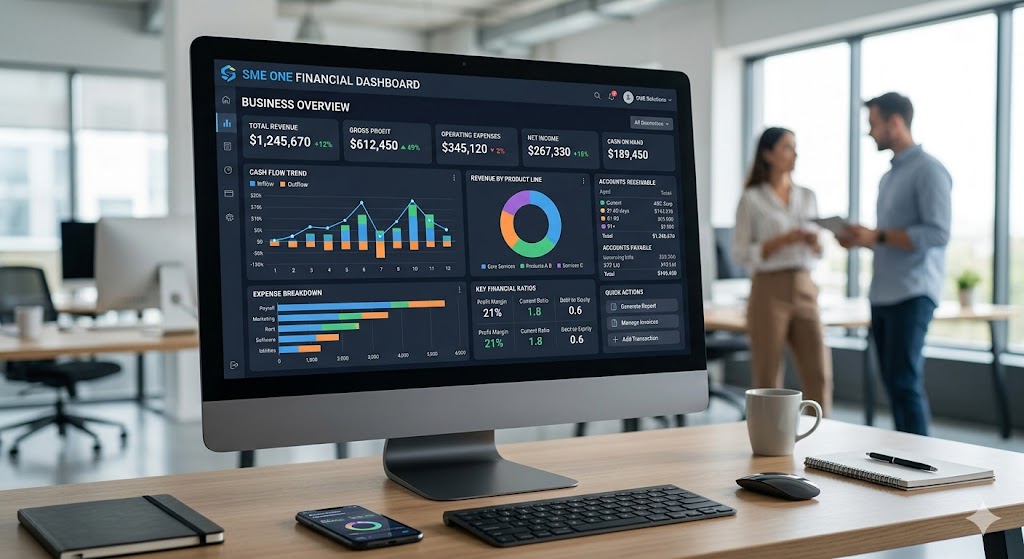
Building one financial dashboard for SMEs addresses this issue at its core.
It consolidates payroll, accounting, cashflow, and business performance data into a single, unified system that provides real-time financial reporting, clear KPI tracking, and a structured foundation for data-driven decision-making.
Amergin works with Irish SMEs and growing businesses that want to move beyond fragmented reporting and build integrated financial systems. Amergin positions itself as an integrated partner across accounting, payroll, finance, marketing, operations, and advisory. This integration is essential because financial clarity does not come from isolated reports. It comes from connecting the systems that drive the business and presenting them in a way that supports understanding.
The hidden cost of fragmented financial reporting
Fragmented financial reporting is one of the most common and least recognised challenges within SMEs. As businesses grow, they adopt systems to solve specific problems. Payroll software is introduced to manage compliance and employee payments. Accounting platforms are implemented to track income, expenses, and statutory reporting. Additional tools are layered in to support forecasting, budgeting, or operational tracking.
Over time, this creates a network of systems that hold valuable information but do not communicate effectively with each other.
The result is a reporting environment where data is technically available but practically difficult to use. Understanding business performance requires extracting information from multiple sources, aligning it manually, and interpreting it without a unified framework. This not only consumes time but also increases the likelihood of errors and inconsistencies.
The cost of fragmentation is not always visible.
It appears in delayed decisions, missed insights, and reduced confidence in financial reporting. It creates a situation where leadership is working harder to understand the business, rather than focusing on improving it.
A single financial dashboard eliminates this inefficiency by bringing all relevant data into one structured view.
Creating a single source of truth for financial data
At the core of any effective financial dashboard is the concept of a single source of truth.
This means that all key financial data, including revenue, expenses, payroll costs, tax obligations, and cashflow, is consolidated into one central system that provides consistent and reliable information. Instead of relying on separate reports that may present slightly different figures, the business operates from one unified dataset.
This consistency is critical for decision-making.
When everyone within the organisation is working from the same information, communication improves and alignment becomes easier. Financial discussions are based on shared understanding rather than interpretation, and decisions can be made with greater confidence.
A single source of truth also simplifies reporting processes.
Rather than generating multiple reports and reconciling differences, the business can rely on one dashboard that reflects accurate, up-to-date information.
Real-time financial visibility changes how SMEs operate
Traditional financial reporting often focuses on historical performance. Monthly or quarterly reports provide insight into what has already happened, but they do not always support immediate decision-making. By the time an issue is identified, the opportunity to respond may have already passed.
A financial dashboard introduces real-time financial visibility.
It allows businesses to see how key metrics are evolving as events occur, rather than waiting for period-end reports. Revenue trends, payroll costs, cashflow movements, and profitability indicators are all visible in real time, providing a dynamic view of business performance.
This level of visibility transforms how SMEs operate.
Instead of reacting to past performance, leadership can respond to current conditions. If labour costs begin to increase relative to revenue, this becomes visible immediately. If cashflow tightens, it can be addressed before it creates operational pressure. If performance deviates from expectations, adjustments can be made quickly.
Real-time reporting shifts the business from reactive to proactive management.
Integrating payroll into financial reporting
Payroll integration is one of the most critical elements of building a comprehensive financial dashboard.
Labour cost is typically one of the largest expenses in an SME, yet it is often treated separately from financial reporting. Payroll systems calculate wages, taxes, and contributions, but without integration, this data may not be fully reflected in financial analysis.
Integrating payroll into the dashboard ensures that labour cost is visible in context.
This includes not only gross salaries but also employer PRSI, statutory contributions, and additional employment costs. When these elements are incorporated into financial reporting, businesses gain a clearer understanding of their true cost structure.
This integration also supports better analysis.
Businesses can track labour cost as a percentage of revenue, monitor trends over time, and assess the impact of hiring decisions on profitability. Without this visibility, labour cost remains a standalone figure rather than a strategic metric.
KPI tracking turns data into insight
A financial dashboard is not simply a collection of numbers.
Its value lies in its ability to present key performance indicators that reflect the health and direction of the business.
Effective KPI tracking allows SMEs to monitor critical metrics such as profitability, cost efficiency, revenue growth, and cashflow stability. These indicators provide a structured way to assess performance and identify trends that may not be immediately obvious from raw data.
For example, tracking gross margin alongside labour cost can highlight whether increased revenue is being offset by rising costs. Monitoring cashflow alongside payroll obligations can reveal potential liquidity risks. Observing revenue trends in relation to operational capacity can inform growth decisions.
KPI tracking transforms data into actionable insight.
Strengthening cashflow management through visibility
Cashflow is often one of the most pressing concerns for SMEs, and it is directly influenced by both payroll and operational costs.
A financial dashboard enhances cashflow management by providing clear visibility into inflows and outflows. It allows businesses to see when payments are expected, when obligations are due, and how these elements interact over time.
This visibility is particularly important for managing payroll.
Payroll represents a recurring financial commitment, and any changes in labour cost can have a direct impact on cashflow. By integrating payroll data into the dashboard, businesses can ensure that these obligations are fully reflected in cashflow projections.
Improved visibility leads to better planning and reduced financial stress.
Real-life example: clarity through integration
An Irish SME had access to detailed financial data across multiple systems, but struggled to gain a clear understanding of overall performance.
Payroll was processed accurately, accounting reports were produced regularly, and additional analysis was carried out in spreadsheets. Despite this, leadership found it difficult to connect the data and identify trends.
Amergin implemented a unified financial dashboard that consolidated payroll, accounting, and cashflow data into one system.
The result was immediate improvement in visibility.
Leadership could see how labour cost affected margins in real time, track performance against key metrics, and make decisions with greater confidence. Reporting became more efficient, and the business gained a clearer understanding of its financial position.
The transformation did not come from new data.
It came from connecting existing data.
Simplicity ensures long-term success
The effectiveness of a financial dashboard depends on its usability.
A system that is overly complex or difficult to interpret is unlikely to be used consistently. The goal is not to display as much data as possible, but to present the most relevant information in a clear and accessible way.
Simplicity ensures that the dashboard becomes part of daily operations.
It allows users to understand performance quickly, identify key trends, and take action without unnecessary complexity. A well-designed dashboard focuses on clarity, structure, and usability.
Consistency in use is what creates lasting value.
How Amergin supports financial dashboard development
Amergin helps Irish SMEs design and implement financial dashboards that align with their specific needs and operational structure.
This involves integrating payroll and accounting systems, defining relevant KPIs, structuring financial data for clarity, and ensuring that the dashboard supports real-time decision-making. The focus is on creating a system that reflects how the business operates and provides meaningful insight into performance.
By building integrated financial dashboards, Amergin ensures that businesses move beyond fragmented reporting and gain a clear, unified view of their financial position.
The deeper truth: clarity is created through connection
Financial clarity is not achieved by increasing the volume of data.
It is achieved by connecting the data that already exists and presenting it in a structured way. When systems operate independently, insight is limited. When they are integrated, understanding improves.
Connection is what transforms information into knowledge.
The takeaway
Building one financial dashboard for SMEs is a strategic step toward improving financial visibility, control, and decision-making.
For Irish SMEs, the goal is not simply to produce reports. It is to create a system that brings together payroll, accounting, and performance data into one coherent view that supports real-time insight.
A unified financial dashboard provides clarity, improves reporting accuracy, strengthens cost control, and enables data-driven decision-making. Strong businesses do not rely on disconnected systems.
They build integrated ones. Because when financial data is clear, decisions become stronger. And when decisions are stronger, the business is better positioned to grow.
About Amergin Consulting Ltd.
Amergin Consulting Ltd. is a Dublin-based chartered accountancy and business advisory firm serving Ireland’s SMEs and growth companies across construction, technology, professional services, and renewable energy.
We specialise in Accounting, Payroll, Taxation, and CFO Services that help businesses build stronger foundations for profit and compliance.
Need help running a year-end tax review or planning your 2026 changes?
Amergin Consulting’s finance and tax team can help you identify deductions, forecast cash flow, and ensure full compliance before the year closes.
Book your 30-minute FREE consultation: https://calendly.com/amergin-group_free/30min-finance-consultation
Disclaimer
This article is for general informational purposes only and does not constitute financial or tax advice. While every effort has been made to ensure accuracy, legislation may change upon enactment of the Finance Act 2025.
Public should seek professional advice tailored to their specific circumstances before acting on any points discussed.
Sources and Resources
Amergin Consulting – Integrated Financial & Marketing Consulting for Irish SMEs and Growing Businesses
https://amergin.ie
Revenue Commissioners – Payroll Reporting and Financial Compliance
https://www.revenue.ie
Department of Enterprise, Trade and Employment – SME Digital and Financial Tools
https://enterprise.gov.ie
Companies Act 2014 (Ireland) – Financial Reporting Requirements
https://www.irishstatutebook.ie
Harvard Business Review – Data-Driven Decision-Making and Business Performance
https://hbr.org
MIT Sloan Management Review – Digital Transformation and Financial Analytics
https://sloanreview.mit.edu